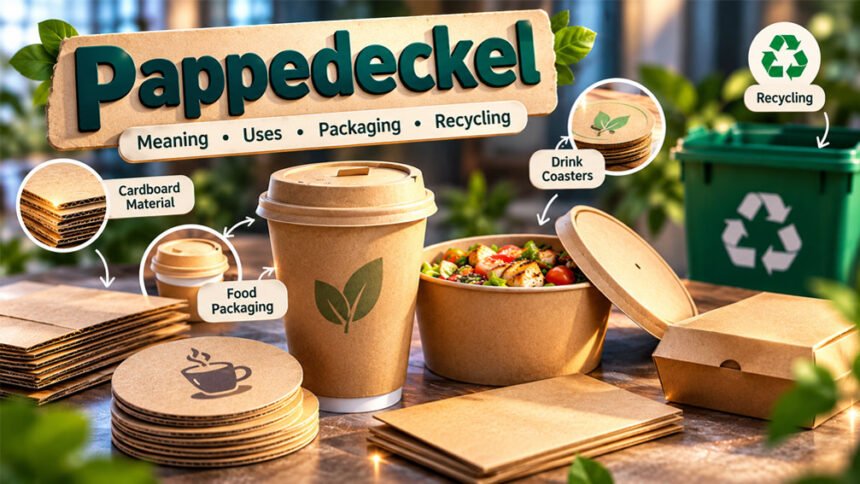
Pappedeckel is a German word linked with cardboard and paperboard. You may find different meanings for this word online. It can mean cardboard, a piece of cardboard, a cover, a lid, packaging material, or sometimes a cardboard coaster.
The exact meaning depends on where the word is used. This guide explains what Pappedeckel means, where the word comes from, how cardboard is made, its common uses, food packaging, recycling, and other useful facts.
What Is Pappedeckel?
Pappedeckel is mainly a word for cardboard or paperboard. It can describe the material itself or something made from it.
For example, a flat piece inside a box may simply be called a piece of cardboard. If it closes a container, it may be called a cardboard lid or cardboard cover. It can also be used for packaging inserts and backing cards.
This is why Pappedeckel does not always mean “cardboard lid.” Its meaning depends on the object and how the word is being used.
Pappedeckel Meaning in German
The word becomes easier to understand when we look at its two parts.
Pappe means cardboard or firm paper-based material. Deckel usually means a lid or cover. So, a direct translation can sound like “cardboard lid.”
However, the real meaning can be wider. Related German words can simply mean a piece of cardboard.
Because of this, Pappedeckel can be translated as cardboard, piece of cardboard, cardboard cover, or cardboard lid. The best translation depends on the situation.
Pappedeckel, Pappdeckel, and Pappendeckel
There are several similar spellings that can cause confusion.
Pappdeckel and Pappendeckel are standard German forms. Both are connected with cardboard or a piece of cardboard.
Pappedeckel is also a real form, but it is more closely linked with regional German. It has been recorded in Alemannic German, which is spoken in parts of southwestern Germany and other German-speaking areas.
Other regional forms include Pabbedeggel and Babbedeckel. Regional words often have different spellings and pronunciations.
So, Pappedeckel should not simply be called an online spelling mistake. It has a regional background, although Pappdeckel and Pappendeckel are more common in standard German.
Why Pappedeckel Can Have Different Meanings
The meaning of Pappedeckel changes with the situation.
In packaging, it may mean a cardboard cover, backing, separator, or insert. In a school or craft project, it may simply mean a firm piece of cardboard.
In food packaging, the word may be used for a paperboard lid on a cup, bowl, tub, or takeaway container. In a café or bar, it may also be linked with a cardboard coaster placed under a drink.
There is also an unusual regional meaning. In some German dialects, related words can refer to a driver’s license. German also uses Pappe informally for a driving license.
This is why context is important. Looking only at a direct online translation may not always give the correct meaning.
How Pappedeckel Is Made
There is no single way to make every Pappedeckel product. The process depends on the type of cardboard and what it will be used for.
Paperboard can be made from new wood fibers, recycled paper, or a mix of both. The fibers are mixed with water to make pulp. This pulp is formed into sheets, pressed, and dried.
Several layers can be joined together when stronger or thicker board is needed. The surface can also be printed, colored, or coated.
The board is then cut or shaped for its final use. A simple packaging insert may only need to be cut. A food lid may need special edges so it can fit securely on a cup or bowl.
Some products also have a thin coating to protect them from water, oil, or grease. These coatings can affect how the product should be recycled or thrown away.
Common Types of Cardboard and Paperboard
Different types of cardboard are made for different jobs.
Folding board is often used for boxes and other packaging. It is light but strong enough to hold its shape.
Greyboard is thicker and stronger. It is often used for rigid boxes, notebook covers, models, and similar products.
Corrugated board has a wavy layer between flat sheets. This makes it stronger and useful for shipping boxes and protective packaging.
Coaster board is made to absorb water from glasses. For this type of board, absorbing moisture is more important than keeping water out.
This is why businesses need to choose the right material. Cardboard that works well as a coaster may not work well as a food lid.
Everyday Uses of Pappedeckel
Cardboard and paperboard are used in many everyday products.
Packaging is one of the most common uses. Cardboard can separate products inside a box, support an item, protect it, or stop things from moving during delivery.
It can also be used as a backing card, cover, insert, or protective layer. Gifts, stationery, cosmetics, household goods, and small electronic products often use paperboard packaging.
At home, clean cardboard can be reused for drawer dividers, labels, photo backing, document covers, and storage protection.
It is also useful for school and craft projects. Cardboard can be cut, painted, folded, and glued. People use it for models, signs, masks, picture frames, handmade books, and templates.
Shops can also use it for price cards, product displays, signs, and backing boards.
However, normal untreated cardboard does not handle water very well. Moisture and repeated bending can quickly damage it.
Pappedeckel in Food Packaging
Pappedeckel is sometimes used online for cardboard or paperboard lids used with food and drinks.
These lids can be used on coffee cups, soup bowls, noodle tubs, dessert containers, bakery packs, and other takeaway packaging.
A lid needs to fit the container correctly. A lid that is the right size but does not grip the rim properly may still come loose.
The type of food also matters. Hot soup creates steam and heat. Greasy food may need a special grease-resistant layer. Cold food can create moisture and condensation.
Some paperboard lids therefore have thin protective coatings. These can help the lid stay firm when it comes into contact with water, steam, or oil.
Food safety is also important. Normal craft cardboard should not automatically be used with food. Cardboard made for direct food contact should use suitable materials, inks, glue, and coatings.
Businesses should test a lid with the real container before using it. They should check how it handles heat, moisture, carrying, and normal travel.
Pappedeckel and Drink Coasters
Pappedeckel can also be linked with cardboard drink coasters.
A coaster sits under a glass. It can absorb some of the water that forms around a cold drink and help protect the table from small spills, scratches, and marks.
However, Pappedeckel and Bierdeckel are not exactly the same.
Bierdeckel is the more specific German word for a beer or drink coaster. Pappedeckel has a wider meaning linked with cardboard.
A cardboard drink coaster can fit both meanings. However, a cardboard packaging insert is not a Bierdeckel.
History of Cardboard Drink Coasters
Cardboard drink coasters have been used for more than a century.
Historical information from the University of Würzburg says Friedrich Horn’s cardboard factory and printing business near Magdeburg was cutting and printing cardboard drink coasters in 1880.
Another important development came in 1892, when Robert Sputh registered an invention linked with molded wood-fiber coasters.
Paper-based board worked well for coasters because it could absorb water from glasses. It was also easy to print, which later made it useful for advertising.
These dates are about the history of cardboard drink coasters. They are not the origin dates of the word Pappedeckel.
Printing and Branding Uses
Cardboard is easy to print on. Businesses can add logos, names, QR codes, short messages, designs, and disposal information.
Cafés and restaurants may print their logos on lids or coasters. Food businesses can also add simple recycling instructions. Event organizers can print names, dates, or messages.
Drink coasters have also been used for advertising for many years. Breweries and other businesses have printed their names and promotions on them.
Some old coasters are now collected. Their designs can show old business names, brewery brands, local events, advertising styles, and printing methods.
Benefits of Pappedeckel
One main benefit of cardboard and paperboard is that they are light and easy to use. They can be cut, folded, shaped, and printed in many ways.
They are also easy to store. Flat cardboard pieces can take up little space before they are used or shaped into packaging.
Paperboard is useful for branding because businesses can print directly on it. Logos, instructions, and simple designs can often be added without needing another label.
Paperboard may also replace some traditional plastic products. For example, some food businesses may use a paperboard lid instead of a plastic one.
However, the full product should always be checked. Some paperboard products have coatings or other added materials.
Limits of Cardboard and Paperboard
Cardboard also has some clear limits.
Normal untreated cardboard does not work well with a lot of water, oil, or moisture. It can become soft, bend, or lose its shape.
Thin cardboard can also crush or fold under pressure. Printed areas may become worn after a lot of handling.
Special coatings can make cardboard more resistant to water and grease. However, these coatings can sometimes make recycling more difficult.
Storage matters too. Paperboard products should normally be stored in a clean and dry place. Too much moisture can damage them before they are used.
Pappedeckel vs. Plastic Lids
Paperboard and plastic lids have different benefits.
Plastic lids usually handle water and moisture well. They can be useful for liquids, oily foods, and cold products that create condensation. Clear plastic also lets customers see the food inside.
Paperboard lids can reduce the amount of traditional plastic used in some packaging. They are also easy to print with logos and information.
However, paperboard is not automatically better for the environment. Some paper lids contain coatings or other materials that make recycling harder.
Businesses should look at the whole package, including the lid, container, coatings, labels, and local waste system.
Is Pappedeckel Compostable?
Some paperboard products are compostable, but not all of them.
A product may contain glue, ink, plastic layers, or special coatings. These materials can affect whether it can be composted.
There is also a difference between industrial composting and home composting. Industrial facilities use controlled conditions. A home compost pile works differently.
Businesses should check the supplier’s information before saying a product is compostable. They should also check whether local waste services accept it for composting.
Can Pappedeckel Be Recycled?
Clean and plain cardboard can often be recycled with other paper products.
However, food, grease, plastic layers, wax, and waterproof coatings can make recycling more difficult. Some products may need to go into a different waste bin.
Plastic, tape, or metal parts may also need to be removed when possible.
Recycling rules are different from place to place. For this reason, local recycling instructions should always be checked.
Environmental Impact and Reuse
Paperboard is made from paper fibers, but this does not mean every paperboard product is good for the environment.
Making cardboard uses raw materials, water, and energy. Printing, coatings, transport, and other production steps also have an environmental impact.
The way a product is made matters too. Plain cardboard may be easier to recycle than packaging made from several materials joined together.
Clean and strong cardboard can sometimes be reused. It may work as a packing divider, craft material, template, backing sheet, or protective layer.
Wet, mouldy, greasy, or badly damaged cardboard should not be reused around food or personal items.
It is also important to remember that recyclable, biodegradable, and compostable are different things. A product may be recyclable without being compostable.
How to Choose the Right Pappedeckel
Start by thinking about what you need the cardboard for.
For normal packaging, check the size, thickness, shape, and strength. The board should be strong enough to protect or support the product.
For food lids, check the fit carefully. Put the lid on the real cup, bowl, or container. Lift and carry it to see if it stays secure.
Also test heat and moisture. Hot soup, coffee, cold desserts, and dry bakery foods all need different types of packaging.
For food use, check that the material is suitable for contact with food. Ask the supplier about coatings, barriers, and disposal instructions when needed.
For drink coasters, absorbency is important. The board should absorb moisture while staying firm enough to support the glass.
Businesses should also think about price, storage, order size, and supply. Custom printed products may need larger orders and more production time.
Testing a small order first can help businesses check the quality before buying a large amount.
Common Misunderstandings About Pappedeckel
One common mistake is thinking Pappedeckel always means cardboard lid. It can mean this, but its regional meaning is wider and can simply refer to cardboard.
Another mistake is calling Pappedeckel an incorrect internet spelling. The word has been recorded in regional German. Pappdeckel and Pappendeckel are the related standard forms.
It is also not correct to say Pappedeckel always means a beer coaster. Bierdeckel is the more specific German word for a beer or drink coaster.
Another common mistake is thinking all cardboard can be recycled or composted. Coatings, glue, ink, grease, and other materials can change how a product should be thrown away.
The easiest way to understand Pappedeckel is to look at the context and the object being described.
Bottom Line
Pappedeckel is a regional German term mainly linked with cardboard and paperboard. Pappdeckel and Pappendeckel are closely related standard German forms.
The exact English meaning depends on the situation. It can mean cardboard, a piece of cardboard, a cover, packaging material, or another cardboard item.
Cardboard is used for packaging, food lids, crafts, displays, and drink coasters. It is light, easy to print, and easy to shape. However, water, grease, coatings, and rough handling can affect it.
When choosing a Pappedeckel product, think about what it will be used for. Check its strength, fit, food safety, coatings, moisture resistance, and local recycling or composting rules.
Frequently Asked Questions
What does Pappedeckel mean in English?
Pappedeckel usually means cardboard or paperboard. It can also mean a cardboard cover or lid.
Is Pappedeckel a real German word?
Yes. Pappedeckel is used in some regional German areas. Pappdeckel and Pappendeckel are more standard forms.
What is the difference between Pappedeckel and Pappdeckel?
Pappedeckel is mainly a regional form. Pappdeckel is a standard German word linked with cardboard.
Does Pappedeckel mean a beer coaster?
Not always. It can refer to a cardboard coaster, but Bierdeckel is the more common German word for a beer coaster.
Can Pappedeckel mean a driver’s license?
Yes, in some regional German use, related words can mean a driver’s license. It depends on the area and context.
Is Pappedeckel used for food packaging?
Yes. Pappedeckel can be used for paperboard lids and packaging, but food packaging should be made for food use.
Can Pappedeckel be recycled?
Clean cardboard can often be recycled. Coatings, grease, and food waste may affect recycling.
Is Pappedeckel compostable?
Some types may be compostable, but not all. It depends on the materials, coatings, and local composting rules.
More To Explore: