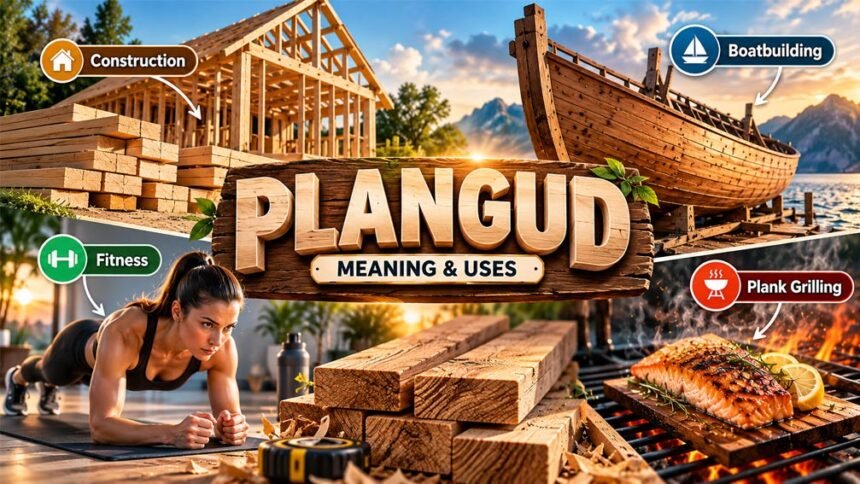
Plangud is an Estonian word that usually means “planks” in English. It mainly refers to thick wooden boards used for building, flooring, fences, furniture, and other wood projects.
The word can also appear in boatbuilding and fitness. Some websites also connect Plangud with planning and productivity. However, there is no clear proof of an official Plangud planning app or system.
This guide explains the meaning of Plangud, its different uses, and why the word can be confusing online.
What Does Plangud Mean?
Plangud is the Estonian plural form of plank. In simple English, it means “planks.” It usually refers to thick wooden boards.
The singular form means one plank. Plangud means more than one plank.
The word does not tell you what type of wood is being used. For example, two products called plangud may be made from different types of wood.
Their size, quality, finish, moisture level, and treatment can also be different.
Plangud also does not mean that every plank can be used for the same job. A plank made for furniture may not be suitable for outdoor building or heavy structural work.
The meaning can also change with the subject. In boatbuilding, it can mean wooden hull planks. In fitness, it can refer to plank exercises.
Why Is There Confusion About Plangud Online?
Searching for Plangud online can bring up very different answers.
Some websites describe Plangud as a planning or productivity system. They connect it with goals, tasks, workflows, project management, and tracking progress.
However, stronger language evidence shows that plangud is an Estonian word meaning planks.
There is no clear evidence in the information we collected of an official Plangud planning company, developer, app, launch date, pricing plan, or known productivity method.
Part of the confusion may come from the spelling. Plangud looks a little like the English words “plan” and “planning.” This may be one reason some websites connect it with productivity.
However, there is not enough reliable information to say exactly how this online meaning started.
A company could still use Plangud as a brand or product name. But such a company or product would need to be checked separately.
Plangud in Construction and Woodworking
Wooden planks are used for many building and woodworking jobs.
They can be used for floors, fences, decks, walls, platforms, shelves, benches, furniture, and other wooden structures.
The right plank depends on the project.
For example, a plank used for a shelf may be different from one used for an outdoor deck. A wooden tabletop may be chosen for its color and grain, while building timber may need to meet certain strength rules.
The type of wood is also important. Different types of wood have different levels of strength, weight, hardness, and resistance to moisture.
Plangud does not describe one particular type of wood.
Wooden planks can also be sold in different conditions. Some are rough, while others have smooth surfaces. Some are dried or treated before they are sold.
For heavy or load-bearing work, you should not choose wood only because it looks strong or thick. The timber should meet the correct requirements for the project.
Plank Thickness, Size, and Strength
One Estonian dictionary description explains a plank as a thick board of around 5 to 10 centimetres.
However, this does not mean every plank has to be this size.
Wooden planks are sold in many different thicknesses, widths, and lengths. The size depends on the product and its intended use.
The strength of a plank also depends on more than thickness.
The type of wood, grain, knots, cracks, moisture, quality, and other defects can all affect its strength.
This means a thick plank is not always safe for heavy building work.
For structural projects, the timber should meet the correct requirements for the weight and job it will handle.
Buyers should also check whether the listed size is for rough wood or finished wood. Planing and cutting can make the final plank slightly smaller.
Types and Conditions of Wooden Planks
Wooden planks can be sold in several different conditions.
Rough-sawn planks still have a rough surface from the cutting process. They may need sanding or other work before they can be used for furniture or visible indoor projects.
Planed planks have been worked to make their surfaces smoother. Planing can make the wood slightly smaller, so check the finished measurements.
Kiln-dried planks have been dried in controlled conditions to reduce moisture. However, the wood can still gain moisture again during storage or use.
Preservative-treated planks have been treated to help protect them in certain conditions. The correct treatment depends on where the wood will be used.
Reclaimed planks are pieces of wood that were used before. They may be useful for new projects, but they should be checked for damage, old coatings, hidden metal, or other problems.
A plank can fit more than one of these descriptions. For example, it may be both kiln-dried and planed.
This is also why buyers should not compare planks by price alone. A cheap rough plank may need extra work before it can be used.
Plangud for Flooring, Fencing, and Outdoor Projects
Wooden planks are often used for floors and fences.
For flooring, it is important to check whether the wood is actually made for floor installation. A normal rectangular plank is not always ready to be used as flooring.
Flooring products may have special shapes, fixing systems, moisture requirements, and installation instructions.
Wooden planks are also commonly used for fences. They can be placed vertically or horizontally depending on the design.
Outdoor wood needs extra care because it may face rain, moisture, insects, soil, and changing weather.
Decks, fences, garden structures, and outdoor seats may need wood that has been chosen or treated for outdoor use.
Wood that stays above the ground may also need different protection from wood that touches soil.
Building rules and timber standards can differ between countries. Always check the product information and local requirements before using wood for an important project.
Moisture and Timber Quality
Wood can take in moisture from the air and lose moisture when the air becomes dry.
These changes can affect the shape and size of a plank.
Wood may shrink, swell, bend, twist, or crack when its moisture level changes.
Kiln drying helps reduce moisture, but it does not mean the wood will stay dry forever. Storage, transport, and weather can change its moisture level again.
For some projects, it can be useful to check the current condition of the wood before cutting or installing it.
There is no single moisture level that is right for every project. The right condition depends on the type of wood, location, weather, thickness, and how the plank will be used.
Quality also depends on other things.
Knots, cracks, splits, uneven edges, bending, and damage can affect how useful a plank is.
Some natural marks may be fine for decorative furniture. For structural work, however, the wood should meet the proper requirements.
Plangud in Traditional Boatbuilding
Wooden planks have been used to build boats for a very long time.
Before materials such as fiberglass became common, many boat hulls were made from carefully shaped wooden planks.
In this context, plangud can refer to the boards that form the outside of a wooden boat.
The pieces must fit together carefully so the boat remains strong and keeps water out.
Traditional boatbuilders also had to understand how wood bends, how moisture affects it, and how the planks should be fixed together.
Two well-known ways of arranging wooden hull planks are clinker and carvel construction.
Clinker vs Carvel Construction
Clinker and carvel are two ways of joining wooden planks when building a boat hull.
In clinker construction, one plank overlaps the edge of another plank. This creates visible raised lines along the outside of the boat.
This method has a long history in Northern European boatbuilding.
In carvel construction, the planks meet edge to edge instead of overlapping. This creates a smoother outside surface.
Both methods need careful work. The planks must be shaped and fitted correctly so the hull stays strong and keeps water out.
The best method depends on the type of boat, its design, the materials, and the building style being used.
Plangud in Fitness
Plangud can have a completely different meaning in fitness.
In Estonian fitness content, it can refer to planks, the bodyweight exercise.
A plank involves holding your body in a stable position. Unlike exercises that involve repeated movement, the basic plank is mainly about holding your body still and controlled.
The exercise works several parts of the body. The stomach and other core muscles are important, but the back, shoulders, hips, and other muscles also help keep the body stable.
If Plangud appears with words such as workout, core, exercise, or fitness, it is probably talking about plank exercises rather than wooden boards.
How to Do a Basic Plank
A basic forearm plank starts with your forearms and toes on the floor.
Keep your elbows under or close to your shoulders.
Try to keep your body in a straight and controlled position. Do not let your hips drop too low or rise too high.
Keep your head and neck in a comfortable position. Continue breathing normally while holding the plank.
Good form is more important than trying to stay in the position for a very long time.
Beginners can place their knees on the floor. This makes the exercise easier while still helping them practice the correct position.
As strength improves, they can move to the normal forearm plank.
Plangud and Plank Grilling
Wooden planks can also be used for cooking. This is called plank grilling.
Food is placed on a suitable wooden plank and cooked on a grill. As the plank gets hot, it can give the food a smoky flavor. It can also help keep delicate food away from direct flames.
Cedar is a common choice for plank grilling, especially for fish. Alder can give food a lighter smoky flavor. Other suitable woods may include oak, maple, and hickory.
Not every piece of wood is safe for cooking.
Construction wood may contain chemicals, preservatives, glue, paint, or other treatments that should not touch food.
Use wooden planks that are sold or confirmed as safe for cooking. Grilling planks are also often soaked in water before use to help stop them from burning too quickly.
How to Choose Wooden Planks
Start by deciding what you want to build.
Wood for a shelf may be different from wood needed for a deck, floor, fence, or structural part of a building.
Check the wood species. Plangud does not tell you which type of tree the wood came from.
Check the thickness, width, and length. Also find out whether these are rough measurements or the final measurements after planing.
Look at the wood carefully when possible.
Check for cracks, splits, large knots, uneven edges, twisting, and other damage. These problems may reduce the amount of wood you can actually use.
Appearance can also matter for furniture and indoor projects. The color and grain of the wood may become part of the finished design.
For outdoor projects, check that the wood and its treatment are suitable for the weather and location.
For structural work, do not choose timber only because it looks thick or strong. Make sure it meets the correct requirements for the project.
How to Compare Plank Prices
There is no single price for plangud.
The cost depends on the type of wood, size, quality, treatment, preparation, amount ordered, seller, and location.
Suppliers can also use different pricing methods. Timber may be sold per plank, linear metre, square metre, or cubic metre.
Make sure you are comparing the same measurement.
For a rectangular plank:
Face area = width × length
When both numbers are in metres, the answer will be in square metres.
To calculate volume:
Volume = thickness × width × length
Use metres for all three measurements if you want the answer in cubic metres.
Also think about waste.
Some parts of a plank may need to be cut away because of cracks, damaged ends, or other problems.
Other costs can include delivery, cutting, planing, treatment, finishing products, fixings, and waste removal.
This means the cheapest plank is not always the cheapest option for the finished project.
Is Plangud a Planning App or Productivity Method?
Some websites describe Plangud as something related to planning, productivity, organization, or project management.
These articles may talk about choosing a goal, breaking it into smaller tasks, setting priorities, tracking progress, and changing plans when needed.
These are common planning ideas. However, there is no clear evidence in the information we collected that they belong to an official system called Plangud.
We could not confirm an official Plangud planning company, developer, launch date, app, subscription plan, or recognized planning method.
Some websites also call Plangud a platform, tool, method, system, or mindset. These different descriptions should not be treated as proof of one official product.
For this reason, claims about Plangud software, prices, downloads, integrations, or special features should be checked before being treated as facts.
A company could use Plangud as a product name now or in the future. If that happens, the product should be researched separately from the Estonian word.
How to Understand Plangud From Context
The easiest way to understand Plangud is to look at the words around it.
If the page talks about wood, timber, floors, fences, decks, furniture, or boards, it probably means wooden planks.
If it talks about boats, hulls, clinker, or carvel, it probably means planks used to build a boat.
If you see words such as workout, core, exercise, or fitness, Plangud may mean plank exercises.
If a page talks about goals, tasks, productivity, planning, or workflows, it may be using the planning meaning found on some websites. This meaning should be checked carefully because there is no clear proof of an official Plangud planning system.
Looking at the full sentence and topic is usually the easiest way to understand the correct meaning.
Bottom Line
Plangud is an Estonian word that mainly means “planks” in English. It usually refers to wooden planks or thick timber boards.
These boards can be used for construction, floors, fences, woodworking, outdoor projects, and traditional wooden boats. Their size, wood type, quality, and treatment can be different depending on the product.
Plangud can also mean plank exercises when it appears in fitness content.
Some websites describe Plangud as a planning or productivity system. However, there is no clear evidence in the information we collected of an official Plangud planning app, company, or recognized method.
The best way to understand Plangud is to look at the context in which the word appears.
Frequently Asked Questions
What does Plangud mean in English?
Plangud means “planks” in English. It is an Estonian word.
Is Plangud an Estonian word?
Yes. Plangud is an Estonian word used for wooden planks.
What are plangud used for?
Plangud can be used for floors, fences, furniture, building, and wooden boats.
How thick are plangud?
One dictionary describes planks as about 5–10 cm thick, but sizes can vary.
Are plangud used in boatbuilding?
Yes. Wooden planks are used to build the outer parts of boat hulls.
Does Plangud also mean a fitness exercise?
Yes. In fitness, Plangud can also mean plank exercises.
Is Plangud a planning app?
There is no clear proof that Plangud is an official planning app or software.
Why does Plangud have different meanings?
Its meaning depends on the context. It can relate to wood, boats, fitness, or unconfirmed planning ideas.
More To Explore: