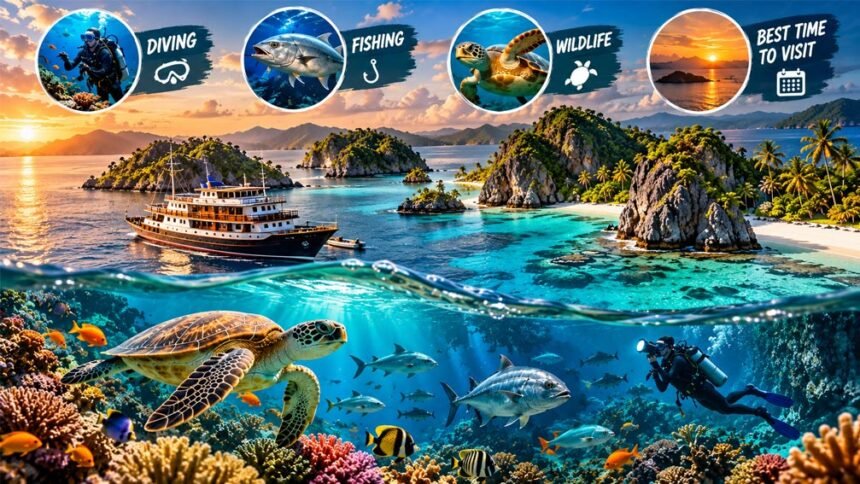
Lucipara is a remote group of small islands and coral reefs in Indonesia’s Banda Sea. It is part of the Maluku region and is far from the country’s main tourist areas.
People visit Lucipara mainly for diving, fishing, sea turtles, coral reefs, and other marine life. There are no large resorts or normal tourist services, so most visitors travel by liveaboard boat.
This guide explains where Lucipara is, how to get there, what wildlife lives there, and the best time to visit.
Where Are the Lucipara Islands?
The Lucipara Islands are in the Banda Sea in eastern Indonesia. They are part of the Maluku Islands, also called the Moluccas.
Lucipara is about 200 kilometers south of Ambon. One source places it at around 5.49° south and 127.54° east.
Lucipara is not one large island. It is a group of small islands, sandy areas, reefs, and shallow reef flats surrounded by deep water.
Sources describe the group in different ways. Some connect Lucipara with the Maisel Islands, including Pulau Selatan, Pulau Kaurangka, and Pulau Mai. Other sources include more small islands from the Maisel and Penyu groups.
The name also has several older or different spellings. These include Lucepara, Lousapara, Lucapin, and Lusipari.
Lucipara is also within the Coral Triangle, a large marine region known for its many coral and fish species.
Why Is Lucipara So Remote?
Lucipara is far from large cities and busy tourist areas. There is no airport or regular tourist ferry on the islands.
There are also no large hotels, resorts, shopping areas, or normal tourist centers. Visitors need a boat that can carry food, water, fuel, safety equipment, and other supplies.
The boat journey from Ambon can take around 15 hours. Travel time can change depending on the boat, weather, waves, and route.
Lucipara is often called uninhabited because it has no normal permanent community. However, one source says Pulau Mai has a small lighthouse with staff who work there for limited periods. Fishermen and people collecting coconuts have also visited the islands.
Reefs and Underwater Landscape
Much of Lucipara’s landscape is hidden below the sea.
The islands and reefs rise from very deep water. Reports describe them as the tops of large underwater mountains that rise from the ocean floor.
This creates steep underwater walls and deep drop-offs. Shallow coral reefs can quickly lead into very deep water.
The area has coral gardens, reef walls, channels, ridges, reef flats, and underwater pinnacles. These places provide homes and feeding areas for many marine animals.
Ocean currents bring food and nutrients through the reefs. Small fish gather around these areas, and larger fish often follow them.
Reports mention hard coral, soft coral, black coral, large sea fans, and barrel sponges.
A survey in November 2019 reportedly found no coral bleaching at the sites it checked. This does not mean that coral bleaching cannot happen in Lucipara.
Diving in Lucipara
Diving is one of the main reasons people visit Lucipara.
Divers can explore coral reefs, steep walls, deep drop-offs, underwater ridges, and pinnacles. Some dives start over shallow coral before reaching deep water.
Visibility can be very good when sea conditions are calm. However, currents, waves, and visibility can change with the weather.
Divers may see tuna, barracuda, giant trevally, Napoleon wrasse, turtles, reef sharks, and schools of smaller reef fish. Wildlife sightings are never guaranteed.
Night diving is also possible. One interesting fish reported in the wider Banda Sea is the flashlight fish (Photoblepheron bandanensis), which has light-producing organs below its eyes.
Visitors can also snorkel around shallower reefs. Some surveys have recorded large numbers of turtles during snorkeling trips.
There is no normal dive center on Lucipara. Diving is usually organized from a liveaboard or expedition boat.
Is Lucipara Suitable for Beginner Divers?
Lucipara is not an easy place to learn scuba diving.
Some dive sites have strong currents, waves, steep walls, and deep water. Medical help can also be many hours away.
Divers should be comfortable in moving water and have good control underwater. Experience with drift diving can be useful.
A good liveaboard should carry first-aid supplies, emergency oxygen, communication equipment, and other safety gear.
Beginners may be able to dive at easier sites with professional supervision. However, some sites are better for experienced divers.
Always check the operator’s diving requirements before booking.
Sea Turtles and Nesting Beaches
Lucipara is known for its sea turtles. Green turtles and hawksbill turtles have both been recorded around the islands.
Turtles use the reefs for feeding and resting. Some sandy beaches are also used for nesting.
A 2019 report recorded 470 green and hawksbill turtles during 14 snorkeling sessions. More than 80% were green turtles. Researchers also found many turtle tracks on the beaches.
Another source reports more than 1,100 turtles during a different trip or survey. These numbers should be kept separate because they may come from different studies.
Some reports also mention loggerhead turtles, but most of the information we found focuses on green and hawksbill turtles.
Visitors should not touch or disturb turtles. Bright lights and loud noise should also be avoided near nesting areas.
Plastic, fishing nets, ropes, and other waste can harm turtles or block nesting beaches. Visitors should take all their rubbish back with them.
Sharks, Whales, and Other Wildlife
Lucipara has many types of marine life.
Blacktip reef sharks and grey reef sharks have been reported around the reefs. Some sources also mention hammerhead sharks, but seeing them is never guaranteed.
Other reported animals include giant trevally, tuna, barracuda, Napoleon wrasse, snapper, surgeonfish, triggerfish, rays, sea snakes, and many smaller reef fish.
Seabirds also visit or nest on the islands. Reports mention lesser frigatebirds and red-footed boobies.
All these animals live freely in the wild. What visitors see depends on the season, currents, weather, food, and chance.
Blue Whales Around Lucipara
Blue whales have been reported in the wider Banda Sea.
The deep water, underwater mountains, and channels around the region may be used by whales as they move through Indonesian waters.
One expedition reported seeing around 10 or 11 blue whales while traveling through the area. This was one particular sighting and does not mean visitors will normally see this many whales.
Blue whale sightings are not guaranteed. Boats should also keep a safe distance and should never chase or block whales.
Fishing in Lucipara
Fishing is another activity around Lucipara. Its reefs, deep water, channels, and currents support several large fish species.
Giant trevally (GT) is one of the main fish targeted by anglers. It is often found around reef edges, channels, and moving water.
Other reported fish include dogtooth tuna, yellowfin tuna, bluefin trevally, barracuda, triggerfish, coral trout, snapper, and grouper.
Dogtooth tuna are often found around deeper reef areas. Triggerfish may be found around shallower reef flats.
Tides and currents can affect fishing. Fish may become more active when moving water brings food through channels and around reefs.
Fishing Methods
Popping is commonly used for giant trevally. Anglers cast surface lures around reefs and areas with moving water.
Jigging is used in deeper water. Anglers use heavy lures to target tuna and other large fish.
Saltwater fly fishing is also possible on shallow flats. Giant trevally and triggerfish are two possible targets.
Strong fishing equipment is important. Large fish can quickly swim toward coral and break fishing line.
People walking on reef flats should also wear suitable shoes because coral can be sharp.
Responsible Fishing
Visitors should check the latest fishing rules before fishing around Lucipara.
Some areas or species may be protected. Fishing rules can also change as conservation work develops.
Catch-and-release fishing can help reduce pressure on large fish. Fish should be handled for as little time as possible and returned to the water carefully.
Protected species should never be deliberately targeted.
How to Get to Lucipara
Most trips to Lucipara start in Ambon.
Travelers normally fly to Pattimura Airport in Ambon and then board a liveaboard or expedition boat.
Lucipara is about 200 kilometers south of Ambon. One expedition reported a boat journey of around 15 hours.
Travel time depends on the boat, route, weather, waves, and currents.
There is no normal public ferry or airport that takes tourists directly to Lucipara.
Many liveaboard trips combine Lucipara with the Banda Islands and other places in the Banda Sea. Some trips last around 10 or 11 nights, but the exact route and length depend on the operator.
Why Liveaboards Are the Main Way to Visit
There are almost no normal tourist services on Lucipara, so visitors usually stay on a liveaboard boat.
The boat provides sleeping rooms, meals, drinking water, fuel, diving equipment, and other supplies.
A good diving boat should also have first-aid supplies, emergency oxygen, communication equipment, and trained staff.
The crew should understand the weather, currents, and routes around the Banda Sea.
Visitors should choose an operator with experience in remote Banda Sea trips.
Best Time to Visit Lucipara
Weather is very important when planning a trip to Lucipara.
The Banda Sea is affected by monsoon winds. Some months can bring rain, strong winds, and rough seas.
The calmer periods between the monsoons are often better for visiting.
April to May is one commonly reported travel period. Another good period may be from mid-September to November.
These dates do not guarantee good weather. Wind, rain, waves, currents, and visibility can change quickly.
Liveaboard operators may change or delay a trip if conditions are unsafe.
What to Pack for Lucipara
Visitors should bring important items before leaving Ambon because there are almost no shops on Lucipara.
Useful items include:
- Diving and safety equipment
- Spare dive parts
- Reef-safe sunscreen
- Sun hat
- Sunglasses
- Light rain jacket
- Reusable water bottle
- Dry bag
- Motion-sickness medicine
- Personal medicines
- First-aid items
- Waterproof camera
- Reef shoes
- Insect protection
- Travel insurance documents
Anglers should also bring suitable fishing equipment and spare lines or leaders.
Ask the liveaboard operator what equipment is already provided before packing.
Safety and Travel Planning
Lucipara is far from hospitals and major ports. Good safety planning is important.
Choose a boat with experienced staff, reliable communication equipment, and proper emergency supplies.
Divers should check that emergency oxygen and first-aid equipment are available.
Travel insurance should cover the activities you plan to do. Divers should check whether their insurance covers scuba diving and emergency evacuation.
Weather can also change travel plans. A captain may cancel a crossing or choose another dive site if conditions become unsafe.
History of Lucipara
There is less written history about Lucipara than about larger islands in the Maluku region.
An early reference reportedly comes from American diplomat Edmund Roberts, who used the name “Lucepara” in an 1832 account.
Fishermen and coconut collectors have also visited the islands over the years. Some families reportedly have traditional connections to the area.
One source also reports a small lighthouse on Pulau Mai with rotating staff.
The Willem I Shipwreck
An important event in Lucipara’s history happened in 1837.
The Dutch steamship Willem I reportedly hit a reef near Lucipara in May while traveling toward Ambon.
Around 140 people were reportedly involved, including passengers, soldiers, crew members, and acting Moluccas governor François Vincent Henri Antoine de Stuers and his family.
The survivors reportedly stayed on a dry part of the reef for 37 days before being rescued.
Historical records also say De Stuers’ wife gave birth to a daughter while they were stranded.
Lucipara and Marine Conservation
Lucipara is important for marine conservation because of its coral reefs, turtles, fish, sharks, seabirds, and deep-water habitats.
It is also part of the Coral Triangle, which has a very high number of coral and reef fish species.
Government agencies, researchers, conservation groups, and local communities have worked on protecting the area.
Sources describe conservation plans covering more than 380,000 hectares, with one giving a figure of about 388,712 hectares.
Reports say the Maluku government included Lucipara in marine conservation planning in 2018. More reef surveys followed, including work in 2021.
In March 2026, conservation groups and Maluku authorities were reported to be working together on stronger protection for Lucipara.
Their reported plans continue through 2028.
However, conservation planning is not always the same as having full legal protected status. The latest official information should be checked before describing all of Lucipara as a fully established marine protected area.
Environmental Threats
Lucipara is remote, but it still faces environmental problems.
Plastic bottles, bags, fishing nets, ropes, and other rubbish can wash onto its beaches. This can be dangerous for turtles and other animals.
Illegal and harmful fishing is another concern. Methods such as blast fishing can kill fish and damage coral reefs.
Climate change can also affect Lucipara. Warmer sea temperatures can cause coral bleaching.
Poorly managed tourism could create more problems. Anchors can damage coral, while rubbish and careless visitors can disturb wildlife.
Lucipara’s remote location also makes it harder to watch and protect such a large marine area.
How to Visit Lucipara Responsibly
Visitors should avoid touching or standing on coral. Divers should control their movement carefully underwater.
Wild animals should not be chased, touched, fed, or surrounded. This includes turtles, sharks, whales, and seabirds.
Visitors should also stay away from turtle nests and follow instructions from guides.
All rubbish should be taken back on the boat. Nothing should be left on beaches or thrown into the sea.
Anglers should follow local fishing rules and respect protected species and areas.
Visitors should also respect fishermen and other people who use these waters.
Is Lucipara Worth Visiting?
Lucipara is mainly suited to people who enjoy remote sea travel.
Experienced divers can explore coral reefs, walls, deep water, and areas with many marine species. Anglers can target fish such as giant trevally and tuna.
However, Lucipara is not a normal beach resort destination.
There are almost no tourist services on land. The boat journey is long, and bad weather can change travel plans.
People looking for hotels, restaurants, shopping, nightlife, and easy transport may prefer other Indonesian destinations.
Lucipara is more suitable for people interested in diving, fishing, marine wildlife, and remote boat trips.
Bottom Line
Lucipara is a remote group of small islands and reefs in Indonesia’s Banda Sea. It is mainly known for diving, fishing, sea turtles, coral reefs, and marine wildlife.
Most visitors travel from Ambon by liveaboard boat. The trip requires planning because there are almost no tourist services on the islands.
Lucipara is also an important marine area. Visitors should follow local rules, avoid harming coral or wildlife, and help keep the islands and surrounding sea clean.
Frequently Asked Questions
Where is Lucipara?
Lucipara is in Indonesia’s Banda Sea. It is about 200 km south of Ambon.
How do you get to the Lucipara Islands?
First travel to Ambon. From there, visitors usually take a liveaboard or expedition boat to Lucipara.
Can you stay overnight on Lucipara?
There are no normal tourist hotels on Lucipara. Most visitors stay and sleep on a liveaboard boat.
Is Lucipara good for diving?
Yes. Lucipara has coral reefs, turtles, sharks, and many types of fish, but some areas have strong currents.
Is Lucipara suitable for beginner divers?
Some easier dive sites may be suitable for beginners with a guide. However, many sites are better for experienced divers.
What wildlife lives around Lucipara?
Lucipara has turtles, reef sharks, tuna, barracuda, trevally, reef fish, and seabirds. Blue whales are also sometimes seen in the wider Banda Sea.
When is the best time to visit Lucipara?
April to May and mid-September to November are often good times to visit. Weather and sea conditions can still change.
Is Lucipara a protected marine area?
Lucipara has several marine conservation projects and protection plans. Its exact legal protected status may change as these plans develop.
More To Explore:
What Is Viltnemnda? Norway’s Local Wildlife Management System