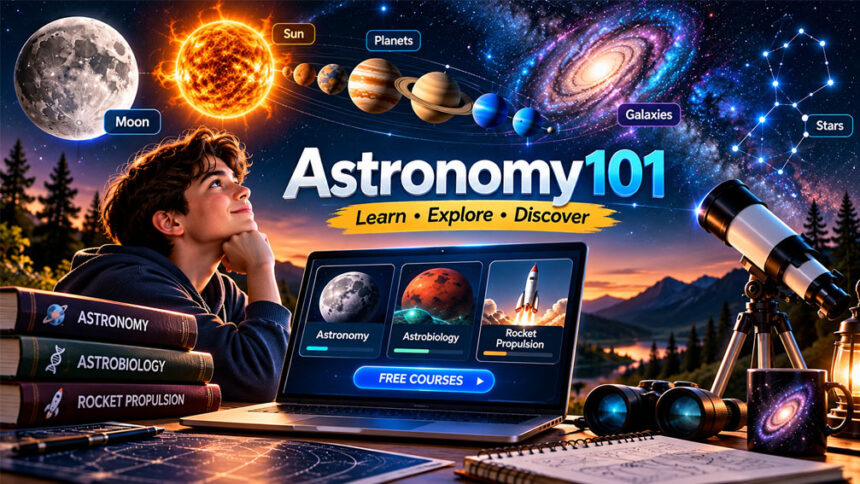
Astronomy101 is an online learning website for people who want to learn about astronomy and space. It offers beginner-friendly courses and articles about the Moon, planets, stars, galaxies, astrobiology, and other space topics.
The term “Astronomy 101” can also mean a basic astronomy course for beginners. This guide explains Astronomy101, its courses, and the main space topics that new learners should know.
What Is Astronomy101?
Astronomy101 is a website for learning about astronomy and space science. It is mainly designed to make space topics easier for beginners.
The website offers courses and educational articles. Learners can follow a course from the beginning or read about a specific topic that interests them.
There is also an important difference between Astronomy101 and Astronomy 101. Astronomy101 can mean the specific website. Astronomy 101 is also a common name for a basic astronomy course.
A normal beginner astronomy course may cover the Solar System, stars, galaxies, the universe, and ways scientists study space.
Astronomy101 can be useful for people who are completely new to astronomy. You do not need previous knowledge to start learning about the Moon, planets, stars, and other space objects.
Astronomy101 Courses and Learning Topics
The collected information lists three courses on Astronomy101: Astronomy, Astrobiology, and Rocket Propulsion.
The Astronomy course is a good starting point for beginners. It covers subjects such as the night sky, Sun, Moon, planets, stars, and smaller objects in the Solar System.
It also includes topics related to constellations and the properties of stars.
Astrobiology is the study of possible life in the universe. It connects astronomy with biology and planetary science.
Rocket Propulsion focuses on how rockets create the force needed to move. It is a more specialized topic but is still connected to space science.
The courses are reported to be free. The Astronomy course is also reported to offer a certificate after completion. These details can change, so users should check the website for the latest information.
The lessons are reported to work on phones and computers.
Beginners do not need to study everything at once. It is often easier to choose one topic, understand it, and then move to another.
Astronomy Basics Every Beginner Should Know
Astronomy is the science of studying space and objects beyond Earth.
It includes the Sun, Moon, planets, dwarf planets, asteroids, comets, stars, nebulae, galaxies, black holes, and many other objects.
Astronomers do more than look through telescopes. They collect information and use science, physics, mathematics, and computers to understand what happens in space.
Modern astronomy also studies different types of light and radiation. These include visible light, radio waves, infrared, ultraviolet, X-rays, and gamma rays. Each type can tell scientists something different about an object.
Astronomy is closely connected to astrophysics. Astrophysics uses physics and chemistry to explain how stars, planets, galaxies, and other space objects work.
Beginners do not need to understand all these subjects immediately. The Moon, Sun, and planets are easier places to start.
Understanding the Moon and Its Phases
The Moon is one of the easiest objects to observe in the sky. You can see it without a telescope, and its shape appears to change during the month.
The Moon does not make its own visible light. The light we see is sunlight reflected from its surface.
The Sun always lights half of the Moon. As the Moon travels around Earth, we see different amounts of this bright half.
This creates the Moon’s different phases, such as crescent, quarter, gibbous, and full Moon.
Earth’s shadow does not cause the normal Moon phases. Earth’s shadow is involved during a lunar eclipse, when the Moon moves into Earth’s shadow.
You can learn about Moon phases by watching the Moon every few nights. Write down the date, time, position, and shape you see. After several observations, you can notice how it changes.
You do not need a telescope for this. Binoculars or a telescope can show more detail, but your eyes are enough to understand the basic phases.
The Solar System and Its Eight Planets
The Solar System includes the Sun and all the objects that travel around it because of gravity.
There are eight planets: Mercury, Venus, Earth, Mars, Jupiter, Saturn, Uranus, and Neptune.
The Solar System also contains moons, dwarf planets, asteroids, comets, and many smaller objects.
Each planet is different. Venus has a thick atmosphere and is covered by clouds. Mars looks reddish. Jupiter is the largest planet in the Solar System. Saturn is famous for its rings.
Some planets are bright enough to see without a telescope. They can sometimes look like bright stars.
A sky map or astronomy app can help you find visible planets. If you watch them over time, you may notice that their positions change compared with the background stars.
Scientists also use spacecraft to study the Solar System. Missions such as Voyager, Juno, New Horizons, and Perseverance have collected information about planets, moons, and other objects.
Astronomy101 includes lessons about the Sun, planets, moons, and smaller Solar System objects.
Stars and How They Work
The Sun is a star. It looks much bigger and brighter than other stars because it is much closer to Earth.
Stars create energy through a process called nuclear fusion. In the Sun’s core, hydrogen joins together to form helium. This process releases a large amount of energy.
Stars are not all the same. They can have different sizes, colours, temperatures, masses, ages, and brightness levels.
A star’s colour can give information about its temperature. Blue stars are generally hotter than red stars.
Stars begin inside large clouds of gas and dust. Gravity pulls the material together. As it becomes hotter and denser, a star can eventually begin producing energy through nuclear fusion.
Stars also change as they get older. What happens to a star later in its life depends greatly on its mass.
Other stars look like tiny points because they are extremely far away. Proxima Centauri, the nearest known star to the Sun, is more than four light-years away.
Beginners can start by learning a few bright stars and easy star patterns. This makes it easier to find your way around the night sky.
Galaxies and the Wider Universe
A galaxy is a huge group of stars, gas, dust, and other matter held together by gravity.
Our Solar System is inside the Milky Way galaxy. The Sun is only one of the huge number of stars in the Milky Way.
The universe contains many other galaxies.
One well-known example is the Andromeda Galaxy. It is about 2.5 million light-years away. Under dark and clear skies, it may be visible without a telescope as a faint patch of light.
Scientists have also discovered thousands of planets outside our Solar System. These are called exoplanets.
Some scientists study exoplanets to understand how planetary systems form and whether some planets could have conditions suitable for life.
Cosmology is the study of the universe as a whole. It looks at how the universe began, how it is structured, how it expands, and how it changes.
A simple way to understand the scale is this: Earth is part of the Solar System, the Solar System is inside the Milky Way, and the Milky Way is one of many galaxies in the universe.
What Is a Light-Year?
A light-year measures distance, not time.
It is the distance light travels in one year. One light-year is about 9.5 trillion kilometres, or around 6 trillion miles.
Astronomers use light-years because distances in space are extremely large.
Light also takes time to travel. This means we see distant objects as they looked in the past.
For example, if a star is four light-years away, the light we see today started travelling toward us about four years ago.
The Andromeda Galaxy is around 2.5 million light-years away. This means the light we see from Andromeda today started its journey around 2.5 million years ago.
How Astronomers Study Space
People studied the sky long before telescopes existed. Early observers watched the Sun, Moon, planets, and stars. They used their observations to understand seasons, make calendars, and help with navigation.
Telescopes changed astronomy greatly. In the 1600s, Galileo Galilei used telescopes to observe Jupiter’s moons, the phases of Venus, and features on the Moon.
Today, astronomers use powerful telescopes on Earth and in space.
Different telescopes can study different types of light. Optical telescopes collect visible light. Radio telescopes detect radio waves. Other instruments study infrared, ultraviolet, X-rays, and gamma rays.
The Hubble Space Telescope has studied planets, stars, nebulae, and distant galaxies.
The James Webb Space Telescope (JWST) mainly observes infrared light. This helps scientists study distant objects and look through some clouds of space dust.
Other large astronomy projects include the Vera C. Rubin Observatory, Extremely Large Telescope, and Square Kilometre Array.
Scientists also study space without using normal light. Gravitational-wave detectors can find signals created by events such as black holes or neutron stars coming together.
Scientists can also study tiny particles called neutrinos.
Space probes are another important tool. They travel closer to planets, moons, asteroids, and other objects to collect information.
Using different signals such as light, gravitational waves, and particles together is called multi-messenger astronomy.
Stargazing for Beginners
You do not need expensive equipment to start stargazing.
The Moon is one of the easiest objects to watch. You can follow its changing phases over several nights.
Bright planets are also good targets. Some planets can easily be seen without a telescope.
You can also learn a few bright stars and simple constellations. Once you know them, they can help you find other objects.
A sky map or astronomy app can show what is visible from your location at a certain date and time.
A darker location is usually better for stargazing. Streetlights and buildings create light pollution, which makes faint stars harder to see.
Try observing the sky regularly. Write down the date, time, weather, and objects you see. This can help you notice changes.
You can also read an Astronomy101 lesson about an object and then try to find that object in the real sky.
Do You Need a Telescope?
No. You do not need a telescope to start astronomy.
You can see the Moon, many stars, some planets, and several star patterns with your eyes. Under very dark skies, some deep-sky objects can also be seen.
Binoculars can be a useful next step. They are often easier to use and carry than a telescope.
Binoculars can show more detail on the Moon and help you see star clusters and some faint objects.
A telescope is useful when you want a closer view of the Moon, planets, and other objects. However, beginners can first learn the night sky before spending money on advanced equipment.
Important Stargazing Safety Tips
Be especially careful when observing the Sun.
Never look directly at the Sun through normal binoculars or a telescope. Doing this can seriously damage your eyes.
Special equipment made for safe solar viewing is required. Normal sunglasses are not enough.
For nighttime stargazing, choose a safe place away from roads and other dangers.
Give your eyes some time to adjust to the dark. Bright phone screens and lights can make faint objects harder to see.
Learn how to use any equipment correctly before observing.
Common Astronomy Misconceptions
Some basic astronomy ideas are often misunderstood.
Astronomy and Astrology Are Different
Astronomy and astrology are not the same.
Astronomy is a science. It uses observations, measurements, mathematics, and scientific evidence to study space.
Astrology connects the positions of planets and stars with claims about people’s lives or personalities. It is not considered a science.
The Sun Is Not Burning Like a Fire
The Sun does not burn like wood or fuel on Earth.
It creates energy through nuclear fusion in its core. Hydrogen joins together to form helium, releasing energy.
Black Holes Do Not Simply Suck Up Everything
Black holes do not automatically pull in everything around them.
From far enough away, their gravity works like the gravity of another object with the same mass. An object normally has to come close enough for the black hole to strongly affect it.
Earth’s Distance From the Sun Does Not Cause the Seasons
Earth’s seasons are mainly caused by its tilt.
When one part of Earth is tilted toward the Sun, it receives more direct sunlight and has longer days. When it is tilted away, it receives less direct sunlight and has shorter days.
Changes in Earth’s distance from the Sun are not the main cause of summer and winter.
Space Exposure Is Often Shown Incorrectly
Movies sometimes show people instantly freezing or exploding in space.
Real exposure to space does not work exactly this way. A person would quickly lose consciousness because there is no breathable oxygen, but they would not instantly freeze or explode.
Why Learning Astronomy Is Useful
Astronomy helps us understand Earth and its place in the universe.
It helps scientists study how planets and stars form, how galaxies change, and how the universe developed.
Learning astronomy can also improve skills in science, mathematics, observation, and problem-solving.
Astronomy has practical uses too. Scientists study the Sun to understand space weather. Strong solar activity can affect satellites, communication systems, and some electrical systems.
Scientists also track asteroids that come close to Earth. This work is part of planetary defense.
Astronomy has also helped improve technology related to cameras, optics, computers, and data analysis.
Amateur astronomers can also help science. Some take part in citizen science projects, observe changing stars, study astronomy data, or report useful observations.
How to Learn With Astronomy101 Effectively
Do not try to learn everything at once.
Start with one simple question. For example, you could ask why the Moon changes shape or why stars shine.
Find a related Astronomy101 lesson or article. Read it and then try to explain the answer in your own words.
If something is still confusing, read that part again.
You can also connect your lessons with real observations.
For example, learn about Moon phases and then watch the Moon over several nights. Read about planets and then use a sky map to find one.
A simple learning plan is:
- Study one topic at a time.
- Write down the main points.
- Observe the object when possible.
- Keep notes about what you see.
- Use a sky map when needed.
- Review topics that are difficult.
You can start with the Moon and planets before moving to stars, galaxies, exoplanets, and cosmology.
If Astronomy101 currently offers a course certificate, it can show that you completed the course. However, understanding the lessons is more important than finishing them quickly.
Other Astronomy Learning Resources
Astronomy101 is not the only place to learn astronomy.
NASA provides educational information about planets, stars, galaxies, space missions, and new discoveries. Other space agencies also provide free educational material.
The Planetary Society provides information about planets and space exploration. Sky & Telescope offers guides for people interested in stargazing and amateur astronomy.
Sky-map tools can also help beginners.
Stellarium shows a digital view of the night sky for different places and times. Apps such as SkyView can help people identify stars, planets, and other objects.
Astronomy clubs and planetariums can also be useful. They may offer talks, observing events, demonstrations, and access to telescopes.
For new astronomy discoveries, it is better to check reliable sources such as space agencies, observatories, universities, and scientific research.
Bottom Line
Astronomy101 is a learning platform for people who want to understand astronomy and space science. The collected information lists courses in Astronomy, Astrobiology, and Rocket Propulsion, along with articles about space.
You do not need a telescope or advanced science knowledge to start. The Moon, bright planets, stars, and simple constellations are good first targets.
Start with one topic at a time. Learn the basic idea and then observe the sky when possible. As your knowledge grows, you can move from the Solar System to stars, galaxies, and the wider universe.
Frequently Asked Questions
What is Astronomy101?
Astronomy101 is a website that helps beginners learn about astronomy, space, planets, stars, and other space topics.
Is Astronomy101 free?
Yes, Astronomy101 is described as a free learning platform. Its courses are reported to be free to use.
What courses are available on Astronomy101?
Astronomy101 lists courses in Astronomy, Astrobiology, and Rocket Propulsion. Beginners can start with the Astronomy course.
Does Astronomy101 offer a certificate?
The Astronomy course is reported to offer a certificate after you complete it. Check the website for current details.
Is Astronomy101 suitable for complete beginners?
Yes. Astronomy101 explains basic topics such as the Moon, Sun, planets, stars, and night sky in a beginner-friendly way.
Do I need a telescope to start astronomy?
No. You can see the Moon, bright planets, stars, and constellations without a telescope.
What should I observe first?
Start with the Moon because it is easy to find. You can then look for bright planets, stars, and constellations.
What is the difference between astronomy and astrology?
Astronomy is the science of studying space and objects in it. Astrology connects stars and planets with people’s lives and is not a science.
More To Explore:
HQPotner Guide: Business Tools, Features, Benefits, and Risks