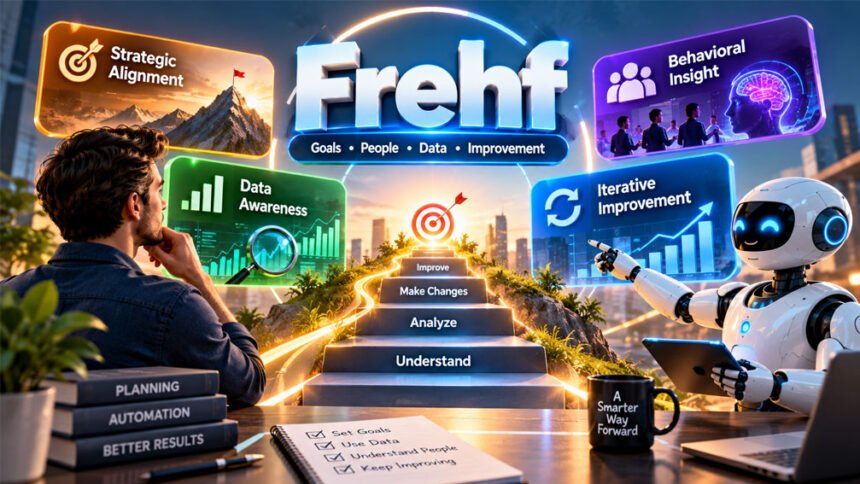
Frehf is an emerging framework that helps people and businesses organize goals, information, human behavior, and improvement.
The term can be confusing because different websites explain it in different ways. Some connect Frehf with AI and automation. Others connect it with business planning, productivity, and better decision-making.
The clearest version of Frehf has four main pillars: Strategic Alignment, Data Awareness, Behavioral Insight, and Iterative Improvement.
This guide explains what Frehf means, how it works, where it can be used, and how it connects with AI and automation.
What Is Frehf?
Frehf is a framework that helps people organize work and make better decisions. It connects clear goals with useful information, human behavior, and regular improvement.
A framework is a way of organizing how you think or work. It does not have to be a software program.
For example, a company may want to answer customer questions faster. Instead of buying new software immediately, it can first study the current process.
The company can find where delays happen, look at useful data, ask employees about problems, and test a small change.
It can then check the results. If the change works, the company can continue using it. If it does not work, another change can be tested.
Frehf is still an emerging framework. There is not enough evidence to call it a widely accepted academic, government, or international industry standard.
Its ideas may still be useful. However, readers should be careful with claims about guaranteed results or scientific proof.
What Does Frehf Mean?
The exact meaning of the name Frehf is not completely clear.
Some websites say FREHF means Future Ready Enhanced Human Framework.
Under this meaning, technology is used to help people rather than replace them in every task. Software can handle simple or repeated work, while people handle work that needs judgment, creativity, context, or responsibility.
This idea is often connected with AI and automation.
However, Future Ready Enhanced Human Framework is not clearly used as the official meaning across all available Frehf sources.
It is safer to say that some online sources use this meaning.
The clearest version of Frehf focuses on four main areas: Strategic Alignment, Data Awareness, Behavioral Insight, and Iterative Improvement.
This is also why different websites may explain Frehf differently. One website may focus on business and productivity, while another may focus on AI and automation.
The Four Main Pillars of Frehf
Frehf has four main pillars. Together, they help people understand goals, information, behavior, and improvement.
They can be explained with four simple questions:
- What do we want to achieve?
- What useful information do we have?
- How are people behaving?
- What should we improve next?
Strategic Alignment
Strategic Alignment means connecting a big goal with everyday work.
A company may have a good goal, but employees also need to understand how their work helps reach that goal.
For example, a business may want to answer customer questions faster. It should look at which employees handle customer requests, how requests are received, and where delays happen.
This can also help businesses find work that is no longer useful.
Some tasks continue simply because they have been done for years. If a task no longer provides enough value, it may need to be changed, removed, simplified, or automated.
Technology should help reach a useful goal. Using more technology should not be the goal itself.
Data Awareness
Data Awareness means using useful information to make decisions.
It does not mean collecting as much data as possible.
Too much information can make decisions harder. Businesses should focus on information that helps them understand a problem.
For example, a customer service team may look at response times, common complaints, unfinished requests, and customer feedback.
Data should also be reasonably accurate, current, and useful.
Problems can happen when different departments have different or outdated information. Information may also be spread across several systems.
Privacy is important too. Sensitive information should only be available to people who need it for their work.
Behavioral Insight
Behavioral Insight means understanding how people behave.
People can become tired, distracted, confused, or frustrated. Customers may also leave a website or process if it is too difficult.
These behaviors can show where a system has problems.
For example, a company may create a very long form for employees. The form may collect useful information, but workers may rush through it because it takes too much time.
In this case, the problem may be the design of the form.
Behavioral Insight looks at things such as workload, habits, motivation, communication, and ease of use.
Feedback from employees and customers can help businesses find problems that reports and numbers may not show.
Iterative Improvement
Iterative Improvement means making a change, checking what happens, and then improving again.
A company does not always need to make one huge change.
Small changes can be easier to test.
The process is simple:
Make a change → check the result → learn → improve again.
For example, a customer service team may change how customer requests are organized.
The team can then check response times, mistakes, customer feedback, and employee feedback.
If the new process works, it can continue. If it creates problems, the team can make another change.
This process can continue as customer needs, technology, employees, and business conditions change.
How Does Frehf Work?
Frehf works as a continuous process.
First, a person or business chooses a clear goal.
The goal could be faster customer service, fewer mistakes, easier information sharing, or less manual work.
The current process is then studied.
Teams can look for repeated work, delays, unnecessary steps, unclear responsibilities, and information problems.
They can also choose useful measurements to track progress.
The next step is to make a useful change.
For example, a company could remove an unnecessary step, change who is responsible for a task, improve access to information, or automate repeated work.
The results are then checked.
If the change works, it can stay. If it does not work, the team can learn from the result and try another change.
The four Frehf pillars work together during this process. Strategic Alignment sets the direction. Data Awareness provides useful information. Behavioral Insight looks at how people respond. Iterative Improvement helps the process become better over time.
Decision Ownership and Responsibility
A company can have useful information but still fail to take action if nobody knows who is responsible.
Decision ownership means deciding who reviews information, who makes the final decision, and who is responsible for the result.
Decision ownership is not one of the four main Frehf pillars. However, it can make the framework easier to use.
For example, a report may show that customer complaints are increasing. If several teams see the report but nobody is responsible for taking action, the problem may continue.
Clear responsibility becomes even more important when AI and automation are used.
AI can provide a recommendation, but a company still needs to know who is responsible for important decisions and mistakes.
Simple and low-risk tasks may need little human review. Important decisions involving health, money, employment, or other sensitive areas may need much stronger human oversight.
Frehf and Artificial Intelligence
Frehf is often connected with artificial intelligence because businesses are using AI for more everyday tasks.
AI can summarize documents, organize information, find patterns, sort customer requests, prepare first drafts, and handle repeated digital work.
A Frehf-style approach starts with the problem instead of starting with AI.
A business should first ask what it wants to improve. It can then decide whether AI can help.
For example, AI could sort incoming customer requests into different groups. Employees could then focus on difficult or sensitive requests.
The company should still check whether the AI is working correctly.
If the system repeatedly makes the same mistake, the company can study the problem and improve the process.
Frehf should not be called an official AI governance standard. Its ideas can simply help organizations think about how people, information, goals, AI, and automation work together.
Human Judgment and Automation
Computers are good at doing some tasks quickly.
They can process large amounts of information, repeat the same task many times, and follow clear rules.
People have different strengths.
Humans can understand context, show empathy, deal with unusual situations, use creativity, and take responsibility for decisions.
A good workflow can use both.
For example, software could search thousands of records and find unusual cases. A qualified person could then review those cases.
This is similar to a human-in-the-loop system. Technology handles part of the work, but a person remains involved when needed.
Not every automated task needs human approval.
Simple and low-risk tasks can sometimes be fully automated. For example, software may automatically move an approved document into the correct folder.
Important decisions may need more human review.
This can be especially important in healthcare, finance, employment, and other sensitive areas.
The goal is not to keep people involved in every small task. The goal is to use automation where it is useful and keep human judgment where it matters.
Frehf vs. Traditional Automation
Traditional automation usually focuses on doing a task with less manual work.
Software may move information, create reports, organize files, or process simple transactions automatically.
Frehf looks at the wider process.
It asks whether automation actually helps reach an important goal. It also looks at the data, people, responsibilities, and results.
This matters because automating a bad process does not always fix it.
For example, a company may have a ten-step approval process. Automating all ten steps could make it faster, but the process may still be too complicated.
The company should first ask whether all ten steps are needed.
Some steps could be removed. Some could be automated. An important approval could still be handled by a person.
Frehf treats automation as a tool, not the final goal.
Where Can Frehf Be Used?
Frehf principles can be used in different types of work. They may be useful for businesses, teams, and individuals.
The examples below are possible uses. They are not proven Frehf case studies.
Business and Office Work
Businesses can use Frehf to connect everyday work with larger goals.
Automation may help with reports, scheduling, document organization, data entry, and other repeated office work.
Employees can then spend more time on planning, customers, communication, and difficult decisions.
Logistics and Operations
Logistics includes both repeated and unexpected work.
Machines and software can help move products, process information, and track inventory.
People can handle damaged products, unusual orders, safety problems, and other situations that need judgment.
Healthcare
Healthcare organizations use technology to manage records, schedules, and other information.
AI may also help professionals review large amounts of information.
However, important medical decisions still need suitable professional oversight.
Frehf does not replace healthcare rules, medical standards, privacy requirements, or applicable laws.
Agriculture
Farmers can use sensors, drones, software, and other technology to collect information about crops, water, soil, weather, and field conditions.
This data can support decisions.
Farmers can combine this information with their own experience and local knowledge.
Content and Creative Work
Content teams can use AI and other tools to organize information, create summaries, analyze data, and manage repeated tasks.
Writers and editors can focus on facts, context, creativity, editing, and final quality.
Personal Productivity
Frehf can also be used for personal goals.
A person can choose a goal, look at useful information, study their habits, make a small change, and check the result.
This approach can be used for studying, saving money, managing time, and improving work habits.
How Businesses Can Implement Frehf
A business should start with a problem, not with new technology.
First, the team should decide what it wants to improve.
Next, it should study the current process. The team can look for delays, repeated work, unnecessary steps, information problems, and unclear responsibilities.
Useful measurements should then be selected.
After understanding the problem, the company can make a small change. It could simplify a process, change a responsibility, improve information access, or automate a repeated task.
Starting small can make testing easier.
Employee feedback should also be considered. A process may look good in a report but still be difficult for employees to use.
Training may be needed when new technology is introduced.
After testing the change, the company should check the results.
If the change works, it can be expanded. If it does not work, the company can study the problem and try another change.
Benefits of Frehf
Frehf may help people understand their goals and priorities more clearly.
It can also help teams focus on useful data instead of collecting information they do not need.
Behavioral Insight can help find problems that reports may miss. Feedback can show when employees or customers find a process difficult.
Automation may reduce repeated manual work. This can give people more time for planning, communication, creative work, and difficult problems.
Clear responsibilities can also make it easier to know who should take action.
Small changes may be easier to test than large changes.
However, these benefits are not guaranteed. Results depend on the company, its goals, people, data, technology, training, and how Frehf is used.
Challenges and Limitations of Frehf
Frehf is still an emerging framework. It does not have one definition that everyone accepts.
There also appears to be limited independent research that tests Frehf as a specific framework.
Many Frehf ideas are similar to ideas found in Lean, Agile, Human-Centered Design, Responsible AI, and other approaches.
Businesses can also face practical problems.
Poor data can lead to poor decisions. Unclear goals can make a project difficult. Employees may resist changes they do not understand.
Training and technology can also cost time and money.
Another problem is automating a bad process. Technology may make a poor process faster without fixing the real problem.
AI can also make mistakes, miss context, or produce biased results.
Frehf cannot solve these problems by itself. Good management, reliable information, suitable technology, training, and proper rules are still needed.
Privacy, Security, and Responsible Use
Privacy and security depend on the tools and information used with Frehf.
A company may work with customer records, employee information, financial details, or private business documents.
It should understand what information is collected, why it is needed, who can access it, and how it is protected.
Connecting different systems can improve information sharing, but it can also create security risks.
Companies should use suitable access controls, secure connections, monitoring, and other data protection methods.
Behavioral Insight also needs care.
Tracking employees too closely can create privacy and workplace concerns. Collecting more information does not always lead to better decisions.
AI systems can also produce unfair, incorrect, or incomplete results.
Important automated decisions should be checked when necessary.
Frehf does not replace privacy, cybersecurity, employment, healthcare, financial, consumer protection, or AI laws. Rules can be different depending on the country and industry.
Does Frehf Require Special Software?
There is no clear evidence that special Frehf software is required.
Its main ideas can be used with simple tools.
A person could use a notebook. A small business could use a spreadsheet. Larger organizations could use dashboards, project management tools, analytics software, automation services, communication platforms, and AI tools.
The important part is how the work is organized.
Readers should therefore be careful with claims that Frehf is a complete software platform.
A software product normally has clear features, prices, system requirements, updates, and supported devices.
A framework is different. It provides ideas or methods that can be used with many tools.
There is currently no reliable information confirming one standard Frehf application with fixed features, device support, or system requirements.
Is Frehf Free?
There is no confirmed requirement to buy a Frehf subscription to use its main ideas.
Reliable information does not currently show official Frehf monthly, yearly, premium, or enterprise pricing plans.
However, using Frehf ideas may still involve costs.
A business may pay for AI tools, project management software, automation services, analytics platforms, training, or consulting.
These are costs for separate tools and services. They should not automatically be called Frehf pricing.
Frehf vs. Other Work Frameworks
Frehf shares some ideas with other management and work frameworks.
However, they are not the same.
Frehf vs. OKRs
OKRs help organizations set objectives and measure results.
This is similar to Frehf’s Strategic Alignment pillar.
Frehf also looks at data, human behavior, and continued improvement.
A company could use both approaches together.
Frehf vs. Agile and Scrum
Agile focuses on adapting to change, teamwork, and regular improvement.
Scrum uses clear roles and repeated work cycles to manage complex projects.
Frehf also supports regular improvement, but it has a wider focus on goals, data, behavior, and learning.
Frehf vs. Lean
Lean focuses on reducing waste and improving processes.
This is similar to Frehf when teams remove unnecessary work or delays.
However, Frehf also focuses on strategy, data, human behavior, and continued improvement.
Frehf vs. Human-Centered Design
Human-Centered Design focuses on the needs and experiences of real users.
This connects closely with Frehf’s Behavioral Insight pillar.
Both approaches recognize that a system may fail if people find it difficult to use.
However, Human-Centered Design is its own established approach and should not be treated as another name for Frehf.
Frehf vs. Human-in-the-Loop and Responsible AI
Human-in-the-loop systems keep people involved when automated systems need human review.
Responsible AI focuses on areas such as fairness, safety, privacy, transparency, and responsibility.
Frehf can help businesses think about people and AI working together.
However, it should not replace proper AI governance, risk management, or legal requirements.
Are Frehf Productivity Claims Reliable?
Readers should be careful with exact numbers about Frehf productivity.
Some websites may claim that Frehf saves a certain number of hours or improves productivity by a specific percentage.
These numbers need strong evidence.
For example, a study may show that an automation tool saves employees time. This does not automatically prove that Frehf caused the improvement.
The same applies to research about AI, business, communication, agriculture, or workplace behavior.
Readers should check the original study and see what was actually tested.
Independent research specifically proving exact Frehf performance results appears limited.
It is safer to say that Frehf may improve productivity or decision-making rather than saying it will always produce a specific result.
The Future of Frehf
It is difficult to know whether Frehf will become a widely used framework because it is still emerging.
However, many of its main ideas are becoming more important.
AI can now process information, create content, complete digital tasks, and help people make decisions.
Businesses therefore need to decide which tasks should be automated and which should stay under human control.
Future AI systems may provide clearer explanations for their decisions. They may also make it easier for people to review, correct, or stop automated actions.
Privacy, security, fairness, safety, and responsibility will also remain important.
Human skills will still matter. Creativity, empathy, communication, responsibility, and judgment can remain important even when technology handles more routine work.
The future of the Frehf name is uncertain, but the idea of making people and technology work better together is likely to remain useful.
Bottom Line
Frehf is an emerging framework based on four main pillars: Strategic Alignment, Data Awareness, Behavioral Insight, and Iterative Improvement.
In simple words, it means setting clear goals, using useful information, understanding people, and improving over time.
Frehf can also be used when businesses work with AI and automation. Technology can handle suitable repeated tasks, while people remain involved when human judgment is important.
Special Frehf software does not appear to be required.
Frehf is also not currently a widely recognized academic or industry standard. Readers should be careful with claims about official software, pricing, guaranteed results, or exact performance improvements.
Frequently Asked Questions
What is Frehf?
Frehf is a framework that helps people and businesses manage goals, data, people, and improvement.
What does Frehf stand for?
Some websites say FREHF means Future Ready Enhanced Human Framework, but this meaning is not fully confirmed.
What are the four main pillars of Frehf?
The four pillars are Strategic Alignment, Data Awareness, Behavioral Insight, and Iterative Improvement.
How does Frehf work?
Frehf helps you set a goal, check useful information, make changes, and improve based on the results.
Is Frehf an AI framework?
Frehf can work with AI and automation, but it is not only about AI. It also focuses on goals, data, people, and improvement.
Does Frehf require special software?
No special software appears to be required. You can use Frehf ideas with simple tools, spreadsheets, or business software.
Is Frehf free to use?
There is no confirmed Frehf subscription or official pricing plan. Other tools used with it may cost money.
Is Frehf a recognized industry standard?
No. Frehf is still an emerging framework and is not currently a widely recognized industry standard.
More To Explore:
Motion Control AI Review: Uses, Privacy, and Commercial Rights