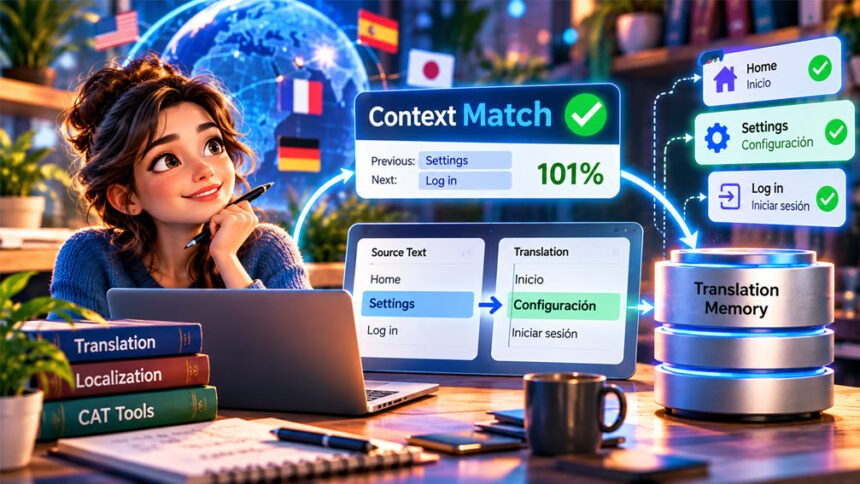
A context match is a strong match used in translation memory and computer-assisted translation (CAT) tools. It happens when new text matches old translated text and appears in the same context.
You may also see terms like 100% match, 101% match, ICE match, and fuzzy match. This article explains what a context match is, how it works, and why it is useful in translation.
What Is a Context Match?
A context match happens when new source text is exactly the same as text already stored in a translation memory. The context around the text must also match.
A segment is a small piece of text in a CAT tool. It can be a sentence, heading, button, label, or another piece of content.
A translation memory, or TM, stores old source text and its translation. When the same text appears again, the CAT tool can suggest the old translation.
A context match goes further than a normal exact match. It checks the text and also looks at where and how the text is being used.
A context match is often called a 101% match. However, different translation tools may use different names and rules.
Simple Context Match Example
Think about the word “Home.” On a website menu, it usually means the main page. In normal writing, it can mean the place where someone lives.
The word is the same, but its meaning can be different.
If “Home” appears in the same menu and around the same items as before, the CAT tool has more information. It can be more confident that the old translation still fits.
The same can happen with words such as “Open,” “Close,” and “Continue.”
How Translation Memory Finds a Context Match
Translation memory saves previous translations so they can be used again.
When a translator opens a new file, the CAT tool compares its text with the text stored in the translation memory.
If the new text is similar but not exactly the same, the tool may show a fuzzy match. If the text is exactly the same, it may show a 100% match.
For a context match, the tool checks something extra. It also looks at the context around the text.
For example, an old file may contain:
“Enter your name.”
“Click Next.”
“Review your details.”
If the same three lines appear in the same order in a new file, the tool has more reason to believe that “Click Next” has the same meaning and use.
Different CAT tools can check context in different ways. Some look at nearby sentences, while others may also use IDs, tags, or file structure.
What Information Can Count as Context?
Context can include the text before or after a segment. It can also include technical information stored inside a file.
The previous and next segments are common examples. If the same sentence appears between the same two sentences, the tool has more evidence that it is being used in the same way.
Segment order can also help. Text appearing in the same order may be easier for the tool to identify.
Some files contain string IDs or segment IDs. These IDs can help CAT tools identify where a piece of text belongs, especially in software and apps.
Context may also include tags, document information, formatting, file structure, or content type.
For example, the same words could appear as a heading, button, table cell, menu item, or normal sentence. Knowing where the words appear can help the tool understand their purpose.
Not every CAT tool uses the same information. Context rules depend on the software, file type, and project settings.
Context Match vs. 100% Match
A 100% match usually means the new source text is exactly the same as text stored in the translation memory.
A context match checks more. The text must match, and its context must also match.
For example, “Save changes?” could appear in profile settings, an account page, or a payment form.
A 100% match tells the translator that the same words were translated before. However, it does not always show that they were used in the same place.
A context match gives extra information about where the text appears. This can make the old translation more useful.
This matters in languages where gender, grammar, tone, or nearby sentences can change the correct translation.
Context Match vs. Fuzzy Match
A fuzzy match happens when new text is similar to an old translation but is not exactly the same.
For example:
Old: “Your order will arrive in 3 days.”
New: “Your order will arrive in 5 days.”
Most of the sentence is the same, but the number has changed. The translator needs to notice and update it.
A fuzzy match can contain different words, names, numbers, or punctuation. CAT tools often give these matches a percentage based on how similar the text is.
A context match is different. The source text is exact, and the required context also matches.
What Do 101%, ICE, and Perfect Match Mean?
A 101% match usually means the source text is exact and its context also matches.
The number does not mean the translation is really 101% accurate. It is simply used to show that the result has more information than a normal 100% match.
ICE means In-Context Exact. It is another term used for an exact match with matching context.
Perfect Match is a term used by some translation software for a stronger type of match. It can use old translated files and context information to find text that can be reused.
These terms do not always mean exactly the same thing in every CAT tool. The rules depend on the software.
What Is a 102% Context Match?
Some translation tools can check more than one type of context.
For example, memoQ can use nearby text and ID-based context. When both types of context match, the tool has more information about the segment.
This may be described as a double context match or a higher match level.
Terms such as 102% are linked to specific tools. They are not used by every translation system.
Why Context Matters in Translation
The same word can have different meanings depending on where it appears.
For example, “Close” can mean closing a window. It can also mean that something is nearby.
Short text can be especially difficult. Buttons, labels, menu items, alerts, and headings may contain only one or two words.
Context helps translators understand what those words mean.
It can also affect grammar. Some languages change words based on gender, formality, sentence order, or other nearby text.
A context match gives the translator more information before deciding whether an old translation can be used again.
Benefits of Context Matches
Context matches can save time because translators do not have to translate the same approved text again.
They can also improve consistency. Buttons, product terms, warnings, and instructions can stay the same across different files and updates.
For large projects, this can make translation easier to manage. Translators can spend more time on new or changed content.
Main benefits include:
- Less repeated translation work
- Faster translation
- More consistent wording
- Better use of old translations
- More focus on new content
- Easier project planning
- Less unnecessary review
These benefits depend on having a good translation memory. If the old translation is wrong, reusing it can repeat the same mistake.
How Context Matches Affect Translation Costs
Translation companies often use match levels when setting prices.
New text usually requires the most work. Fuzzy matches may need some editing. Exact matches usually need less work.
A context match may need even less work if the old translation is correct and approved. Because of this, some translation companies charge less for these segments.
There is no fixed price for a 101% match. The cost depends on the translation company, language, project, topic, and review rules.
Some projects still charge for checking context matches. Others may lock approved matches so translators do not need to work on them.
When a Context Match Can Still Be Wrong
A context match does not always mean the translation is correct.
The old translation may already contain a mistake. If that mistake stays in the translation memory, it can be reused again.
Words and product terms can also change over time. A company may update its style guide or preferred terms while old translations remain in the TM.
The product itself may also change. For example, a software button may do something different even though its text stays the same.
Some languages also need more context than the CAT tool can see.
For these reasons, a context match should be treated as a useful result, not a guarantee.
When Human Review Is Still Important
Some context matches still need human review.
This is especially important for legal text, safety instructions, health information, financial content, payment messages, and other important information.
Review may also be needed when a product, style guide, or important term has changed.
Some CAT tools or workflows can lock trusted matches. This can save time, but translators should still be able to check a segment when needed.
CAT tools can help find old translations, but human judgment is still important.
Best Uses for Context Matches
Context matches work best when content is repeated and the structure stays similar.
They are common in software and app translation. Apps often reuse buttons, menus, settings, error messages, and other short text.
Websites can also use context matches when pages are updated without major changes to their structure.
Technical manuals often reuse instructions, warnings, and other standard text. New versions may contain large parts of an older manual.
Context matches can also be useful for product catalogs, forms, support pages, training content, online stores, and standard legal or financial text.
Structured files can work especially well because they may contain stable IDs that help CAT tools identify the same text.
When Context Matching Is Less Useful
Context matching is less useful when content changes often.
Creative and marketing content may be rewritten regularly, so exact matches are less common.
Changing the structure of a file can also cause problems. If text moves or IDs change, the CAT tool may not recognize the old context.
Poor translation memory can also reduce the value of context matches. Old, incorrect, or duplicate translations can lead to poor results.
Some text needs information from the whole page or document. In these cases, the translator may need to look beyond the context provided by the CAT tool.
How to Improve Context Match Quality
A clean translation memory gives better results.
Wrong translations should be corrected. Old terms should be updated, and unnecessary duplicate entries should be removed.
Teams should use approved translations when possible. This makes future matches more reliable.
Keeping IDs, tags, templates, and file structure stable can also help CAT tools find the same content again.
Source text should be written consistently. If the same message has the same meaning, using the same wording can improve translation memory matches.
Translation memories should also be checked from time to time so old or incorrect information does not stay in the system.
Use Termbases and Style Guides
A translation memory and a termbase are different tools.
A translation memory stores translated segments, such as sentences and labels.
A termbase stores important terms and their approved translations. It may include product names, technical words, abbreviations, and other important terms.
A style guide gives rules for writing and translation. It may cover tone, punctuation, capitalization, and formality.
Using all three together can help teams keep translations clear and consistent.
Preserve Context During File Updates
Developers and content teams can also help improve context matches.
Stable string IDs are useful in software translation. If an old string gets a new ID without a good reason, the CAT tool may lose useful context.
File structure, tags, templates, and text order can also matter.
Files do not need to stay exactly the same forever. However, keeping useful IDs and structure when possible can help translation tools reuse old work.
This can reduce unnecessary translation during future updates.
Bottom Line
A context match happens when the same source text and its context match an older entry in translation memory.
It gives translators more information than a normal exact match. This can save time, improve consistency, and reduce repeated work.
However, context matches are only useful when the translation memory contains good information. Important content may still need human review.
Frequently Asked Questions
What is a context match in translation?
A context match happens when source text exactly matches an old translation memory entry and its context also matches.
Is a context match the same as a 101% match?
It is often called a 101% match. However, different CAT tools may use different names and rules.
What is the difference between a 100% and 101% match?
A 100% match means the source text matches exactly. A 101% match usually means both the text and its context match.
What is an ICE match?
ICE means In-Context Exact. It is an exact translation match that also has matching context.
What is a fuzzy match?
A fuzzy match is similar to an old translation memory entry but is not exactly the same. It normally needs to be checked and edited.
Does a context match always mean the translation is correct?
No. An old translation can contain mistakes or outdated terms. Important matches should still be checked when needed.
Do translators need to review context matches?
It depends on the project. Trusted matches may need little review, while legal, health, safety, or financial content may need careful checking.
Can context matches reduce translation costs?
Yes. They can reduce repeated work, so some translation companies charge less for them. The actual price depends on the project and provider.
More To Explore:
Lucipara Travel Guide: Diving, Fishing, Wildlife, and Best Time to Visit