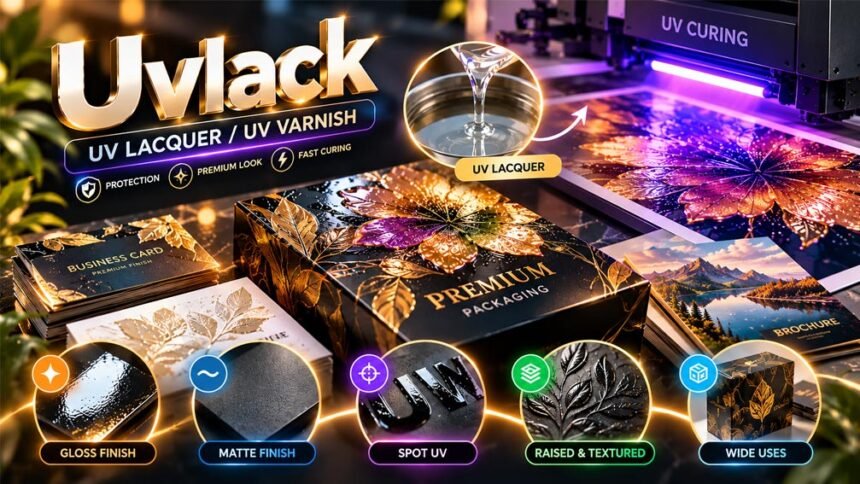
Uvlack is a term linked to UV lacquer or UV varnish. It is a coating used mainly in printing and packaging. UV light makes the coating hard very quickly.
There are different explanations of Uvlack online. Some sources connect it with UV varnish products, while others give unrelated meanings. This guide explains what Uvlack means, how UV curing works, where it is used, and what you should know about its safety.
What Is Uvlack?
Uvlack is linked to UV lacquer, also known as UV varnish or UV coating. It is a liquid coating that becomes hard when UV light shines on it.
In printing, UV lacquer is usually added over a printed surface. It can protect the print and also change how it looks.
UV coating and UV curing are well-known technologies. However, the word Uvlack is not used everywhere as a standard name. Some information also connects UVLACK with specific UV varnish products.
The name is often explained as a mix of UV, meaning ultraviolet, and lack, a word used for lacquer or varnish in German and some other European languages.
There are also very different descriptions online. Some websites call Uvlack software, a digital platform, or another type of technology. There is little clear evidence for these meanings.
For this reason, Uvlack is best understood in connection with UV lacquer and UV coating, while keeping in mind that the exact term is not used in the same way everywhere.
How Does UV Curing Work?
UV lacquer does not dry like normal paint or varnish. It becomes hard through a process called UV curing.
First, liquid UV lacquer is placed on a surface. A roller, screen, or another coating system can be used to apply it.
The material then moves under a UV light. The coating contains chemicals called photoinitiators. UV light activates these chemicals and starts a reaction that makes the coating hard.
The basic process is simple:
- Liquid UV lacquer is added to the surface.
- The material moves through a UV curing machine.
- UV light activates the coating.
- The liquid quickly becomes a solid layer.
- The finished material can move to the next production step.
This can happen very quickly with the right equipment. Some industrial UV coatings can cure in less than a second.
This fast curing is useful for printing companies. They do not have to wait a long time before cutting, folding, binding, or packing printed materials.
What Is UV Lacquer Made Of?
The exact ingredients depend on the product and manufacturer. However, UV coatings commonly contain oligomers, monomers, photoinitiators, and other additives.
Oligomers and monomers help create the main structure of the finished coating. They can affect how hard, flexible, or strong the final surface is.
Photoinitiators react to UV light. They start the chemical process that changes the liquid coating into a hard layer.
Other ingredients can change the look or performance of the coating. For example, some additives reduce shine, while others can improve resistance to rubbing and scratches.
Not every UV lacquer uses the same formula. Manufacturers can change the ingredients depending on the surface, equipment, and finish they want.
Types of UV Lacquer Finishes
UV lacquer is available in different finishes. Each one gives the surface a different look and feel.
Gloss UV
Gloss UV creates a shiny surface. It can make printed colors look brighter and stronger.
It is often used on packaging, labels, promotional materials, and other printed products.
Matte UV
Matte UV has less shine. It creates a softer and less reflective surface.
It is often used on packaging, book covers, cards, and other products where a strong shine is not wanted.
Spot UV
Spot UV is used only on selected parts of a design.
For example, a printer may add it to a logo, headline, image, or pattern while leaving the rest of the surface uncoated.
This creates a clear difference between the coated and uncoated areas. Spot UV is commonly used on business cards, book covers, and packaging.
Raised and Textured UV
Some UV coatings can create raised or textured surfaces.
A thicker coating can make words, logos, or patterns stand out. People may also be able to feel the difference when touching the surface.
The final effect depends on the coating, its thickness, and the equipment being used.
Spot UV vs Full UV Coating
Spot UV and full UV coating are different because they cover different amounts of the surface.
Spot UV covers only selected areas. For example, only the logo on a business card may have a shiny UV coating.
Full UV coating covers most or all of the surface. It can give the whole product a gloss or matte finish while also adding some protection.
Spot UV is useful for highlighting certain parts of a design. Full UV coating is better when the whole surface needs the same finish.
Where Is Uvlack Used?
UV lacquer is mainly used in printing and packaging.
It can be found on business cards, brochures, flyers, folders, postcards, book covers, labels, posters, product boxes, and other printed materials.
Packaging is a common use. A company may use full UV coating across an entire box or use spot UV only on its logo or product name.
UV-curable coatings can also be made for materials other than paper. These can include plastic, wood, metal, furniture parts, flooring, and some automotive or electronics parts.
However, these are uses of UV coatings in general. They may not be uses of every product sold under the Uvlack name.
The coating must also work with the surface. A UV lacquer made for paper may not work correctly on plastic or metal. Testing may be needed before a large production run.
Benefits of UV Lacquer
One of the biggest benefits of UV lacquer is fast curing. The coating can become hard very quickly under the right UV light.
This helps printing companies save production time. Printed products can move to cutting, folding, binding, or packing without waiting a long time for the coating to dry.
UV lacquer can also help protect a printed surface from scratches, rubbing, and normal handling.
It can improve appearance too. Gloss UV adds shine, matte UV reduces reflection, and spot or raised UV can make certain design parts stand out.
Some UV coatings also provide protection against light moisture. However, this does not mean every UV-coated product is waterproof.
UV coatings may also release fewer volatile organic compounds (VOCs) than some solvent-based coatings because much of the coating becomes part of the finished solid layer.
Limitations of UV Lacquer
UV lacquer is not suitable for every project.
Special equipment is needed to cure the coating. This means not every printing company can offer UV coating.
The coating also needs to match the material. Different types of paper, plastic, ink, wood, and metal may need different UV coating formulas.
Some coatings can crack if the material is folded or bent too much. This is why testing can be important for packaging and other folded products.
UV coating can also cost more than simple printing without a special finish.
Spot UV needs to be placed very carefully. If it does not line up correctly with the printed design, the finished product may not look right.
UV lacquer also does not always provide as much physical protection as lamination. Lamination may be better when a product needs stronger protection.
UV Lacquer vs Other Print Finishes
UV lacquer is only one way to finish printed materials.
| Finish | How It Works | Main Benefit | Main Limitation |
|---|---|---|---|
| UV lacquer | Hardens under UV light | Fast curing and many effects | Needs UV equipment |
| Aqueous coating | Water-based coating dries with air and heat | Good general protection | Different finish and durability |
| Traditional varnish | Dries through normal drying methods | Simple print finishing | Usually slower |
| Solvent-based coating | Solvent leaves the coating as it dries | Useful for some special jobs | Can release more VOCs |
| Lamination | Plastic film is added to the surface | Strong protection | Adds another material and process |
UV lacquer is useful when fast curing or special visual effects are important.
Lamination is often chosen when stronger physical protection is needed.
The right choice depends on the material, budget, design, production method, and amount of protection needed.
UV Coating vs UV Printing
UV coating and UV printing are not the same thing.
UV printing uses special ink that becomes hard under UV light. The UV light cures the ink soon after it is printed.
UV coating adds a clear layer over a printed or manufactured surface. This layer is normally used for protection, appearance, or both.
For example, a product box can first be printed with UV ink. A clear spot UV coating can then be added over its logo.
The printing creates the design. The coating adds the finishing effect.
Equipment Needed for UV Coating
UV coating needs equipment that can apply the liquid coating and cure it with UV light.
The coating may be added using rollers, screens, flexographic units, or special coating machines.
The curing system can use traditional UV lamps or newer UV-LED lights.
The coating must be made to work with the type of UV light being used.
UV coating can be done inline, meaning it happens as part of the main production line. It can also be done offline, where printed materials are moved to a separate coating machine.
The final result can depend on several things. These include coating thickness, UV light strength, machine speed, ink, material, and surface condition.
UV-LED systems can produce less heat and may use less energy in some production setups.
Is Uvlack Safe?
Safety depends on the type of coating and whether it is still liquid or fully cured.
Uncured UV coating is an industrial chemical product. Workers should follow the manufacturer’s safety instructions when using it.
Protective equipment and proper ventilation may be needed. UV curing machines should also have proper shielding because strong UV light can be harmful with direct exposure.
Once the correct coating is fully cured, it forms a solid finished layer designed for its intended use.
However, this does not mean every UV coating is safe for every purpose.
This is especially important with food packaging. A UV coating should only be used for food-related packaging when the specific product and production method meet the required safety rules.
Environmental Considerations
UV coatings can have some environmental benefits compared with certain solvent-based coatings.
Many UV coatings contain materials that become part of the finished solid layer. Less material needs to evaporate during curing. This can mean lower VOC emissions than some traditional solvent-based products.
Fast curing can also reduce the need for long drying periods.
UV-LED systems may use less energy and produce less heat than some traditional UV lamps.
However, this does not mean every UV coating is environmentally friendly. Its environmental impact also depends on the ingredients, electricity use, waste, material being coated, and production process.
How to Choose the Right UV Finish
Start by thinking about what you want from the finish.
If you want the whole product to shine, full gloss UV may be suitable. If you only want to highlight a logo or image, spot UV may make more sense.
You should also consider the material. Make sure the coating works with the paper, plastic, ink, or other surface being used.
Think about what will happen after coating. Folding, cutting, binding, and gluing can affect which coating works best.
For a large print job, testing a small sample first can be useful. Check the appearance, adhesion, curing, and resistance to rubbing.
For spot UV, also check that the coating lines up correctly with the printed design.
Physical samples can help when choosing between gloss, matte, raised, and textured finishes because these effects may look different on a screen.
Cost also matters. Premium UV finishes may be useful for packaging, business cards, covers, and marketing materials where appearance is important. Basic printed materials may not need them.
Why Is There Conflicting Information About Uvlack?
There are very different explanations of Uvlack online.
Some sources connect Uvlack with UV lacquer and UV coating. Other websites describe it as software, a digital platform, health technology, or even a possible brand name.
These meanings are very different.
What is clear is that UV curing, UV coating, UV lacquer, and UV varnish are real technologies used in industry.
The exact word Uvlack is less clear. It should not automatically be treated as the standard name for every type of UV coating.
There is also information connecting UVLACK with UV varnish product names, including standard and spot varnish products.
This is why context matters. If Uvlack is the name of a specific product, information from its manufacturer should be checked.
For general information about the technology, terms such as UV coating, UV lacquer, UV varnish, and UV curing are more useful.
Before buying or using a specific product, it is also useful to check its technical data sheet, safety information, supported materials, and curing requirements.
Bottom Line
Uvlack is mainly connected with UV lacquer or UV varnish. These coatings become hard quickly when exposed to ultraviolet light.
UV coatings are widely used in printing and packaging. They can add shine, create matte or textured effects, highlight parts of a design, and help protect printed surfaces.
They also need the right equipment, material, and curing setup.
The word Uvlack is not used as consistently as terms such as UV coating and UV lacquer. Readers should therefore be careful with unrelated meanings found online and check reliable technical or manufacturer information when researching a specific product.
Frequently Asked Questions
What does Uvlack mean?
Uvlack is a term linked to UV lacquer or UV varnish. It is mainly used for coating and finishing surfaces.
Is Uvlack the same as UV lacquer?
Uvlack is linked to UV lacquer, but the term is not commonly used as a standard name for all UV lacquers.
How does UV lacquer cure?
UV light starts a chemical reaction in the liquid coating. This quickly turns it into a hard layer.
How quickly does UV lacquer cure?
UV lacquer can cure in less than a second or within a few seconds with the right equipment.
What is spot UV?
Spot UV is a coating added only to selected areas, such as a logo, title, or image, to make them stand out.
Can UV coating be used on materials other than paper?
Yes. Some UV coatings can be used on plastic, wood, metal, and other suitable materials.
Is UV lacquer safe?
Fully cured UV lacquer is generally safe to handle. The liquid coating and UV equipment need proper safety measures during use.
Is UV coating better than lamination?
It depends on the use. UV coating adds visual effects, while lamination usually gives stronger physical protection.
More To Explore:
How Does MathsSpot Work? Roblox, Chromebooks, and Browser Gaming