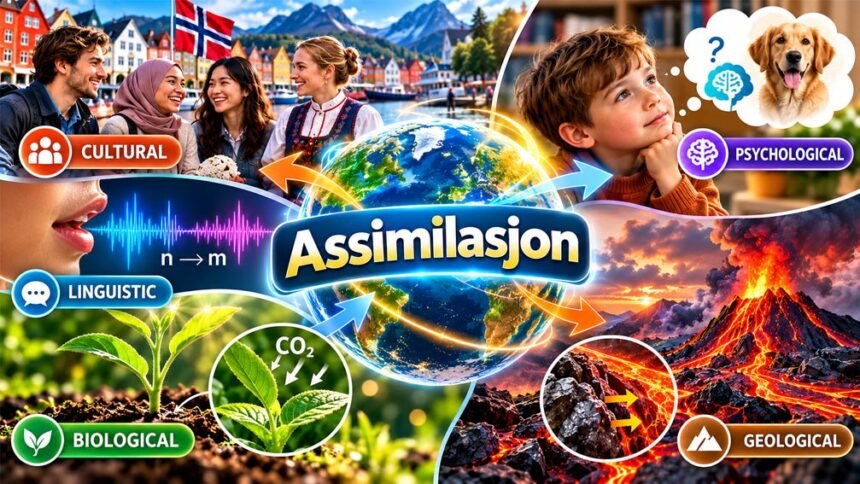
Assimilasjon is a Norwegian word that means assimilation in English. It describes how people, sounds, ideas, or materials change or become part of something else.
The word is used in culture, psychology, language, biology, and geology. This article explains what Assimilasjon means, its main types, benefits, challenges, and everyday examples.
What Is Assimilasjon?
Assimilasjon is a process in which something becomes similar to something else or becomes part of an existing system. Its meaning depends on where the word is used.
In society, it describes how people adopt another culture’s language and customs. In psychology, it explains how people understand new things using what they already know.
In linguistics, it describes changes in speech sounds. In biology, it explains how living things take in and use different substances.
Origin and Background of Assimilasjon
The word Assimilasjon comes from the Latin word assimilare, which means to make something similar.
It is an established word in Norwegian and Danish. Over time, it has developed different meanings in several subjects.
Psychologists use it to explain how people learn. Linguists use it to describe changes in pronunciation. Scientists use it to explain how living things use substances and how rocks interact with magma.
The word also has an important place in Norwegian history. It is connected with past government policies that pressured minority communities to adopt Norwegian language and culture.
Main Types of Assimilasjon
Assimilasjon has five main types discussed in this article. Each describes a different process, but all involve some form of change, similarity, or incorporation.
| Type | Meaning | Example |
|---|---|---|
| Cultural | Adopting another culture | Learning another country’s main language |
| Psychological | Understanding new things using existing knowledge | Recognizing a different breed of dog |
| Linguistic | Speech sounds becoming more similar | Pronouncing input like imput |
| Biological | Taking in and using substances | Using nutrients to build body tissues |
| Geological | Magma taking in material from surrounding rocks | Magma incorporating nearby rock material |
These types are used in different subjects. Understanding their differences helps explain what Assimilasjon means in each situation.
Cultural Assimilasjon and How It Works
Cultural Assimilasjon happens when people adopt the language, customs, and habits of another culture. It often involves people moving to a new country or living among a larger cultural group.
For example, someone moving to Norway may learn Norwegian, follow local customs, and develop friendships with local people.
Schools, workplaces, universities, neighborhoods, and social relationships can all influence cultural assimilation.
The process may continue across generations. Children may become more familiar with the surrounding culture than their parents.
However, adopting another culture does not always mean losing your original identity. People can follow new customs while keeping their family traditions and original language.
Voluntary and Forced Assimilasjon
Cultural assimilation can happen voluntarily or through pressure.
Voluntary assimilation happens when people choose to adopt another culture. They may learn a new language, make local friends, or follow different customs to make everyday life easier.
Forced assimilation happens when people are pressured to abandon their original language, beliefs, or traditions.
In the past, some governments used schools and laws to force minority communities to adopt the dominant culture.
Forced assimilation can cause language loss and weaken cultural traditions. Its effects may continue for several generations.
The main difference is freedom of choice. Voluntary assimilation involves personal choice, while forced assimilation involves pressure.
Assimilasjon in Norwegian History
Assimilasjon is an important part of Norwegian history because of a process called fornorsking, or Norwegianization.
Norwegianization involved government policies intended to make minority communities more Norwegian in their language and culture.
These policies affected Sámi, Kven/Norwegian Finnish, and Forest Finn communities.
Schools played an important role. Norwegian was strongly promoted, while minority languages faced restrictions and pressure.
Over time, these policies contributed to language loss and made it harder for some families to pass their traditions to younger generations.
Norway later established a Truth and Reconciliation Commission to study these policies and their effects.
The commission submitted its report to the Norwegian Parliament in June 2023.
In November 2024, the Norwegian Parliament apologized for its historical role in Norwegianization and accepted responsibility for the consequences of these policies.
This history shows how forced cultural assimilation can affect communities for many years.
Assimilasjon vs. Integration
Assimilasjon and integration are related, but they have different meanings.
Assimilation happens when people become more similar to another cultural group. Integration means taking part in society while keeping important parts of your original culture.
For example, someone moving to Norway may learn Norwegian, find a job, and make local friends while continuing to speak their original language at home.
This is an example of integration.
Two other related terms are acculturation and multiculturalism.
Acculturation describes cultural changes that happen when different groups have regular contact. Multiculturalism supports different cultures living together in the same society.
| Concept | Meaning |
|---|---|
| Assimilation | Becoming more similar to another culture |
| Integration | Taking part in society while keeping your cultural identity |
| Acculturation | Cultural changes caused by contact between different groups |
| Multiculturalism | Different cultures living together in one society |
These processes can happen together. People may adopt local customs while continuing to follow their family traditions.
Assimilasjon in Psychology
In psychology, Assimilasjon explains how people understand new things using knowledge they already have.
The idea is an important part of psychologist Jean Piaget’s theory of cognitive development.
Piaget explained that people organize knowledge into mental structures called schemas. These help us recognize objects and understand different situations.
When we experience something new, we often try to understand it using an existing schema.
For example, a child who knows what a dog looks like may recognize another breed of dog, even if it has a different size or color.
The child understands the new animal using existing knowledge. This process is called assimilation.
It helps people learn because they can connect new information with things they already understand.
Assimilation vs. Accommodation
Assimilation and accommodation are two important parts of Piaget’s theory.
Assimilation happens when new information fits what we already know. Accommodation happens when we need to change our existing understanding.
For example, a child may call a cat a dog because both animals have fur and four legs.
Later, the child learns that cats and dogs are different animals. The child must change their understanding to recognize the difference.
This is accommodation.
Both processes help people learn and develop a better understanding of the world.
Assimilasjon in Linguistics
In linguistics, Assimilasjon happens when one speech sound becomes more similar to another sound.
This usually happens during natural speech. Our tongue, lips, and other speech organs move quickly when we speak. Sometimes these movements overlap.
This overlap is called coarticulation. It can make certain sounds change during pronunciation.
For example, the Norwegian word tannbørste may sound closer to tambørste. The n sound changes toward m because the following b is made using the lips.
A similar change can happen in English. Some speakers pronounce input closer to imput.
These changes are a normal part of spoken language. They do not automatically mean someone is pronouncing words incorrectly.
Types of Linguistic Assimilation
There are several types of linguistic assimilation.
Regressive assimilation happens when a later sound changes an earlier sound. For example, the n in input may sound like m because of the following p.
Progressive assimilation happens when an earlier sound influences the sound that follows it.
For example, the English plural ending is pronounced /s/ in cats but /z/ in dogs. The sound before the ending affects its pronunciation.
Contact assimilation happens when two sounds are directly beside each other.
The Norwegian word kronprins may sound closer to kromprins. The n changes toward m because of the following p.
Distant assimilation happens when sounds influence each other even when they are separated by other sounds.
Vowel harmony in Turkish is one example. Some word endings change their vowels to match the vowel pattern of the main word.
Assimilation can also change different features of speech:
- Place assimilation: A sound changes where it is made in the mouth.
- Voicing assimilation: A sound changes depending on whether the vocal folds vibrate.
- Manner assimilation: A sound becomes more similar to another in how airflow is controlled.
In some Norwegian dialects, the sounds represented by rn in barn combine into one sound.
Assimilation is different from dissimilation. Assimilation makes sounds more similar, while dissimilation makes similar sounds less alike.
Assimilasjon in Biology
In biology, Assimilasjon describes how living things take in and use substances.
In humans, food must go through several processes before the body can use its nutrients.
Digestion breaks food into smaller parts. Absorption moves nutrients from the digestive system into the body. Assimilation involves using these nutrients and making them part of living cells and tissues.
For example, the body breaks proteins into amino acids. After absorption, these amino acids can be used to build new proteins needed for growth and tissue repair.
Plants also carry out biological assimilation.
Carbon assimilation happens when plants take carbon from carbon dioxide and use it to produce organic compounds. This process is closely connected with photosynthesis.
Nitrogen assimilation happens when plants take in inorganic nitrogen and turn it into organic compounds. They use nitrogen to produce proteins and other important materials.
Assimilasjon also has a separate meaning in geology.
Geological assimilation happens when magma takes in material from surrounding rocks. This can change the magma’s chemical composition and affect the minerals that form when it cools.
Benefits of Assimilasjon
The benefits of Assimilasjon depend on the type being discussed.
In society, voluntary cultural assimilation may help people communicate and adjust to a new environment.
Learning the local language can make education, employment, healthcare, and everyday activities easier. Understanding local customs can also help people develop social relationships.
However, people do not need to abandon their original culture to gain these benefits.
In psychology, assimilation helps people understand new experiences using existing knowledge. It makes it easier to recognize familiar patterns and learn related information.
In linguistics, assimilation can make speech smoother by making certain sounds easier to pronounce together.
Biological assimilation helps living organisms use important substances. Humans use nutrients for growth and tissue maintenance, while plants use carbon and nitrogen to produce essential materials.
These benefits are different for each type. They do not mean that every form of assimilation is beneficial.
Challenges and Limitations of Assimilasjon
Assimilasjon can also create challenges, especially when cultural change happens under pressure.
One concern is the loss of language and traditions. People may feel pressured to stop using their original language or following their cultural practices.
Differences may also develop between generations. Children may become more familiar with the surrounding culture than their parents or grandparents.
Forced assimilation can have serious effects because people have little or no freedom to maintain their cultural identity.
Psychological assimilation has different limitations. Existing knowledge can sometimes lead people to misunderstand new information.
When old ideas no longer explain something correctly, accommodation becomes necessary.
Linguistic assimilation can make spoken language harder for learners to understand. Words may sound different in natural conversation than they do when pronounced slowly.
Biological assimilation also has limitations. Living organisms cannot use every substance equally. Nutrient availability and biological conditions can affect how substances are absorbed and used.
Examples of Assimilasjon in Everyday Life
Assimilasjon appears in different parts of life. These examples show how its meaning changes depending on the subject.
| Type | Example | Explanation |
|---|---|---|
| Cultural | Someone moves to Norway and learns Norwegian | The person adopts the local language. |
| Cultural | A family follows local customs while keeping its traditions | The family adapts without completely losing its original culture. |
| Psychological | A child recognizes a different breed of dog | The child uses existing knowledge. |
| Linguistic | Someone pronounces input closer to imput | One sound becomes more similar to another. |
| Biological | The body uses amino acids to build proteins | Nutrients become part of body tissues. |
| Plant biology | A plant uses carbon from carbon dioxide | Carbon becomes part of organic compounds. |
| Geological | Magma takes in material from nearby rocks | The magma’s composition may change. |
These examples show that Assimilasjon is not limited to one subject. It describes different processes involving change, similarity, or incorporation.
Assimilasjon in Modern Society
Cultural assimilation continues as people move between countries and interact with different communities.
Migration, education, employment, travel, and online communication bring people from different cultures together.
Social media also influences cultural change. Music, fashion, entertainment, language, and everyday habits can spread quickly between countries.
People may adopt these influences without moving to another country. However, cultural exchange does not always mean assimilation.
Many people also maintain connections with more than one culture.
For example, someone may speak one language at work and another at home. They may follow local customs while continuing their family traditions.
This can lead to bicultural or multicultural identities.
Technology can also help people preserve their original culture. Online dictionaries, educational videos, digital archives, and communication platforms make it easier to learn and maintain minority languages.
Modern communication can therefore support both cultural change and cultural preservation.
Bottom Line
Assimilasjon means assimilation in English. It describes different processes involving adaptation, similarity, or incorporation.
In society, it explains cultural change. In psychology, it describes how people use existing knowledge to understand new things. Linguistics, biology, and geology use the term for different processes.
Understanding the subject is important because each type has its own meaning, benefits, and challenges.
Frequently Asked Questions
What does Assimilasjon mean in English?
Assimilasjon means assimilation. It describes how something changes, adapts, or becomes part of something else.
What are the main types of Assimilasjon?
The main types are cultural, psychological, linguistic, biological, and geological assimilation.
How does cultural Assimilasjon happen?
It happens when people adopt another culture’s language, traditions, or everyday habits.
What is the difference between Assimilasjon and integration?
Assimilation means adopting another culture. Integration means joining a society while keeping your original culture.
What is Assimilasjon in psychology?
It means understanding new things using what you already know.
What is an example of Assimilasjon in linguistics?
The word input may sound like imput because the n sound changes before p.
What are the benefits and challenges of Assimilasjon?
It can help people communicate and adapt. However, cultural pressure may cause people to lose their language or traditions.
Can cultural Assimilasjon happen without losing your original identity?
Yes. People can adopt new customs while keeping their original culture and traditions.
More To Explore: