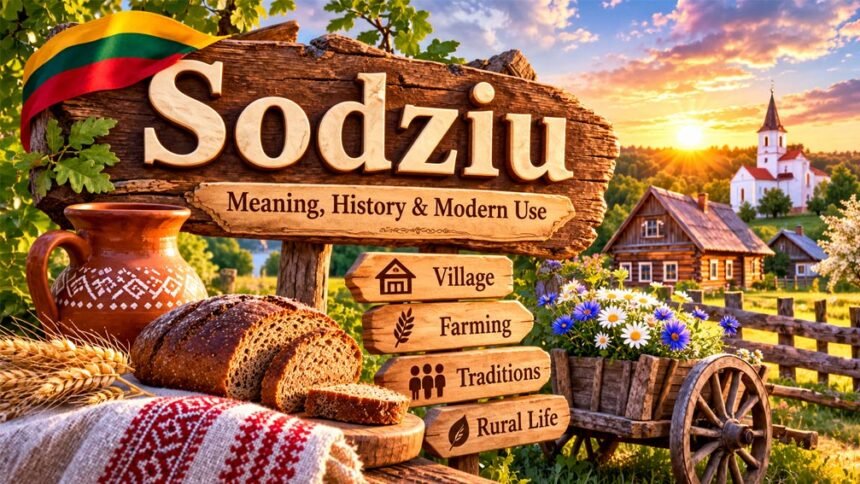
Sodziu is a term linked to the Lithuanian language and village life. It is closely related to sodžius, a Lithuanian word for a village or rural settlement.
People search for Sodziu because several Lithuanian words look similar. Words such as sodžius, sodžiu, sodyba, kaimas, and žodžiu can be confusing, especially when special Lithuanian letters are removed.
This guide explains what Sodziu means, its history, related words, traditional village life, and how it is understood today.
What Does Sodziu Mean?
Sodziu is often used online as a simple spelling linked to the Lithuanian word sodžius. In English, sodžius generally means a village or rural settlement.
In the past, these villages were closely linked with farming. Homes were surrounded by fields, gardens, barns, animals, paths, forests, and water sources.
The word can also remind people of family roots, traditions, community, and country life. However, these are cultural ideas linked to village life. They are not the direct meaning of the word.
Sodziu is not normally the name of a company, app, technology, or special lifestyle. A business or project may use the name, but that would be a separate use.
Why Is It Written as Sodziu?
Lithuanian uses some letters that are not found in basic English. One of them is ž.
When people type Lithuanian words without these special letters, the spelling changes:
- sodžius can become sodzius
- sodžiu can become sodziu
This may happen in search engines, URLs, online posts, or on keyboards without Lithuanian letters.
These small changes are important. Different Lithuanian words can look very similar when their special letters are removed.
Lithuanian words can also change their endings depending on how they are used in a sentence. This is why you may see different forms of the same word.
Sodžius vs Sodžiu: What Is the Difference?
Sodžius and sodžiu are closely related.
Sodžius is the basic word linked to a village or rural settlement.
Sodžiu is another form of the same word. Lithuanian changes word endings depending on how a word is used in a sentence.
This is common in Lithuanian grammar but can be confusing for English speakers.
Without the special letter ž, sodžius becomes sodzius and sodžiu becomes sodziu.
The exact meaning can depend on the full sentence. For this reason, it is better to check the original Lithuanian spelling and context.
Sodžius vs Sodyba vs Kaimas
These three Lithuanian words are connected with country life, but they are not exactly the same.
Sodžius usually means a village or rural settlement. It can also appear in older discussions about Lithuanian villages.
Sodyba usually means one homestead, farmstead, or country property. It may include a house, garden, land, barns, and other buildings.
Kaimas is a common Lithuanian word for a village.
| Word | Simple Meaning |
|---|---|
| Sodžius | Village or rural settlement |
| Sodyba | Homestead, farmstead, or country property |
| Kaimas | Village |
A sodyba may be part of or located near a larger village.
The word sodybos also comes from sodyba. It should not be confused with Sodziu.
Sodziu vs Žodžiu: A Common Online Mix-Up
Sodziu and žodžiu have different meanings.
Sodžiu is related to sodžius, meaning a village or rural settlement.
Žodžiu comes from the Lithuanian word žodis, meaning “word.” In everyday speech, it can sometimes mean something like “in short,” “basically,” or “in a word.”
Without special Lithuanian letters:
- sodžiu becomes sodziu
- žodžiu becomes zodziu
The spellings look similar, so people can easily confuse them online.
The best way to know the correct meaning is to check the original spelling and the full sentence.
History of Sodžius in Lithuania
Sodžius has a strong link with Lithuania’s farming history.
In older times, rural families needed to live close to the land and resources they used every day. They needed fields for crops, grassland for animals, forests for wood, and water for people and livestock.
Paths connected homes with fields and nearby settlements.
Older villages were not always carefully planned. Houses and farm buildings could be spread across the land instead of standing in straight rows.
The shape of the land, nearby water, forests, fields, and farming needs could all affect where people built their homes.
Not every Lithuanian village looked the same. Different regions, farming conditions, land systems, and local customs created different village layouts.
How Traditional Sodžius Settlements Were Organized
A traditional sodžius could include several rural homes and working farms.
A household might have a main house, garden, barn, sheds, animal areas, storage buildings, and nearby farmland.
Water was also important. Families could depend on wells, streams, or other nearby water sources.
Forests provided wood, berries, mushrooms, herbs, and other useful resources. Open land could be used for crops or animals.
Natural features affected where people lived. Hills, streams, forests, and fields could shape the layout of a settlement.
Home and work were closely connected. Farming, cooking, storing food, caring for animals, and repairing tools often happened in the same area.
Village layouts differed across Lithuania and also changed over time.
The Valakų Reform and Changes to Lithuanian Villages
Lithuanian villages went through an important change during the Valakų reform in the 16th century.
The reform changed how agricultural land was organized in many areas.
Older village layouts could be changed as fields and settlements became more organized. It could affect the location of houses, roads, farmland, and other parts of village life.
Some settlements became more regular in their layout.
This shows that Lithuanian villages did not stay the same forever. Farming methods, land ownership, government decisions, and economic changes continued to shape rural communities.
Daily Life in a Traditional Lithuanian Village
Traditional village life followed the seasons.
In spring, families prepared the land, planted crops, worked in gardens, and repaired tools or buildings.
Summer was a busy farming season. People cared for crops, made hay, and looked after animals.
Autumn was mainly about harvesting crops and storing enough food for winter.
During winter, people still had plenty of work. They cared for animals, prepared food, repaired tools, and worked inside their homes.
Children often helped adults with simple jobs. In this way, they learned farming, food preparation, animal care, crafts, and other useful skills.
Neighbors could also help each other with large jobs such as harvesting or building.
Village life was not always easy. Farming required hard physical work. Bad weather could damage crops, and cold winters could make everyday life difficult.
Traditional Houses and Rural Architecture
Wood was commonly used for traditional Lithuanian countryside buildings.
A rural property could include a main house, barn, sheds, animal buildings, gardens, fences, and storage areas.
Heating was very important during cold winters. Stoves and fireplaces helped keep homes warm and could also be used for cooking.
Families also needed places to store food. Cellars and other cool areas helped keep vegetables and other supplies for winter.
Traditional houses were not exactly the same across Lithuania. Their size, design, decoration, and layout could change by region, time period, and family income.
This also helps explain sodyba. A sodyba usually means one rural home or property with its land and buildings. A sodžius can refer to the wider village or settlement.
Farming, Gardens, Animals, and Beekeeping
Farming was an important part of traditional Lithuanian village life.
Families grew grains, potatoes, vegetables, and other foods. What they grew depended on the land, weather, and their needs.
Rye was especially important because it was widely used for traditional Lithuanian bread.
Families also kept animals. These could include cattle, pigs, chickens, horses, and other livestock.
Animals provided meat, milk, transport, farm work, and other useful materials.
Beekeeping also has a long history in Lithuanian rural life. Bees provided honey and beeswax.
Forests were another useful source of food and materials. People collected mushrooms, berries, herbs, and wood.
Many rural families therefore depended on farming, gardening, animals, forests, and other local resources together.
Traditional Food and Food Preservation
Traditional village food depended on what families could grow, raise, collect, or store.
Common foods included grains, potatoes, vegetables, dairy products, meat, mushrooms, berries, and honey.
Juoda duona, or dark rye bread, is an important part of Lithuanian food culture. Traditional bread could be fermented before being baked.
Potatoes also became an important food. They are used in dishes such as cepelinai, which are potato dumplings.
Šaltibarščiai, a cold beet soup, is another famous Lithuanian dish.
These dishes are part of Lithuanian food culture in general. They are not foods that belong only to sodžius settlements.
Families also needed to keep food through winter. They used methods such as drying, smoking, salting, fermentation, and cool storage.
Vegetables, berries, mushrooms, meat, and other foods could be stored or preserved for later use.
Crafts and Practical Rural Skills
People in traditional villages needed many practical skills.
They often made or repaired things at home because buying new items was not always easy.
Weaving was an important skill. Linen and wool could be used to make clothing, towels, belts, and other fabrics.
Sewing and embroidery were also useful for clothing and household items.
Woodworking helped people make furniture, spoons, fences, tools, and parts for buildings.
People also made baskets and repaired tools and farm equipment.
Some items included local or family designs. This gave practical objects a cultural value as well.
Lithuania has real textile traditions, but this does not mean Sodziu is the name of a textile or fabric-making method.
Folk Songs, Stories, and Rural Beliefs
Songs and stories were important parts of Lithuanian village culture.
Older family members could pass stories, sayings, songs, and useful knowledge to younger generations.
Lithuanian folk songs are often called dainos. They can be about family, work, relationships, nature, war, and the seasons.
Traditional stories also included supernatural figures. Laumės are female beings found in Baltic folklore. Velnias also appears in many traditional stories.
The details of these stories could differ between places and time periods.
Lithuanian traditions were shaped by both older Baltic beliefs and Christianity. Some older customs continued alongside Christian traditions.
These beliefs and stories are part of Lithuanian village culture. They are not the direct meaning of the word sodžius.
Festivals and Seasonal Traditions
Festivals helped families and neighbors spend time together.
Joninės is Lithuania’s midsummer celebration. Traditions can include bonfires, wreaths, plants, songs, and outdoor gatherings.
Kūčios is the traditional Christmas Eve meal. It is an important family event with special foods and customs.
Užgavėnės takes place before Lent. It is known for masks, costumes, performances, noise, and festive food.
Harvest time could also include celebrations after important farm work was finished.
These traditions were not exactly the same everywhere. Customs could change by family, region, religion, and time period.
Why Sodziu Became a Cultural Symbol
Sodžius directly means a village or rural settlement, but village life also has a wider cultural meaning.
For some Lithuanians, the countryside is connected with family roots, home, land, and tradition.
People who moved to cities or other countries may still have family homes or memories connected with rural Lithuania.
Village communities also helped pass language, songs, farming knowledge, crafts, and family traditions from one generation to another.
This can make people feel nostalgic about older village life. However, life in the countryside was often difficult and required hard work.
It is therefore important to separate the two ideas. Sodžius refers to a rural settlement. Ideas such as family, belonging, memory, and simple living are cultural meanings linked with village life.
Sodziu and Sustainable Living
Some old village practices are similar to modern ideas about sustainable living.
Families repaired tools and reused useful materials. They grew food in gardens and preserved food for winter.
They also used resources found nearby, including wood, mushrooms, berries, and herbs.
However, people often did these things because they were practical and saved money or resources.
It would not be accurate to say every historical Lithuanian village was organic, zero-waste, or eco-friendly in the modern meaning of these terms.
Modern rural homes can mix older habits with new technology. They may use better insulation, efficient heating, renewable energy, and modern farming equipment.
Sodziu can be connected with discussions about simple and careful use of resources. However, sustainability is a modern idea linked with village life, not the direct meaning of the word.
Sodziu in Modern Lithuania
Village life in Lithuania has changed greatly.
Modern villages can have electricity, paved roads, cars, farm machines, smartphones, internet access, schools, and modern transport.
Not everyone living in the countryside works on a farm.
Some people travel to towns for work. Others run small businesses, work online, provide local services, or farm alongside another job.
Old wooden houses may stand beside renovated homes and newer buildings.
Some old farmsteads are now private homes, museums, guesthouses, or tourism businesses.
Families may also keep country homes for weekends and holidays. Some people restore older homes, grow gardens, or choose to live outside larger towns.
Modern village life therefore mixes old rural traditions with modern technology and services.
Rural Tourism and Sodziu Heritage
Rural tourism allows visitors to experience another side of Lithuania.
Visitors may stay in a sodyba, or country property. It may be an older farm home or a modern guesthouse near forests, fields, rivers, or lakes.
Activities can include bread-making, traditional cooking, crafts, beekeeping, mushroom picking, sauna visits, hiking, cycling, fishing, and canoeing.
Visitors may also explore museums, old farmsteads, wooden churches, and heritage villages.
Rural tourism can support local families, accommodation owners, guides, food producers, and craftspeople.
Visitors should remember that villages are real communities. Homes and farms may be private property, so permission should be asked before entering or taking close photographs.
Common Misunderstandings About Sodziu
There are several confusing claims about Sodziu online.
One is that Sodziu means “basically” or “in short.” This usually comes from confusion with žodžiu, which is a different Lithuanian word.
Another mistake is saying sodybos is simply the plural of Sodziu. Sodybos comes from sodyba, meaning a homestead or rural property.
Some websites also describe Sodziu as an old fabric-dyeing technique. Lithuania does have traditional weaving and textile crafts. However, the information available for this topic supports sodžius as a word connected with a village or rural settlement, not the established name of a dyeing method.
Sodziu is also not the name of one specific Lithuanian village. Individual villages have their own names.
It should also not automatically be defined as a special lifestyle based on nature or sustainability. These ideas can be connected with rural life, but they are not the basic meaning of the word.
How to Research the Word Sodziu Correctly
Always check the original Lithuanian spelling when possible.
Similar words include:
- sodžius
- sodžiu
- žodžiu
- sodyba
Small spelling differences can change the meaning.
It is also important to read the full sentence. This helps you understand whether the text is talking about a village, Lithuanian grammar, or something completely different.
Remember that Lithuanian word endings can change because of grammar.
Sodziu may also be used as the name of a business, artwork, tourism property, or project. Such uses may have their own meaning.
For reliable information, check Lithuanian dictionaries, universities, museums, historical archives, academic sources, and recognized cultural organizations.
Do not assume a claim is true only because several general websites repeat it.
Why Sodziu Still Matters
Sodziu can help people understand Lithuanian language and rural history.
For language learners, it shows why correct spelling, special letters, grammar, and context are important.
For people studying history, it can help explain old village layouts, farming, land use, homes, and rural communities.
It can also be useful for family-history research. People researching Lithuanian ancestors may find rural words in old maps, letters, church records, or other documents.
Lithuanian rural culture also remains visible through traditional buildings, foods, crafts, songs, museums, farms, and historic landscapes.
Protecting this heritage does not mean villages must stay exactly as they were in the past. Modern homes, jobs, roads, technology, and services can exist while older traditions and historic places are still protected.
Bottom Line
Sodziu is mainly connected with the Lithuanian words sodžius and sodžiu. Its basic meaning is related to a village or rural settlement.
Sodžius refers to a village or settlement. Sodžiu is a different grammatical form of the same word. Sodyba usually means one homestead or country property, while kaimas is another Lithuanian word for village.
Žodžiu is a completely different word connected with žodis, meaning “word.”
Understanding Sodziu also gives readers a useful look at Lithuanian farming, village history, traditional food, crafts, family life, and rural culture.
Frequently Asked Questions
What does Sodziu mean?
Sodziu is linked to sodžius, a Lithuanian word meaning a village or rural settlement.
Is Sodziu a Lithuanian word?
Yes. It is linked to the Lithuanian words sodžius and sodžiu and may appear without the special letter ž online.
What is the difference between sodžius and sodžiu?
Sodžius means a village or rural settlement. Sodžiu is another form of the same word used in Lithuanian sentences.
What is the difference between sodžius and sodyba?
Sodžius means a village or rural settlement. Sodyba means a single homestead, farmstead, or country property.
Is Sodziu the same as kaimas?
They have similar meanings. Kaimas commonly means village, while sodžius can have an older or historical meaning.
Does Sodziu mean the same thing as žodžiu?
No. Sodžiu is linked to a village, while žodžiu is a different word that can mean “in short” or “basically.”
Is Sodziu a traditional fabric-dyeing method?
There is no strong evidence that Sodziu is a traditional dyeing method. Sodžius is mainly linked to a village or rural settlement.
Is Sodziu still relevant in modern Lithuania?
Yes. It is still useful for understanding Lithuanian language, village history, family roots, and rural culture.
More To Explore:
What Does Acamento Mean? Origin, Applications, and Techniques