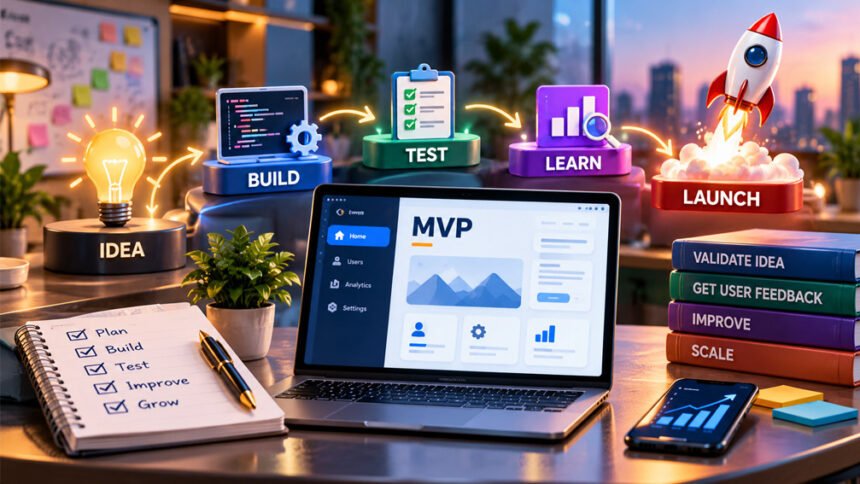
MVP development means building a simple first version of a product with its most important features. The goal is to solve a real problem, give the product to users, and learn from their feedback.
Businesses use MVPs to test new ideas before spending a lot of time and money on a full product. This guide explains what MVP development is, how it works, what it costs, and how businesses can build a useful MVP.
What Is MVP Development?
MVP stands for Minimum Viable Product. It is the first working version of a product with enough features to solve its main problem.
MVP development includes planning, designing, building, testing, and launching this first version.
The goal is not to build every possible feature. The team focuses on the features users really need.
“Minimum” does not mean poor quality. It simply means the product has a smaller number of features. Its main functions should still work properly.
For example, imagine a company wants to build a food delivery app. The complete app may have recommendations, rewards, advanced filters, reviews, and many other features.
Its MVP may only let users create an account, find restaurants, choose food, place an order, and check the order status.
The company can add more features later after learning what users actually need.
An MVP is also a learning tool. It helps a business test its idea with real users before spending more money on a larger product.
Why Do Businesses Build an MVP?
Businesses often have many ideas about what customers want. However, it can be difficult to know if those ideas are correct until real people use the product.
An MVP helps test these ideas.
A business can see whether people understand the product, use its main features, and find it helpful.
It can also save development time and money. Instead of building dozens of features, the team can start with the most important ones.
Real users can also find problems that the development team did not notice. For example, users may find registration confusing or have trouble completing an important task.
Businesses can use this feedback to improve the product.
An MVP can also help test market demand. A company can see whether people sign up, use the product again, complete important actions, or are willing to pay.
A working MVP may also be useful when talking to investors. It can show how the idea works and provide early user data.
However, an MVP does not guarantee funding or business success. It simply gives a company better information for making future decisions.
What Should an MVP Include?
There is no single list of features that every MVP should have.
The features depend on the product, its users, and the problem it solves.
The best place to start is the core user journey. This means the main steps a user must take to get value from the product.
For a booking platform, the journey may look like this:
Search for a service → choose a service → select a time → book → receive confirmation.
The MVP should include everything needed to make this process work.
Features can usually be divided into three groups:
- Must-have features: Features users need to solve the main problem.
- Useful features: Helpful features that are not required for the first version.
- Future features: Features that can be added later.
For example, a service marketplace may need accounts, provider profiles, search, service requests, messaging, and an admin panel.
Advanced recommendations, rewards, detailed analytics, and social features may be added later.
Important security and data protection features should not be removed just to make the MVP smaller.
The goal is to build the smallest useful product, not simply the product with the fewest features.
How to Prioritize MVP Features
Feature prioritization means deciding which features should be built first.
Without clear priorities, teams may continue adding new features. This is called feature creep. It can make the MVP more expensive and take longer to build.
One popular method for choosing features is called MoSCoW.
Must-Haves
These features are necessary.
Without them, users cannot complete the main task or receive the main value of the product.
For a ride-booking app, these could include requesting a ride, finding a driver, location tracking, and payment.
Should-Haves
These features are useful but are not required for the first version.
Examples may include ride history, ratings, or extra messaging options.
Could-Haves
These are extra features that may improve the product but can wait.
Examples include advanced filters, personalized suggestions, and social sharing.
Won’t-Haves
These are features the team decides not to build in the current version.
They may still be added in the future.
Other methods can also help teams choose features.
RICE looks at reach, impact, confidence, and effort.
The Kano Model looks at how features affect customer satisfaction.
The Eisenhower Matrix helps teams separate important work from less important work.
Before adding a feature, teams should ask:
- Does it help solve the main problem?
- Can users complete their main task without it?
- Does it help test our main idea?
- Does it provide real value?
- Can we add it later?
If a feature is not needed for the main experience or test, it can usually wait.
How Does the MVP Development Process Work?
MVP development follows several steps. The process starts with understanding the problem and ends with learning from real users.
Step 1: Define the Problem
First, clearly identify the problem the product will solve.
Find out who has this problem and how they currently deal with it.
Businesses can use customer interviews, competitor research, market research, and workflow analysis.
The goal is to understand the problem before deciding what software to build.
Step 2: Understand the Target Users
Next, decide who will use the product.
Learn about their needs, behavior, expectations, and problems.
Different users may need very different products. Software for business managers, for example, may work differently from an app for everyday consumers.
Understanding the target audience helps with later decisions about features, design, and testing.
Step 3: Set a Validation Goal
Decide what you want to learn from the MVP.
For example, you may want to know whether users can complete the main task, return to the product, or are willing to pay.
The goal should be clear and measurable when possible.
Without a clear goal, businesses may collect a lot of data without knowing what it means.
Step 4: Define the MVP Scope
Now decide exactly what the first version will include.
Map the main user journey and select the features needed to complete it.
Some simple-looking features may also need a database, login system, API, permissions, or admin panel.
Every feature should have a clear reason for being included.
Other ideas can be saved for later.
Step 5: Design the User Experience
An MVP should still be easy to use.
Teams can create user flows, wireframes, and interface designs before development starts.
They can also create clickable prototypes to test how users move through the product.
Good design is important because a confusing interface can affect the test results.
Users should be able to understand and complete the product’s main tasks easily.
Step 6: Choose the Technology
The technology should match the product’s needs.
The team may need to choose between a web app, mobile app, or another platform.
The product may also need databases, APIs, cloud hosting, payments, user accounts, analytics, and other services.
Teams should choose technology that can support the MVP and reasonable future growth.
However, they should avoid building complex systems that are not needed yet.
Security, accessibility, privacy, maintenance, and legal requirements should also be considered.
Step 7: Build the MVP
The development team now builds the selected features.
This may include front-end and back-end development, databases, APIs, user accounts, payment systems, integrations, and admin tools.
The team should stay focused on the planned features.
Adding too many new ideas during development can increase costs and delay the launch.
Step 8: Test the MVP
The MVP should be tested before launch.
Teams should check whether the main features work correctly and whether users can complete important tasks.
Testing may also cover usability, different screen sizes, data handling, errors, integrations, and security.
Serious bugs should be fixed before real users start using the product.
An MVP may be small, but its main features should work properly.
Step 9: Launch to Early Users
The MVP can then be released to a small group of suitable users.
These people should be similar to the product’s real target audience.
Teams can collect usage data as well as direct feedback through interviews, surveys, comments, and support requests.
The goal is to understand how real people use the product.
Step 10: Measure, Learn, and Improve
Launching an MVP is not the final step.
The team should study the results and compare them with the goals set before launch.
It should look at what users like, where they have problems, what they use most, and whether they return.
Not every user request needs to become a new feature. Teams should look for common patterns.
The results may lead the business to improve existing features, add new ones, change the design, target different users, change the business model, or change direction.
Sometimes the results may show that the idea is not worth further investment. This can still be useful because the business learned this before spending more money.
This process is often called Build-Measure-Learn.
How to Measure MVP Success
MVP success should be measured using the goals set before launch.
Simply getting many sign-ups does not always mean the product is successful. Users also need to receive value from it.
Useful metrics include:
- Activation rate: How many new users complete an important first action.
- Task completion rate: How many users complete the main task.
- Retention: How many users return.
- Repeat usage: How often users come back and use the product again.
- Conversion rate: How many users complete a desired action, such as buying a plan.
- Customer feedback: What users like, dislike, or find difficult.
- Engagement: How people use important features.
- Abandonment: Where people leave or stop a process.
- Willingness to pay: Whether customers are ready to pay for the product.
- Customer acquisition cost: How much it costs to gain a customer.
Teams should use several types of information together.
Analytics show what users do. Interviews and feedback can help explain why they do it.
Even a poor result can provide useful information. If users do not want the product, learning this early can prevent a business from spending much more money.
How Much Does MVP Development Cost?
There is no fixed price for MVP development.
The cost depends on the type of product and how difficult it is to build.
A simple web application may cost much less than a marketplace, financial platform, or complex mobile application.
Important cost factors include:
- Number of features
- Feature complexity
- UI and UX design
- Web or mobile development
- Technology used
- Front-end and back-end development
- Databases
- User accounts and permissions
- Third-party APIs
- Payment systems
- Security
- Legal and compliance requirements
- Testing
- Development team
- Hosting
- Maintenance
Published cost estimates can vary widely.
One collected source estimates that an MVP may cost around $15,000 to $150,000. The same source gives an estimated range of about $30,500 to $99,000 for a typical SaaS MVP.
These are only estimates from one source. They are not fixed prices. Some MVPs may cost less or much more.
Businesses should first decide what features they actually need. They can then estimate the cost of design, development, testing, hosting, and maintenance.
It is also useful to keep some extra money for unexpected work, such as API problems, security changes, additional testing, and bug fixes.
How Long Does It Take to Build an MVP?
There is no fixed development time for an MVP.
A small MVP can usually be built faster than a complete product because it has fewer features.
However, development involves more than coding.
The timeline may include research, planning, UX/UI design, technical planning, development, testing, deployment, and launch preparation.
Complex integrations, many user roles, mobile apps, multiple platforms, and strict security needs can make development take longer.
The best way to estimate the timeline is to define the features first and then calculate how much work they require.
Low-Code and No-Code MVP Development
Some MVPs can be built without writing all the software from scratch.
Low-code and no-code platforms provide ready-made tools that make development easier and faster.
Examples include Bubble, Retool, Airtable, Webflow, Adalo, and Glide.
These platforms can be useful for internal tools, directories, simple booking systems, basic marketplaces, workflow tools, and early product tests.
Their main benefits can include faster development, lower starting costs, easy changes, and built-in hosting or other services.
However, they also have limits.
Businesses may face platform lock-in, limited customization, migration problems, monthly fees, performance limits, and less control over the software.
Security and compliance can also be important concerns.
Custom development may be better for products that need complex features, special integrations, high performance, or more control.
The right choice depends on the product.
MVP vs. Prototype vs. Proof of Concept
These three terms are related, but they have different purposes.
MVP
An MVP is a working product with enough features to provide its main value.
Real users can use it.
Its main purpose is to test whether the product solves a real problem and provides value.
Main question: Does this product provide value to real users?
Prototype
A prototype is an early model of a product.
It may be a drawing, wireframe, or clickable design. It does not always have working features.
Its main purpose is to test design, user flow, and usability.
Main question: Does this design or workflow make sense?
Proof of Concept
A Proof of Concept, or PoC, tests whether an idea is technically possible.
Developers may use it to test an API, integration, AI feature, or another technology.
It usually focuses on technical questions rather than the full user experience.
Main question: Can this technology or idea work?
| Aspect | MVP | Prototype | Proof of Concept |
|---|---|---|---|
| Purpose | Test product value | Test design | Test technical possibility |
| Form | Working product | Model or design | Small technical test |
| Users | Early customers | Team or test users | Technical team |
| Main question | Does it provide value? | Does the design work? | Can it work technically? |
A project may use all three.
For example, a team may first create a PoC to test the technology, then create a prototype to test the design, and finally build an MVP for real users.
MVP vs. Full Product
An MVP and a full product have different goals.
An MVP contains only the features needed to provide the main value and test important ideas.
A full product usually has more features, users, integrations, and workflows.
An MVP should still be built properly. However, teams should avoid creating complex systems for future needs that may never happen.
If the MVP performs well, it can grow into a full product.
New features can be added based on user feedback, business goals, and real product data.
Benefits of MVP Development
MVP development can offer several useful benefits:
- Test an idea with real users
- Get feedback early
- Reduce unnecessary development
- Control the first development budget
- Launch sooner
- Find UX problems early
- Learn which features people actually use
- Make better product decisions
- Change direction more easily
- Collect useful business data
- Show a working product to investors or other stakeholders
These benefits depend on proper planning.
An MVP needs a clear problem, target audience, and goal. Simply launching a small product does not guarantee useful results.
Limitations and Risks of MVP Development
An MVP does not remove every risk.
Testing with the wrong people can produce poor or misleading feedback.
The MVP can also become too simple. If too many important features are removed, users may not understand its real value.
Poor quality can also affect the results. Users may leave because the product is confusing, slow, broken, or insecure rather than because the idea itself is bad.
Quick technical decisions may also create technical debt. This means the team may need to spend more time fixing or rebuilding parts of the product later.
A small group of early users may not represent the whole market.
Businesses should also avoid relying only on numbers such as downloads, page views, or registrations. These numbers do not always show whether users actually find the product useful.
An MVP still needs proper planning, design, development, testing, security, and maintenance.
Common MVP Development Mistakes
One common mistake is trying to build too many features.
When every feature becomes “important,” the MVP can turn into a full product.
Feature creep can also increase costs and delay the launch.
Another mistake is thinking an MVP should be cheap and poorly made. A smaller feature set does not mean poor quality.
Teams should also have a clear goal before launch. Without one, it can be difficult to understand whether the MVP worked.
Not every user request should become a feature. Teams should look for common patterns in feedback.
Choosing technology too early can also cause problems. The product requirements should come before choosing a programming language or framework.
Teams should also avoid building complex systems for future growth before they know whether the product has demand.
Testing is important too. Bugs, broken features, security problems, and confusing design can affect the results.
Building web, iOS, Android, and other versions at the same time may also be unnecessary. Sometimes one platform is enough for the first test.
Finally, businesses should plan for what happens after launch. They need time for feedback, bug fixes, measurement, and improvements.
When Should You Skip an MVP?
An MVP is not right for every project.
Safety-critical software may need more testing before people can use it.
Regulated products may also need specific security, features, documents, or legal requirements before launch.
Some products only work when several systems are connected. Removing important parts may make the MVP useless.
Software that replaces an important business system may also need a more complete first version.
Sometimes a prototype or PoC should come first.
A prototype can test the design, while a PoC can test whether the technology works.
The right approach depends on the product, market, risks, and business needs.
MVP Development Best Practices
Start by understanding the problem.
Know who the target users are and what they need to do.
Set a clear goal for the MVP.
Focus on the main user journey and build only the features needed to support it.
Test designs before development when possible. Wireframes and prototypes can help find problems early.
Do not ignore quality, security, or privacy just because the product is an MVP.
Choose success metrics before launch.
Collect both user data and direct feedback. Data can show what users do, while conversations can help explain why.
Look for common patterns instead of reacting to every individual request.
Keep some time and money available for changes after launch.
Most importantly, keep learning from the results. Build the product, measure what happens, learn from users, and use that information to decide what comes next.
Bottom Line
MVP development helps businesses test new product ideas before making a much larger investment.
A good MVP is not simply the cheapest or smallest product possible. It is the smallest useful version that solves the main problem and provides enough value to test the idea with real users.
A successful MVP needs a clear problem, important core features, proper testing, useful metrics, and real user feedback.
After testing, the business can improve the product, add features, change direction, or decide not to continue.
The main goal is to make these decisions using real evidence instead of guesses.
Frequently Asked Questions
What does MVP stand for in development?
MVP means Minimum Viable Product. It is a simple first version of a product used to test an idea.
What is the main purpose of MVP development?
The main purpose is to test a product with real users. It helps businesses learn if the idea is useful.
What features should an MVP include?
An MVP should include only the main features users need. Extra features can be added later.
How much does it cost to develop an MVP?
There is no fixed price. The cost depends on the features, design, technology, and development work.
How long does MVP development take?
The time depends on the product’s size and features. Simple MVPs usually take less time than full products.
Is an MVP the same as a prototype?
No. A prototype tests an idea or design, while an MVP is a working product that real users can use.
Can an MVP become a full product?
Yes. An MVP can grow into a full product by adding new features and improvements over time.
Does every startup need an MVP?
No. Some startups may need an MVP, while others may need a prototype, PoC, or a more complete product first.
More To Explore:
Remote Employee Monitoring Software: How It Works, Features, and Costs