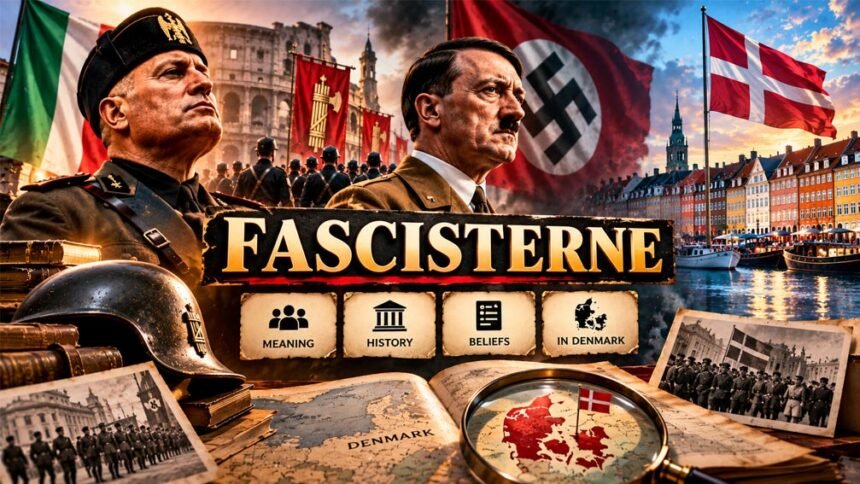
Fascisterne is a Danish word that means “the fascists” in English. It describes people who support fascism or are part of a fascist group.
People may see this word in Danish history books, news, political discussions, or articles about World War II.
This article explains what Fascisterne means, where fascism came from, its main beliefs, and its history. It also covers Mussolini, Nazism, Denmark’s DNSAP, and the German occupation of Denmark.
What Does Fascisterne Mean?
Fascisterne means “the fascists” in Danish. It describes a specific group of people who support fascism.
The word refers to people, not the political idea itself. The Danish word for fascism is fascisme.
Fascisterne is not the name of one political party. Its exact meaning depends on the subject.
For example, a Danish article about Italy may use Fascisterne for followers of Benito Mussolini. An article about Denmark may use the word for Danish fascists.
Today, people sometimes use “fascist” as a political insult. Because of this, readers should always check the context.
Fascisterne Meaning in Danish
Danish grammar works differently from English. Instead of always putting “the” before a noun, Danish can add an ending to the word.
Here are the main forms:
| Danish | English |
|---|---|
| Fascist | A fascist |
| Fascisten | The fascist |
| Fascister | Fascists |
| Fascisterne | The fascists |
| Fascisme | Fascism |
| Fascistisk | Fascist or fascistic |
The ending in Fascisterne changes the meaning from “fascists” to “the fascists.”
Another Danish word is Nazisterne, which means “the Nazis.” Fascists and Nazis are connected in history, but the two words do not mean exactly the same thing.
Where Did Fascism Come From?
Modern fascism grew in Europe after World War I. Italy became the home of the first major fascist movement.
After the war, many European countries faced serious problems. People struggled with unemployment, high prices, strikes, and political conflict.
Italy had fought on the winning side of World War I. However, some Italians believed their country had not gained enough from the war.
Nationalist groups used this anger to call for stronger leadership and greater national power.
The word fascism comes from the Italian word fascio, which can mean a group or bundle. It is also connected to the Latin word fascis.
In ancient Rome, a bundle of rods called the fasces was used as a symbol of authority. Italian Fascists later used this symbol.
Economic problems were not the only reason fascism grew. Political instability, nationalism, fear of communism, and anger toward existing governments also helped fascist movements gain support.
Benito Mussolini and the Rise of Italian Fascism
Benito Mussolini was one of the most important figures in the history of fascism.
In 1919, Mussolini founded the Fasci Italiani di Combattimento in Milan.
The movement attracted war veterans, nationalists, people who opposed socialism, and others who were unhappy with Italy’s government.
Mussolini promised stronger leadership, order, and national strength.
His supporters also used violence. Groups known as the Blackshirts attacked socialists, trade unions, political meetings, and other opponents.
In October 1922, Fascist supporters took part in the March on Rome. King Victor Emmanuel III then appointed Mussolini as prime minister.
Italy did not become a full dictatorship immediately.
Mussolini slowly weakened his political opponents. Freedom of the press was reduced, opposition parties lost their freedom, and critics faced violence and punishment.
By the middle of the 1920s, Italy had become a fascist dictatorship.
Mussolini was known as Il Duce, meaning “the leader.”
Why Fascist Movements Attracted Support
World War I caused huge damage across Europe. Millions of people were killed or injured, economies struggled, and political problems continued after the war.
Fascist movements used these problems to attract supporters.
They promised jobs, security, discipline, stronger government, national unity, and economic recovery.
Fear of communism was another reason some people supported fascist movements. Some feared strikes, revolution, or major changes to society.
People supported fascist groups for different reasons.
Some strongly believed in fascist ideas. Others were attracted by nationalism, promises of stability, anti-communism, or anger with existing political parties.
Rallies, uniforms, flags, symbols, and youth groups also gave some supporters a strong feeling of belonging.
Main Beliefs and Characteristics of Fascism
Fascist movements were not exactly the same in every country. However, many shared similar ideas.
One important idea was extreme nationalism. Fascists believed the interests of the nation should come before individual political interests.
They also opposed liberal democracy. Fascist governments did not support free competition between many political parties.
Instead, they supported strong central control and powerful leaders.
Individual rights could become less important than loyalty to the nation or state. Political opponents were sometimes treated as enemies instead of people with different views.
Many fascist movements also supported military strength, discipline, obedience, and sacrifice.
They were often strongly against socialism and communism.
Some fascist movements also decided that certain groups did not fully belong to the nation. These groups could face discrimination, persecution, or violence.
This is why fascism means more than simply having a strong government. Not every nationalist, conservative, strict, or authoritarian government is fascist.
Political Violence and Paramilitary Groups
Violence was an important part of several historical fascist movements.
Fascist groups sometimes attacked political opponents, trade unions, meetings, and organizations that stood against them.
Mussolini’s Blackshirts are a well-known example.
They attacked socialists, union members, and other political opponents in Italy.
Some fascist movements praised strength, struggle, military discipline, and sacrifice. Violence could therefore become part of their political methods.
Paramilitary groups also created fear. People could become afraid to speak openly or take part in opposition politics.
This helped fascist movements weaken their political rivals.
Propaganda and Mass Mobilization
Fascist movements did not use only violence. They also used propaganda to gain support.
They spread their messages through newspapers, radio, posters, films, speeches, schools, rallies, and public events.
Uniforms, flags, and other symbols helped make these movements easy to recognize.
Large rallies were used to show strength and unity.
Some fascist governments also created youth groups. These groups taught young people government-approved ideas and encouraged loyalty to the state.
Independent news became harder to find after fascist governments gained control.
Newspapers that criticized the government could be restricted or closed. Government-controlled media repeated messages that supported the leadership.
Propaganda often showed leaders as strong and successful. Problems could be hidden or blamed on political opponents and other groups.
Fascism vs. Nazism
Fascism and Nazism are closely related, but they are not exactly the same.
Italian Fascism developed under Benito Mussolini. Nazism developed in Germany under Adolf Hitler and the Nazi Party.
Both supported strong leaders, extreme nationalism, military power, propaganda, and strict political control. Both also opposed liberal democracy.
One major difference was the central role of race and antisemitism in Nazi ideology.
The Nazis promoted the false idea that some races were better than others. They claimed that an “Aryan” race was superior.
Jewish people lost basic rights and faced systematic persecution. Nazi Germany also persecuted Roma, disabled people, political opponents, and other groups.
These policies led to the Holocaust. Nazi Germany and its collaborators murdered six million Jews. Millions of other people also died because of Nazi persecution, occupation, mass killings, and war.
The Nazis also supported Lebensraum, meaning “living space.” Hitler used this idea to support German expansion into other parts of Europe.
Italian Fascism did not begin with exactly the same racial ideas as Nazism.
However, Mussolini’s government did use racist policies, especially in its colonies. Italy also introduced antisemitic racial laws in 1938.
Nazism is therefore closely connected with the wider history of fascism, but the two terms should not be treated as exactly the same.
Fascisterne in Denmark Before World War II
Denmark also had fascist and Nazi groups during the 1930s.
However, these groups never gained the same level of public support as similar movements in Germany or Italy.
The best-known Danish Nazi party was Danmarks Nationalsocialistiske Arbejderparti, usually called DNSAP.
DNSAP was founded in 1930 by Cay Lembcke. The party was strongly influenced by Hitler’s Nazi movement in Germany.
In 1933, Frits Clausen became its leader.
DNSAP supported strong nationalism, antisemitism, anti-communism, and opposition to liberal democracy.
The party held political meetings, published newspapers and other material, and created youth groups.
Denmark also introduced laws to reduce political violence.
In 1933, Denmark banned political uniforms. More rules followed in 1934 to limit weapons and military-style political groups.
These laws were designed to stop political groups from using uniforms, weapons, or organized force to threaten other people.
DNSAP Election Results and Public Support
DNSAP remained a small party compared with Denmark’s major political parties.
Its election results were:
| Election | Votes | Vote Share | Seats |
|---|---|---|---|
| 1935 | 16,257 | 0.99% | 0 |
| 1939 | 31,032 | 1.83% | 3 |
| 1943 | 43,309 | 2.15% | 3 |
DNSAP entered Denmark’s parliament in 1939 with three seats.
The party’s membership later grew. Historical reports put its membership at around 5,000 near the beginning of World War II and about 20,000 by spring 1943.
However, more members did not mean wide public support.
Even during the German occupation, only a small percentage of Danish voters supported DNSAP.
DNSAP never formed Denmark’s government.
Fascisterne During the German Occupation of Denmark
Germany invaded Denmark on April 9, 1940.
Danish forces resisted for a short time. The Danish government then accepted the German occupation.
Germany occupied Denmark until May 1945.
At first, Denmark kept its king, parliament, government, and many public institutions.
Danish leaders cooperated with German authorities in an attempt to keep some control over Danish affairs.
DNSAP hoped the German occupation would help it gain power.
The party received some support from German authorities, but Germany did not put DNSAP in control of Denmark.
German officials found it more useful to work with Denmark’s existing government.
Some Danish Nazis worked closely with Germany. DNSAP also supported recruitment for German military forces.
Danish volunteers served in groups connected with Frikorps Danmark and the Waffen-SS.
However, not every Danish person who worked with German authorities was a Nazi or DNSAP member. People cooperated for different reasons.
The situation became more difficult during 1943. Strikes, protests, and sabotage increased.
In August 1943, the Danish government refused new German demands and stopped following the cooperation policy. Germany then took more direct control.
Danish Resistance and the Rescue of Danish Jews
Danish resistance against the German occupation grew during the war.
Resistance groups secretly printed newspapers and shared information that German authorities tried to control.
Some groups also collected information for the Allies.
Sabotage became another important activity. Resistance members damaged factories, railways, equipment, and businesses connected with the German war effort.
Two well-known Danish resistance groups were BOPA and Holger Danske.
In October 1943, German authorities planned to arrest and deport Denmark’s Jewish population.
News about the plan became known before it was fully carried out.
Danish citizens and resistance members helped Jewish families hide and reach the coast.
Fishing boats and other small boats then carried thousands of people across the Øresund to neutral Sweden.
Historical estimates say about 7,200 Danish Jews and around 680 non-Jewish family members escaped to Sweden.
Around 470 Danish Jews were deported to Theresienstadt. Most of them survived the war.
Because of this rescue effort, most Danish Jews escaped Nazi deportation and murder.
The German occupation of most of Denmark ended in May 1945.
What Fascist Rule Meant in Everyday Life
Fascist rule affected many parts of everyday life.
Independent newspapers and political groups could lose their freedom. People who openly criticized the government could face punishment.
Schools could also be used to teach government-approved political ideas.
Independent trade unions could be restricted or replaced with organizations controlled by the state.
Writers, journalists, artists, and academics could face censorship. Some books, articles, or other work could be banned.
People could also become afraid to discuss politics openly.
Some people supported fascist governments. Others stayed quiet because they feared losing their jobs, freedom, or safety.
Because of this, public support shown under a dictatorship did not always show what people truly believed.
What Happened After World War II?
Mussolini’s Fascist government fell in 1943.
He later led a smaller German-backed government in northern Italy. Mussolini was captured and killed by Italian partisans in April 1945.
Nazi Germany surrendered in May 1945. Hitler had died shortly before the surrender.
DNSAP also lost its remaining influence after Denmark was freed.
Danish authorities investigated people accused of serious cooperation with German forces. Some people faced court cases and punishment.
Being a DNSAP member was not by itself the same as committing a specific wartime crime. Legal cases depended on what each person had done.
Frits Clausen was arrested on May 5, 1945.
He faced legal proceedings connected with his wartime actions, but his case did not reach a final judgment.
He died in prison on December 5, 1947.
Fascist and Nazi ideas did not completely disappear after the war.
Later groups influenced by fascism are often called neo-fascist groups. Groups that continue or revive Nazi ideas are generally called neo-Nazi groups.
How Fascisterne Is Used Today
Fascisterne is still used in Danish.
People may see it in history books, schools, newspapers, documentaries, archives, and political discussions.
Its exact meaning depends on the subject.
For example, an article about Mussolini may use Fascisterne for Italian Fascists. An article about Danish history may use it for Danish fascist groups.
The word can also appear in modern political arguments.
Sometimes people use “fascist” simply as an insult for someone they see as strict, extreme, or controlling. This does not always match the historical meaning.
Readers should therefore look at the facts and context instead of relying only on the label.
Fascism, Authoritarianism, Nationalism, and Conservatism
These political terms can sometimes share certain features, but they do not mean the same thing.
Nationalism focuses on a nation and its interests. A nationalist movement is not automatically fascist.
Authoritarianism means political power is strongly controlled and political freedoms may be limited. Not every authoritarian government follows fascist ideas.
A military dictatorship is usually controlled by military leaders. It can be authoritarian without being fascist.
Conservatism is also different from fascism. Conservative political parties can support free elections, civil rights, independent institutions, and peaceful changes of government.
Populism often presents politics as a struggle between ordinary people and powerful elites. Populist movements can come from different political backgrounds.
For this reason, one political feature alone is usually not enough to describe a movement as fascist.
Common Misunderstandings About Fascisterne
One common mistake is thinking Fascisterne means “fascism.” It actually means “the fascists.” The Danish word for fascism is fascisme.
Another mistake is thinking Fascisterne is the name of one political party. It is a normal Danish word and can describe different fascist groups.
It also does not always mean Mussolini’s followers.
People sometimes think fascists and Nazis are exactly the same. They shared several ideas, but Nazism placed much more importance on racial hierarchy and antisemitism.
Another misunderstanding is that DNSAP controlled Denmark. It did not. The party remained small and never formed the Danish government.
Not every Dane who worked with German authorities was a Nazi either. Collaboration and support for Nazi ideology were not always the same thing.
The word fascist should also not be used automatically for every nationalist, conservative, strict, or authoritarian political group.
Context, beliefs, actions, goals, and historical evidence are important.
Why the History of Fascisterne Matters
The history of Fascisterne helps people understand an important period in European history.
Fascist movements grew during periods of political problems, economic difficulty, social fear, and public anger.
They used nationalism, propaganda, political organization, promises of order, and sometimes violence to gain support.
Their history also shows how political freedoms can be removed over time.
Mussolini first became prime minister. Italy then gradually developed into a dictatorship as political opposition and freedoms were reduced.
Learning about fascism also helps readers better understand World War II, Nazi Germany, political repression, and Denmark’s history during the German occupation.
However, not every modern political disagreement should be compared directly with the 1920s or 1930s.
Using political terms carefully helps readers understand history more clearly.
Bottom Line
Fascisterne is a Danish word meaning “the fascists.” It describes people who support fascism. The Danish word for the ideology itself is fascisme.
The term is important when reading about Italian Fascism, Nazi Germany, and smaller fascist and Nazi groups in countries such as Denmark.
Denmark’s best-known Nazi party was DNSAP. It won three seats in parliament but remained a small political force and never governed Denmark.
Today, Fascisterne is still used in Danish historical and political writing. Readers should always look at the context to understand exactly who the word describes.
Frequently Asked Questions
What does Fascisterne mean in English?
Fascisterne means “the fascists” in English. It refers to people who support fascism.
Is Fascisterne the same as fascism?
No. Fascisterne means “the fascists,” while fascisme means “fascism” in Danish.
Is Fascisterne the name of a political party?
No. Fascisterne is a Danish word, not the name of one political party.
Were fascists and Nazis the same?
No. They shared some ideas, but Nazism had a stronger focus on race and antisemitism.
Did Denmark have fascists or Nazis?
Yes. Denmark had some small fascist and Nazi groups. DNSAP was the best-known Danish Nazi party.
Did DNSAP ever rule Denmark?
No. DNSAP never ruled Denmark. It remained a small political party.
What happened to Danish fascists after World War II?
DNSAP collapsed after Denmark was freed in 1945. Some people who helped German forces faced legal action.
Is the word Fascisterne still used today?
Yes. The word is still used in Danish history, news, education, and political discussions.
More To Explore: