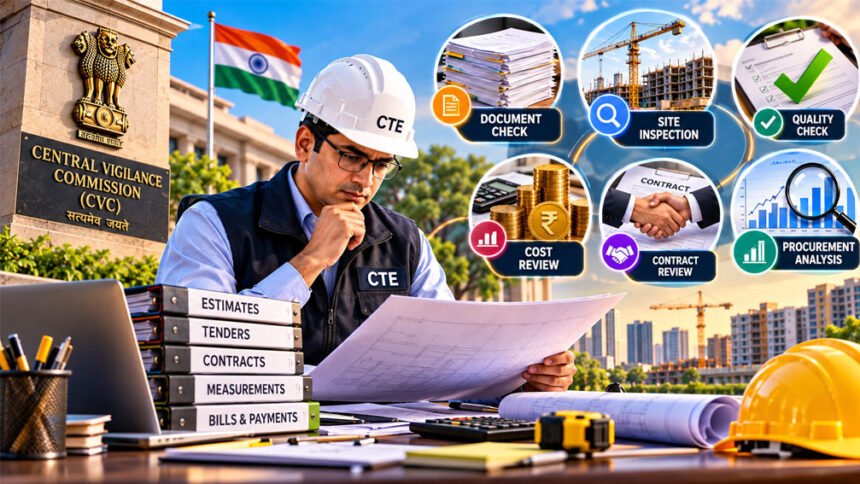
A Chief Technical Examiner (CTE) is a senior technical officer in India. The role is connected with the Chief Technical Examiners’ Organisation (CTEO), which is the technical wing of the Central Vigilance Commission (CVC).
The CTEO checks selected government projects, contracts, and purchases. It looks at tenders, costs, quality, measurements, payments, and other records to see whether proper rules were followed.
This guide explains what a Chief Technical Examiner does, how CTE inspections work, what problems may be found, and what happens after an examination.
What Is a Chief Technical Examiner?
A Chief Technical Examiner is a senior technical officer who helps examine government projects, procurement, and contracts.
In India, the role is mainly connected with the CTEO under the Central Vigilance Commission. The organisation checks selected procurement cases for technical, financial, quality, and procedural problems.
A Chief Technical Examiner is different from the engineer who manages the original project. The project team may design, build, or supervise the work. The CTEO independently checks whether the work and related records are correct.
For example, an examiner may check whether the materials used match the approved specifications. They may compare actual work with measurements, bills, and project records. Tender conditions and contract changes can also be examined.
The Chief Technical Examiner is a senior position. The collected information describes CTE posts as being at Chief Engineer level.
The title may have a different meaning in other countries or organisations. This guide mainly covers the official CTE role in India’s CVC and CTEO system.
CTE, CTEO, CVC, and CVO
These terms are closely connected, but they have different meanings.
CTE stands for Chief Technical Examiner. It is the senior technical role discussed in this guide.
CTEO stands for Chief Technical Examiners’ Organisation. It carries out technical examination work.
CVC stands for Central Vigilance Commission. The CTEO works under the CVC framework.
CVO stands for Chief Vigilance Officer. A CVO handles vigilance work within an organisation and may help with follow-up after a CTE examination.
History of the Chief Technical Examiners’ Organisation
The Chief Technical Examiners’ Organisation was created in 1957 under the then Ministry of Works, Housing & Supply.
At first, its work mainly involved technical audits of projects handled by the Central Public Works Department (CPWD). The aim was to improve technical control, financial control, and the proper use of government money.
Later, the Santhanam Committee on Prevention of Corruption recommended strengthening the organisation and expanding its work.
In 1964, the CTEO came under the administrative control of the Central Vigilance Commission.
A second Chief Technical Examiner post was created in 1979.
Over time, government procurement changed. It was no longer limited mainly to construction. Government bodies also started buying equipment, technology, consultancy, transport services, and many other goods and services.
The CTEO’s work therefore became much wider.
How the CTEO Is Structured
The collected information describes the CTEO as having two Chief Technical Examiners at Chief Engineer level.
One technical area mainly covers civil and horticulture works. The other covers areas such as electrical and mechanical works, supplies, IT procurement, consultancy, services, and transport contracts.
Different contracts need different technical knowledge. Checking a building project, for example, is very different from examining an IT contract.
Chief Technical Examiners are supported by other technical staff. These can include Technical Examiners (TEs), Assistant Technical Examiners (ATEs), and Junior Technical Examiners (JTEs).
These officers can review documents, inspect work, check records, and prepare technical observations. Important findings can then be reviewed at the Chief Technical Examiner level.
The exact number of staff can change over time.
What Does a Chief Technical Examiner Do?
A Chief Technical Examiner helps check selected government procurement and contracts.
The examination may begin with the project estimate. The technical team can check whether the expected quantities, costs, rates, and specifications have a proper basis.
Technical approvals can also be reviewed. The examiner may compare what was originally approved with what was later purchased, supplied, or built.
Tendering is another important area. The examination may look at tender conditions, specifications, bids, prices, and the final award. This helps check whether the required process was followed and whether bidders were treated fairly.
After the contract starts, the technical team may check the agreement, scope of work, rates, specifications, changes, and other records.
For construction projects, physical work may also be inspected. This can include materials, measurements, workmanship, drawings, and test records.
Bills and payments can also be checked. The examiner may compare the amount paid with the actual quantities, approved rates, measurements, and supporting documents.
The role therefore combines engineering, procurement, contracts, financial checks, and vigilance.
What Is an Intensive Examination?
An Intensive Examination is a detailed review of a selected government procurement case or contract.
It can cover the whole process, not just one document or one stage of the project.
The examination may include the original estimate, technical approvals, tender process, contract, specifications, materials, measurements, bills, site records, and actual work.
Documents are an important part of the examination. However, the technical team may also physically inspect the work when needed.
For example, measurements recorded in project documents can be compared with the actual work. Bills can also be checked to see whether payments match the work completed.
An Intensive Examination does not automatically mean corruption has happened. The purpose is to identify issues and understand the facts.
Some differences may have a valid explanation. The organisation can provide records and other information before further action is considered.
What Does a CTE Inspection Check?
A CTE inspection can check different parts of a procurement or project.
At the planning stage, examiners may review estimates, quantities, specifications, approvals, and technical sanctions.
During tendering, they may check tender conditions, bids, rates, comparisons, and the final award process.
After work starts, the examination can look at the contract, approved scope, materials, specifications, quantities, and rates.
Project changes may also be checked. If the design, quantity, specification, or scope was changed, there should normally be a clear reason and proper approval.
Quality is another important area. Examiners may check whether the work and materials meet the agreed requirements.
Measurements may be compared with the actual work. This is especially important when payments are based on measured quantities.
Bills and payments can also be compared with contracts, measurements, rates, approved changes, and other records.
The exact checks depend on the contract. A construction project and an IT services contract need different types of examination.
Site Visits and Physical Verification
Documents do not always show the full picture. This is why site visits can be useful.
During a site visit, the technical team may compare the actual work with drawings, specifications, measurements, and project records.
They may check materials, workmanship, quantities, installed equipment, and testing arrangements.
In some cases, material samples may also be taken for testing under the applicable procedure.
The basic purpose is simple: the records should match the actual work.
How Are Contracts Selected for Examination?
CTEO cannot examine every government procurement case. It therefore selects certain contracts for closer examination.
One important source is the Quarterly Progress Report (QPR). These reports provide information about important procurement activities and can help CTEO choose cases for Intensive Examination.
Complaints can also lead to an examination.
Other factors may include the type and importance of the procurement, its value, and major time or cost overruns.
Being selected for examination does not mean that wrongdoing has already been found. It simply means the case will receive closer technical review.
There can also be different reporting limits for different types of procurement. These limits may change, so organisations should check the latest applicable CVC instructions.
Why Quarterly Progress Reports Matter
Quarterly Progress Reports give CTEO information about important procurement activities.
They help the organisation decide which contracts may need closer examination. This is useful because CTEO cannot directly inspect every contract.
According to the CVC’s 2024 reporting cited in the collected information, 371 organisations submitted QPRs to CTEO during that year.
QPR rules and reporting limits can change. Organisations should therefore check the latest CVC instructions when preparing these reports.
What Types of Procurement Can CTEO Examine?
CTEO was originally focused mainly on government construction work. Its work is now much wider.
It can examine civil and horticulture works, as well as electrical and mechanical contracts.
It can also examine store purchases and supply contracts. In these cases, examiners may check specifications, quantities, prices, inspection records, and whether the correct goods were supplied.
IT procurement can also be examined. The review may focus on technical requirements, agreed work, deliverables, acceptance, and contract conditions.
Other areas can include consultancy, hiring of services, and transport-related procurement.
This means CTEO is not simply a construction inspection body. Its technical examination can cover many types of public procurement.
Common Problems Found During Technical Examination
A technical examination may find problems at different stages of a contract.
These problems do not always mean deliberate wrongdoing. They can also happen because of poor planning, weak records, mistakes, or poor contract management.
Poor or Inflated Estimates
A project estimate should clearly explain expected costs, quantities, rates, and specifications.
Problems can arise when quantities are too high, rates are not properly supported, or the estimate does not match the real needs of the project.
A weak estimate can affect the budget, tender value, contract price, and final cost.
Restrictive Tender Conditions
Tender conditions should allow fair competition while still meeting the project’s needs.
An examiner may find conditions or specifications that unnecessarily limit who can bid.
The review may therefore check whether tender requirements had a proper reason and whether bidders were treated fairly.
Quality Problems
Work and materials should meet the quality required by the contract.
Technical examination may find poor workmanship, unsuitable materials, missing tests, or work that does not match the approved specifications.
These problems can affect the safety, performance, useful life, or value of a project.
Measurement Differences
Measurements are important because they can directly affect payments.
An examiner may compare recorded measurements with drawings, bills, site records, and actual work.
If there is a difference, the examiner may check why it happened and whether it affected the amount paid.
Unauthorised Changes
Sometimes a project needs changes after work starts. The design, quantity, specification, or scope may need to be changed.
Such changes should have a proper reason and the required approval.
Changes that are not properly approved or recorded can create technical and financial problems.
Overpayments and Financial Issues
Technical examination may find payments that do not appear to match the work, goods, or services provided.
For example, the quantity shown on a bill may be higher than the quantity supported by measurements.
Questions can also arise about rates, extra work, contract changes, or payments for work that does not meet the required standards.
Time and Cost Overruns
Some projects take longer or cost more than originally planned.
A delay or higher cost does not automatically mean something improper happened. There may be valid reasons.
The examiner can check why the project was delayed or became more expensive and whether the changes were properly approved and recorded.
What Happens After a CTE Examination?
After an examination, important observations are recorded.
After review and approval by the concerned Chief Technical Examiner, the findings can be sent to the organisation’s Chief Vigilance Officer (CVO) for comments and action.
The organisation can explain the issues and provide supporting documents.
If the explanation properly answers an observation, the matter may be closed or the observation may be dropped.
Other findings may require action. For example, an organisation may need to improve its records, strengthen quality checks, correct a process, or deal with an unsupported payment.
If a matter appears to have a vigilance angle, it may receive further examination or investigation through the proper vigilance process.
A CTE observation itself is not proof of corruption. It identifies a matter that needs to be explained or addressed.
CTE vs CVO: What Is the Difference?
A Chief Technical Examiner mainly provides technical and procurement examination.
A Chief Vigilance Officer handles and coordinates vigilance work within an organisation.
The CTE may examine technical issues involving specifications, measurements, quality, contracts, rates, and payments. The CVO may receive observations, collect responses, and handle the required follow-up.
CVOs can also carry out CTE-type Intensive Examinations because CTEO cannot directly examine every procurement case.
According to the collected CVC reporting, CVOs from 299 organisations reported 1,845 CTE-type examinations in 2024.
The two roles therefore work in the same wider vigilance system, but they have different responsibilities.
CTE vs Project Manager and Technical Examiner
A project manager mainly focuses on completing a project. This can involve budgets, schedules, contractors, workers, progress, and delivery.
A Chief Technical Examiner does not normally manage the original project. The role focuses on independently checking technical decisions, records, contracts, and work.
A Technical Examiner (TE) can inspect work, study documents, check measurements, and prepare technical observations.
A Chief Technical Examiner is a more senior role. The CTE can review important findings, guide examination work, and deal with more complex technical matters.
Qualifications and Skills of a Chief Technical Examiner
The Chief Technical Examiner role within CTEO is a senior technical position. The collected information describes CTE posts at Chief Engineer level.
Strong engineering knowledge is important. The work can involve drawings, materials, quantities, specifications, construction methods, testing, and quality standards.
Knowledge of public procurement and contracts is also useful. An examiner needs to understand estimates, tenders, agreements, measurements, variations, and payments.
Other useful skills include attention to detail, analytical thinking, clear report writing, communication, leadership, independence, and integrity.
The information collected for this guide does not provide one confirmed official recruitment route for becoming a CTE. It would therefore be incorrect to describe a general engineering career path as the official CVC appointment process.
Why Documentation Is Important
Good records are very important during technical examination.
A project may have estimates, approvals, tender documents, bids, contracts, drawings, specifications, work orders, measurements, test reports, bills, change approvals, inspection reports, and completion records.
The examiner can compare these documents with each other.
For example, if a specification was changed, the examiner may check why it changed, who approved it, whether it affected the price, and whether the final work matches the new requirement.
Changes and variations should therefore have clear records and approvals.
Keeping accurate records throughout a project also makes it easier to explain decisions if the contract is later examined.
Preventive Vigilance and System Improvements
Technical examination is not only used to find problems in one contract.
Sometimes one problem shows a wider weakness in an organisation’s procurement system.
For example, repeated problems with tender specifications may show that the organisation needs to improve how tenders are prepared.
The same may apply to measurements, approvals, quality checks, contract changes, or payment controls.
This is known as preventive vigilance. The aim is to fix weaknesses before they cause similar problems in future contracts.
Technical examination can therefore help improve procurement systems as well as deal with individual cases.
Why the Chief Technical Examiner Role Matters
Government procurement can involve large amounts of public money. Poor planning, weak contracts, incorrect measurements, or quality problems can increase costs and reduce value.
A Chief Technical Examiner provides specialist technical checks that may find issues that are difficult to notice through a normal administrative review.
According to the CVC Annual Report 2024 figures cited in the collected information, CTEO conducted 81 Intensive Examinations covering 64 organisations in 2024.
The procurement cases examined had a combined value of more than ₹33,514.68 crore.
The same reporting states that CTEO provided advice in 137 vigilance or complaint-related cases during 2024.
These figures are for 2024 and should not be treated as fixed yearly numbers.
The role helps connect technical knowledge with public accountability. It can help improve quality, identify payment problems, support fair procurement, and find weaknesses in contract management.
Bottom Line
A Chief Technical Examiner is a senior technical officer connected with India’s CVC and CTEO system.
The role covers much more than construction inspection. It can involve tenders, contracts, estimates, specifications, materials, measurements, quality, bills, payments, and project records.
CTEO also supports preventive vigilance. Problems found during an examination can help government organisations improve future procurement and contract management.
The main goal is to support proper technical checks, fair procedures, good records, and responsible use of public money.
Frequently Asked Questions
What is the full form of CTE?
CTE stands for Chief Technical Examiner. It is a senior technical role in India’s CTEO system.
What is CTEO?
CTEO stands for Chief Technical Examiners’ Organisation. It checks selected government projects, contracts, and purchases.
Is the Chief Technical Examiner part of the CVC?
Yes. The CTEO works under the Central Vigilance Commission (CVC) and has been under its control since 1964.
What does a Chief Technical Examiner inspect?
A CTE can check tenders, contracts, materials, quality, measurements, bills, payments, and project records.
What is an Intensive Examination by CTEO?
It is a detailed check of a selected government contract or purchase. It may include documents, payments, technical details, and physical work.
Does a CTE observation mean corruption?
No. It only means that an issue needs to be checked or explained. It does not automatically mean corruption happened.
What is the difference between a CTE and a CVO?
A CTE mainly checks technical and contract matters. A CVO handles wider vigilance work within an organisation.
Does CTEO examine every government contract?
No. CTEO examines selected contracts based on reports, complaints, and other relevant factors.
More To Explore:
Brandihomes.com Review: What It Offers, Safety, and Key Features