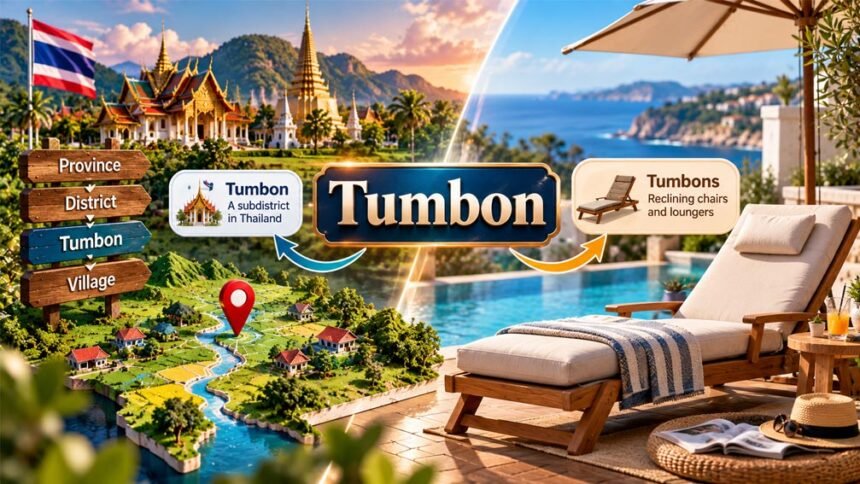
Tumbon is a word with more than one meaning. In Thailand, Tumbon is another spelling of Tambon, which means a subdistrict. Online, Tumbons is also sometimes used for outdoor loungers and reclining chairs.
The furniture meaning may come from the Spanish word tumbona, which means a lounger or reclining chair.
This guide explains what Tumbon means, its history in Thailand, its furniture use, and other important facts.
What Does Tumbon Mean?
Tumbon can have different meanings depending on where the word is used.
In Thailand, Tumbon is another spelling of Tambon. A tambon is a subdistrict. It normally contains several villages.
The word is also used on some websites for furniture. In this case, Tumbons may mean sun loungers, reclining chairs, beach chairs, or similar seats used for relaxing.
However, Tumbon is not a standard English name for one type of furniture. Different websites may use it for different kinds of chairs.
The word also has a possible Spanish connection. The Spanish word tumbona means a lounger or reclining chair.
The context usually makes the meaning clear. If Tumbon appears in a Thai address, it probably means a subdistrict. If it appears in a furniture listing, it may mean a reclining chair or lounger.
Tumbon vs. Tambon: Which Spelling Is Correct?
Tumbon and Tambon can mean the same thing when talking about Thailand. However, Tambon is the preferred English spelling.
Tambon follows Thailand’s standard system for writing Thai words in English letters. This system is called the Royal Thai General System of Transcription (RTGS).
Thai government information, maps, research, and formal documents normally use Tambon.
Tumbon is an alternative spelling. It may appear in older writing, travel articles, informal content, or other online sources.
The two spellings do not normally describe different administrative areas.
For official information or formal writing, Tambon is the better spelling to use.
What Is a Tumbon in Thailand?
A Tumbon, or more correctly Tambon, is a subdistrict in Thailand.
Thailand’s basic administrative structure can be shown like this:
Province → District → Tambon → Village
A province is called a changwat. Provinces contain districts called amphoe. Districts contain tambons, and tambons normally contain several villages called muban.
This means a tambon is larger than a village but smaller than a district.
Tambons are important because local services and community projects can be managed close to the people who use them.
Bangkok is different. It has its own administrative system and uses khwaeng instead of tambon.
How Many Tambons Are There in Thailand?
The information collected for this article reports 7,255 tambons across Thailand’s 76 provinces.
Bangkok is not included in this number because it uses khwaeng instead of tambons.
Tambons can be very different in size and population. A rural tambon may cover a large area but have fewer people. A tambon near a city may be smaller but have many more residents.
The collected information also reports close to 75,000 villages across Thailand.
There is no fixed number of villages in every tambon. The number depends on the location, population, and size of the area.
History of the Tambon System
Thailand’s tambon system developed during major government reforms more than 100 years ago.
Important changes began in the 1890s. Prince Damrong Rajanubhab, who served as Minister of the Interior, played an important role in these reforms.
The changes helped create a clearer system of districts, subdistricts, and villages.
For many years, local government was closely controlled by higher levels of government. Later, Thailand started giving local authorities more responsibility.
An important change came in 1994 with the Tambon Council and Tambon Administrative Authority Act. It helped give local organizations more responsibility for budgets and local decisions.
Thailand continued to develop local government after this.
Today, the system is more complex. Some areas have Tambon Administrative Organizations, while others are covered by municipalities or special local systems.
How Are Tambons Governed?
Many tambon areas are served by a Tambon Administrative Organization (TAO). In Thai, this type of organization is often called OrBorTor.
A TAO is a local government body. It can manage local budgets, plan projects, provide services, and support community development.
Elected local officials can take part in decisions about roads, services, infrastructure, budgets, and other local needs.
Thailand also has a traditional local position called kamnan, or subdistrict headman. This person has an important role in connecting local communities with the wider administrative system.
However, not every tambon is governed in exactly the same way. Some areas are part of municipalities. Bangkok and Pattaya also have special administrative systems.
What Services Are Provided at the Tambon Level?
Local authorities in tambon areas can provide or support many everyday services.
They may work on local roads, drainage, small bridges, and other basic infrastructure.
Water is also important, especially in farming areas. Local projects may support water supply and irrigation.
Local authorities may also help with waste collection, sanitation, public health programs, and community cleanliness.
They can support schools and community activities. Local festivals, cultural events, community centers, and development projects may also receive support.
Some areas may help local markets, tourism, small businesses, handicrafts, and community products.
The exact services are not the same everywhere. They depend on the local authority, its budget, and the needs of the area.
Tambons, Municipalities, Bangkok, and Pattaya
Not every area in Thailand uses the same local government system.
Some growing or urban areas are governed by municipalities. A municipality is called thesaban in Thai.
It is also important to understand the difference between a tambon and a TAO. A tambon is an administrative area, while a TAO is a local government organization.
Some municipal areas may cover parts of one or more tambons.
Bangkok is different from the normal provincial system. It uses khwaeng instead of tambons.
Pattaya also has its own special form of local government.
This means the local authority responsible for an area can depend on where the tambon is located.
Why Tumbon Matters in Thai Addresses
Knowing what Tumbon or Tambon means can help when reading Thai addresses.
Outside Bangkok, an address may include a village, tambon, district, province, and postal code.
The tambon name helps identify the correct location. This can be useful when sending mail, receiving deliveries, booking hotels, finding government offices, or filling out forms.
Travelers may also see tambon on maps, road signs, hotel addresses, and local documents.
Knowing that Tambon means subdistrict makes these addresses easier to understand.
What Does Tumbon Mean in Furniture?
Tumbon has another meaning on some furniture and lifestyle websites.
Some websites use Tumbon or Tumbons for chairs made for reclining and relaxing.
These may include sun loungers, folding chairs, beach chairs, garden loungers, and poolside sunbeds.
These chairs usually allow a person to lean back. Some also support the legs or allow the body to lie almost flat.
However, Tumbon is not a standard English furniture term. Different sellers may use the word for different types of loungers.
Because of this, buyers should check the product photos, size, materials, reclining positions, and other details instead of depending only on the name.
Spanish Connection: Tumbon, Tumbón, and Tumbona
The furniture meaning of Tumbon may have a connection with Spanish.
In Spanish, tumbona means a reclining chair or lounger. It can describe a chair used at a beach, pool, patio, or other place for relaxing.
The word is related to the Spanish verb tumbar. Depending on the situation, tumbar can mean to put something down, knock something over, or lie down.
Tumbón, with an accent, is a related Spanish word. However, it is not simply another spelling of tumbona. It can have other meanings, including a person who is lazy or likes to lie around.
The correct Spanish plural of tumbona is tumbonas.
Therefore, “Tumbons” should not be presented as the normal Spanish word for several loungers. Its use for furniture appears to be informal.
Common Types of Furniture Tumbons
Tumbon is not one specific type of chair. The word may be used online for several kinds of reclining furniture.
Folding Loungers
Folding loungers are easy to move and store. Many have a lightweight metal frame with a fabric or mesh seat.
They can be useful on patios, balconies, beaches, and camping trips. They can usually be folded when they are not being used.
Sun Loungers
Sun loungers are longer than normal chairs. They support more of the body and allow the user to stretch out.
Many have an adjustable backrest. They are often used beside pools, in gardens, or on decks.
Zero-Gravity Chairs
Zero-gravity chairs have a special reclining frame. When the back moves down, the legs move upward.
The seat, back, and leg support work together to create a supported reclining position.
Padded Recliners
Padded recliners have cushions or soft seat material. Some also include armrests, head support, or a small pillow.
The cushions need more care outdoors. They should be protected from rain and stored in a dry place when needed.
Chaise-Style Loungers
A chaise-style lounger has a long seat that supports the legs.
Some are designed for outdoor areas, while others are used in bedrooms, hotels, sunrooms, or reading areas.
They can take up more space than normal chairs, so measuring the area before buying is important.
Common Features of Reclining Loungers
Many reclining loungers have an adjustable backrest. This allows the user to sit upright, lean back, or rest in a lower position.
Some models also support the legs or have a separate footrest.
Portable loungers may have folding frames, making them easier to carry and store.
Other possible features include armrests, head pillows, mesh seats, cushions, wheels, side trays, cup holders, and sun shades.
Not every chair has these features.
The reclining system should be easy to use and should lock safely in place.
Materials Used in Outdoor Tumbons
Outdoor loungers need materials that can handle sun, heat, moisture, dust, and regular use.
Aluminium
Aluminium is lightweight and easy to move. It also does not rust in the same way as normal steel.
The strength of the chair still depends on the quality and design of its frame.
Powder-Coated Steel
Steel is strong and can make a chair feel solid.
Outdoor steel is often covered with a protective coating. If this coating becomes badly damaged, the exposed metal may start to corrode.
Wood
Wood gives outdoor furniture a natural look.
Wooden loungers may need cleaning, sealing, oiling, or other care to protect them from water, sunlight, cracking, and fading.
Plastic and Synthetic Wicker
Plastic furniture is often lightweight and easy to clean.
Synthetic wicker can give a chair a woven look while being more suitable for outdoor use than many natural materials.
Mesh and Cushions
Mesh allows air to pass through and can dry quickly. This makes it useful in warm weather and around pools.
Cushions are softer but need more care. Wet cushions should be fully dried before storage.
How to Choose the Right Tumbon Lounger
First, decide where you will use the chair.
A lightweight folding chair may be useful for beaches or camping. A larger lounger may be better for a garden, patio, or pool.
Measure the space before buying. Remember that the chair may need more room when fully reclined.
Check the seat width, depth, back height, head support, and leg support. If possible, try the different reclining positions before buying.
Also check the weight limit, frame, hinges, joints, and locking system.
For outdoor use, choose materials that suit your local weather.
If you have limited storage space, check the chair’s folded size too.
Best Places to Use Reclining Tumbons
Reclining loungers can be used in gardens, patios, terraces, and pool areas.
Light folding models can also be useful at beaches and campsites.
A balcony may have enough room for a lounger, but the chair needs space to open and recline safely.
Some models can also be used indoors. They may fit in bedrooms, sunrooms, studios, or reading areas.
Shade can make an outdoor lounger more comfortable in hot weather. An umbrella, tree, pergola, or covered patio can provide protection from direct sunlight.
Always leave enough space around the chair for people to walk safely.
Tumbons and Mediterranean Outdoor Design
Reclining loungers can work well in Mediterranean-style outdoor areas.
These spaces often include stone, tiles, wood, plants, simple furniture, and shaded areas.
A wooden or woven lounger can fit well on a patio or terrace. Metal loungers can also work with simple tables, plants, and outdoor lights.
Umbrellas and pergolas can provide useful shade.
A small side table can also hold a drink, book, or other small items.
However, Tumbon is not an official type of Mediterranean furniture. This connection is mainly about using reclining loungers in relaxed outdoor spaces.
Tumbons and the Slow-Living Idea
Some online articles connect Tumbons with slow living.
The idea is simple. A comfortable reclining chair can provide a place to take a break.
People may use it for reading, listening to music, drinking tea, or sitting quietly.
A comfortable place to sit can make it easier to spend some time away from normal tasks.
However, slow living is not an official meaning of Tumbon. It is simply a lifestyle idea that some websites connect with reclining loungers.
How to Clean and Care for Outdoor Tumbons
Regular cleaning can help an outdoor lounger last longer.
Dust, sand, pollen, sunscreen, food, and drinks can collect on the chair.
Many metal and plastic surfaces can be cleaned with mild soap and water. Always check the manufacturer’s cleaning instructions first.
Fabric and cushions may need different cleaning methods. Some covers can be washed, while others need gentle hand cleaning.
Let wet cushions and fabric dry fully before storing them. Wet material can develop stains, bad smells, or mold.
Check screws, hinges, joints, and reclining locks regularly. Loose parts may need tightening.
During severe weather, it may be better to cover the chair or store it in a dry place. Cushions should usually be kept dry when possible.
Safety Tips for Reclining Tumbons
Always place a reclining chair on flat and stable ground.
Make sure the reclining lock is properly secured before sitting down.
Keep your fingers away from folding joints and hinges when opening or closing the chair.
Children should not play with the moving parts of a folding or reclining chair.
Follow the manufacturer’s weight limit. Do not stand or jump on the chair unless it is designed for that use.
Stop using the chair if the frame is cracked, badly bent, unstable, or unable to lock correctly.
Metal parts can also become very hot in direct sunlight. Check them before sitting down or touching them.
Tumbons vs. Sunbeds and Reclining Chairs
These furniture terms can sometimes describe similar products.
A sunbed is usually a long outdoor seat that allows a person to stretch out or lie almost flat. Sunbeds are common beside pools and on beaches.
A reclining chair normally starts in a more upright position. Its back can move backward, but it may not support the whole body.
A lounger is a general term for furniture made for relaxed sitting or lying down.
Tumbon is less clear. When used for furniture, it appears to be an informal term rather than a fixed furniture type.
When buying one, check its size, recline angle, leg support, materials, weight limit, and folding design instead of relying only on the name.
Are Furniture Tumbons Worth Buying?
A reclining lounger can be useful if you want a comfortable chair for a garden, patio, balcony, pool, beach, or indoor rest area.
Whether it is worth buying depends on the actual chair.
A good model should feel stable and comfortable. Its reclining system should also work smoothly and lock safely.
If you move the chair often, a lightweight folding model may be easier to use.
If the chair will stay in one place, a larger and heavier model may be suitable.
Also think about storage and cleaning. Cushioned chairs may be comfortable but usually need more protection from rain.
The word Tumbon does not tell you whether a chair is good or bad. Check its quality, materials, comfort, size, and safety before buying.
Bottom Line
Tumbon has two main meanings in the information collected for this guide.
In Thailand, Tumbon is another spelling of Tambon, which means a subdistrict. Tambon is the preferred English spelling.
In some online furniture content, Tumbon or Tumbons is used for reclining chairs and loungers. This use may be connected with the Spanish word tumbona, meaning a reclining chair or lounger.
The furniture meaning is not a fixed English term. Different websites may use it for different types of chairs.
Context helps you understand the meaning. In a Thai address, Tumbon probably means a subdistrict. In furniture content, it may mean a reclining chair or lounger.
Frequently Asked Questions
What does Tumbon mean?
Tumbon can mean a subdistrict in Thailand. It may also refer to a reclining chair or lounger online.
Is Tumbon the same as Tambon?
Yes. Both can mean a Thai subdistrict, but Tambon is the preferred spelling.
What is a Tambon in Thailand?
A Tambon is a Thai subdistrict. It is below a district and usually includes several villages.
Is Tumbon a type of chair?
Sometimes. Some websites use Tumbon for loungers and reclining chairs, but it is not a standard furniture term.
What does Tumbona mean in Spanish?
Tumbona means a reclining chair or lounger in Spanish. Its plural is tumbonas.
Are Tumbons and sun loungers the same?
They can mean similar types of chairs online, but the word Tumbon is used in different ways.
What should I check before buying a Tumbon lounger?
Check its size, materials, comfort, weight limit, reclining positions, and weather resistance.
Are outdoor Tumbons safe?
Yes, if used correctly. Place the chair on flat ground, lock it properly, and follow its weight limit.
More To Explore:
SimplifyDiggs.com Review: Content, Safety, Benefits, and Limitations