HCOOCH CH2 H2O is an unclear chemical expression that may refer to methyl formate reacting with water. The expression is not a standard formula for one clearly identified compound.
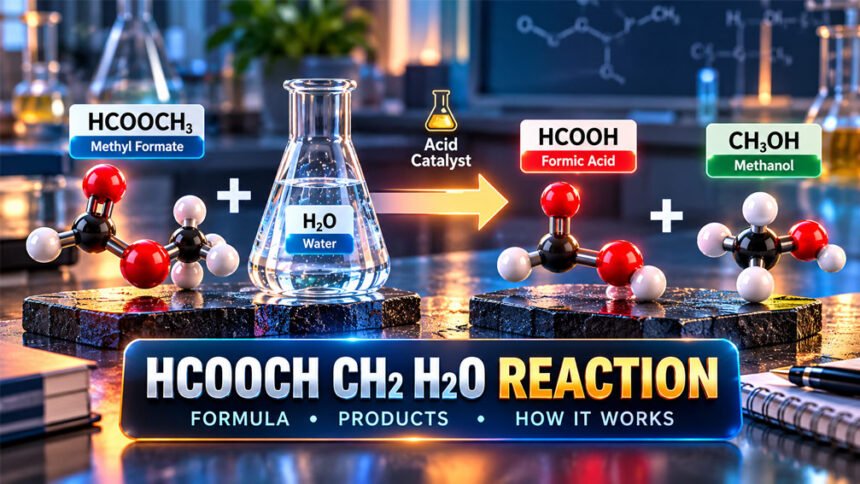
Methyl formate has the correct formula HCOOCH₃. When it reacts with water under suitable conditions, it can form formic acid and methanol. This process is called ester hydrolysis.
This article explains the meaning of the expression, the correct chemical formulas, the reaction products, and how the reaction works.
What Does HCOOCH CH2 H2O Mean?
The expression HCOOCH CH2 H2O is not written in a standard way that clearly identifies one chemical compound. It appears to combine parts of different chemical formulas.
The H₂O part is easy to identify. It is the chemical formula for water. However, the meaning of HCOOCH and CH₂ is unclear without more information about their bonds and arrangement.
The expression may be related to methyl formate and its reaction with water. Methyl formate is an ester that can undergo hydrolysis to form an acid and an alcohol.
However, this is only a possible interpretation. The expression alone does not prove that methyl formate hydrolysis is the intended reaction.
Understanding the correct formulas is important because a small change in a chemical formula can represent a different group of atoms or a different substance.
Is HCOOCH CH2 H2O a Real Compound?
There is not enough information to identify HCOOCH CH2 H2O as one specific compound. It may be an incomplete formula, a typing error, or an incorrectly written chemical reaction.
A chemical formula shows the types and numbers of atoms in a substance. A structural formula also shows how those atoms are connected. Without clear bonding information, the meaning of an expression can remain uncertain.
For example, writing two formulas next to each other does not automatically mean they form one compound. A plus sign normally shows separate reactants, while an arrow shows the direction of a chemical reaction.
If the intended topic is methyl formate reacting with water, the clearer way to write the reaction is:
HCOOCH₃ + H₂O ⇌ HCOOH + CH₃OH
This equation identifies the reactants, products, and reversible nature of the reaction.
Correct Formula: Methyl Formate HCOOCH₃
Methyl formate is an organic compound belonging to a group called esters. It is also known as methyl methanoate or formic acid methyl ester.
Its correct condensed formula is HCOOCH₃. Its molecular formula is C₂H₄O₂, and its molar mass is approximately 60.05 g/mol.
Its structure can be written as:
H–C(=O)–O–CH₃
This structure contains a carbon atom connected to a hydrogen atom, a double-bonded oxygen atom, and another oxygen atom. The second oxygen connects the carbonyl carbon to a CH₃ group.
The –C(=O)–O– arrangement is the key part of its ester structure. This arrangement allows methyl formate to take part in reactions such as hydrolysis.
Methyl formate is the methyl ester of formic acid. During hydrolysis, the ester can react with water and form formic acid and methanol.
What Does CH2 Mean?
CH₂ represents one carbon atom and two hydrogen atoms. Its exact meaning depends on how it appears in a chemical structure.
It is important not to treat CH₂ and CH₃ as the same group. Methyl formate contains a CH₃ group, not a separate CH₂ reactant.
CH₂ as a Methylene Group
In organic chemistry, –CH₂– commonly represents a methylene group. It usually forms part of a larger molecule and is connected to other atoms or groups.
For example, ethanol has the structure CH₃–CH₂–OH. The CH₂ group is part of the carbon chain between the CH₃ group and the OH group.
In this example, CH₂ is not a separate substance. It is one part of the complete molecular structure.
This matters when reading HCOOCH CH2 H2O because the CH₂ part may have been copied from another formula or placed in the wrong position.
CH₂ as Methylene Carbene
In a different chemical context, CH₂ can represent methylene carbene, a highly reactive chemical species.
A carbene has a carbon atom with two bonds and unusual electron arrangements. It is different from an ordinary methylene group inside a stable organic molecule.
There is no evidence in the expression HCOOCH CH2 H2O alone that methylene carbene is involved in the methyl formate hydrolysis reaction.
CH₂ as an Incomplete Formula
CH₂ may also appear because a longer chemical formula was shortened or copied incorrectly.
Without the original structure, it is not possible to determine whether CH₂ represents a group within a molecule, a separate chemical species, or a typing mistake.
For the standard hydrolysis of methyl formate, no separate CH₂ reactant is needed.
HCOOCH vs HCOOCH₃
HCOOCH and HCOOCH₃ should not be treated as identical formulas.
The correct condensed formula for methyl formate is HCOOCH₃. The final subscript 3 shows that the methyl group contains three hydrogen atoms.
CH₂ contains two hydrogen atoms, while CH₃ contains three. Changing the number of hydrogen atoms changes the chemical composition.
The expression HCOOCH, without further structural information, does not clearly show the complete structure of methyl formate.
When discussing methyl formate and its reaction with water, use HCOOCH₃ + H₂O. This makes the intended chemistry clear and avoids confusion with unrelated compounds or incomplete formulas.
HCOOCH₃ + H₂O Reaction
If the expression HCOOCH CH2 H2O refers to methyl formate reacting with water, the correct reaction is:
In simple words, methyl formate reacts with water to form formic acid (HCOOH) and methanol (CH₃OH). This process is called ester hydrolysis.
The double arrow means the reaction can happen in both directions under suitable conditions. An acid catalyst can help the forward reaction happen faster.
The equation contains no separate CH₂ reactant. Adding CH₂ to this equation would change the reaction and would require more information about the intended chemical substance.
Is the Reaction Balanced?
Yes. The methyl formate hydrolysis equation is balanced.
HCOOCH₃ + H₂O ⇌ HCOOH + CH₃OH
| Atom | Reactants | Products |
|---|---|---|
| Carbon (C) | 2 | 2 |
| Hydrogen (H) | 6 | 6 |
| Oxygen (O) | 3 | 3 |
Both sides contain the same number of each type of atom. This follows the law of conservation of matter, which means atoms are rearranged during a chemical reaction rather than created or destroyed.
Products of the HCOOCH₃ and H₂O Reaction
The two main products of methyl formate hydrolysis are formic acid and methanol.
Formic Acid (HCOOH)
Formic acid is a simple organic acid. Its formula is HCOOH.
During hydrolysis, the ester changes and forms the carboxylic acid. Formic acid contains the carboxyl group, written as –COOH.
It is different from methyl formate, even though the two substances contain similar atoms. Methyl formate is an ester, while formic acid is a carboxylic acid.
Methanol (CH₃OH)
Methanol is the simplest alcohol. Its chemical formula is CH₃OH.
During methyl formate hydrolysis, the part containing the methyl group becomes methanol through a series of reaction steps.
Methanol is a flammable and toxic liquid. It must not be tasted or handled without proper safety precautions.
How Methyl Formate Hydrolysis Works
Hydrolysis is a reaction in which water helps break a chemical bond. In methyl formate hydrolysis, the ester changes into formic acid and methanol.
Under acidic conditions, the reaction takes place through several steps. The acid helps make the ester more likely to react with water.
Step 1: Protonation
An acid provides hydrogen ions, written as H⁺. A hydrogen ion attaches to the carbonyl oxygen in methyl formate.
This makes the carbonyl carbon easier for water to attack.
Step 2: Water Attacks
A water molecule attacks the carbonyl carbon. This forms a temporary structure called a tetrahedral intermediate.
At this stage, the atoms are connected differently from how they were in the original ester.
Step 3: Proton Transfers
Hydrogen ions move between oxygen atoms during the next steps.
These changes help prepare the intermediate to release the alcohol-related part of the ester.
Step 4: The Carbonyl Group Forms Again
The intermediate changes, and the carbonyl bond forms again. The ester linkage breaks as the reaction continues.
The reaction then moves toward forming formic acid and methanol.
Step 5: The Catalyst Is Regenerated
The final proton-transfer step produces the neutral products under suitable conditions and restores the acid catalyst.
The catalyst helps the reaction happen faster but is not consumed overall.
Role of Water in the Reaction
Water is an important reactant in methyl formate hydrolysis. It is not simply a liquid used to dissolve the ester.
Water participates in the reaction steps that break the ester linkage and produce formic acid and methanol.
The amount of water can also affect the reaction balance. Under suitable conditions, using excess water can favor hydrolysis by shifting the equilibrium toward the products.
However, the final amounts of formic acid and methanol depend on the reaction conditions, including temperature, acidity, and the amounts of the substances present.
Role of the Acid Catalyst
An acid catalyst helps methyl formate react with water more quickly.
Hydrochloric acid and sulfuric acid are examples of acids that can provide H⁺ ions in suitable laboratory conditions. These ions activate the ester, making it easier for water to attack the carbonyl carbon.
The acid is regenerated during the reaction. This means it helps the process without being used up in the overall equation.
Acid catalysts can be corrosive, so this reaction should not be attempted without suitable laboratory equipment, training, and safety procedures.
Hydrolysis vs Esterification
Hydrolysis and esterification are related reactions that can proceed in opposite directions.
Hydrolysis:
Methyl formate reacts with water to form formic acid and methanol.
Esterification:
Formic acid reacts with methanol to form methyl formate and water under suitable conditions.
Both reactions can be affected by temperature, acidity, and the amounts of the reactants and products. The double arrow represents a reversible reaction, although the balance between the two directions depends on the conditions.
Acid Hydrolysis vs Base Hydrolysis
Methyl formate can react with water under acidic conditions or undergo hydrolysis under basic conditions. The products differ in how the acid portion is present.
Acidic Hydrolysis
Under acidic conditions, methyl formate can form formic acid and methanol.
The acid catalyst speeds up the reaction and is regenerated. The process is reversible, so the products can also react to form the ester under suitable conditions.
Base-Promoted Hydrolysis
Under basic conditions, hydroxide ions react with methyl formate. A simplified equation is:
The products are the formate ion and methanol.
The formate ion, HCOO⁻, is different from neutral formic acid, HCOOH. Adding acid under suitable conditions can convert formate into formic acid.
Methyl Formate vs Formic Acid
Methyl formate and formic acid are different chemicals.
| Property | Methyl Formate | Formic Acid |
|---|---|---|
| Formula | HCOOCH₃ | HCOOH |
| Chemical group | Ester | Carboxylic acid |
| Main structure | Contains an ester linkage | Contains a carboxyl group |
| Role in hydrolysis | Reactant | Product |
Methyl formate contains the ester linkage –C(=O)–O–. Formic acid contains the carboxyl group –COOH.
This difference explains why the two substances behave differently in chemical reactions.
Physical Properties of Methyl Formate
Methyl formate is a clear, colorless, volatile liquid. Its molar mass is about 60.05 g/mol, and it has a relatively low boiling point compared with many other organic liquids.
It can dissolve in water to a useful extent, but mixing with water does not mean hydrolysis will always happen quickly. The reaction rate depends on the conditions.
Methyl formate is also highly flammable. Its volatility means that its vapor can form a fire hazard near ignition sources.
These properties are important when storing, transporting, or using the chemical in a laboratory or industrial setting.
Methyl Formate and Water as Separate Components
Chemical databases may describe mixtures or records containing methyl formate and water together. This does not automatically mean that a new compound has formed.
For example, the notation COC=O.O uses a dot to separate two components. In this context, it represents methyl formate and water as separate substances.
The dot does not show a new covalent bond between them. To identify a chemical mixture or reaction correctly, readers must distinguish between separate components and atoms joined within one molecule.
Safety of Methyl Formate
Methyl formate is highly flammable and volatile. It requires proper handling and storage.
Important precautions include:
-
Keep it away from flames, sparks, and other ignition sources.
-
Use suitable ventilation and follow the chemical’s safety data sheet.
-
Wear appropriate protective equipment when handling it.
-
Store it in a suitable, properly labeled container.
-
Follow laboratory rules when using acids or other reaction chemicals.
Methanol, one of the reaction products, is toxic and flammable. Formic acid can also cause harm, depending on its concentration and exposure.
Do not attempt this reaction at home. Chemical handling should follow appropriate laboratory safety procedures.
Why Methyl Formate Hydrolysis Matters
Methyl formate hydrolysis is a useful example of a basic organic chemistry reaction.
The general pattern is:
Ester + water ⇌ carboxylic acid + alcohol
Learning this reaction helps explain how esters change when they react with water. Similar reactions are important in organic chemistry, biochemistry, industrial processes, and the breakdown of some materials.
Ester hydrolysis is also relevant to the chemistry of fats and oils, which contain ester bonds. However, the exact reactions and conditions can differ between substances.
Common Mistakes With HCOOCH CH2 H2O
Several mistakes can cause confusion when reading this chemical expression.
-
Treating it as one confirmed compound: The expression is unclear and needs more structural information.
-
Writing methyl formate incorrectly: Its correct condensed formula is HCOOCH₃.
-
Confusing CH₂ with CH₃: These groups contain different numbers of hydrogen atoms.
-
Adding CH₂ to the reaction without evidence: The standard methyl formate hydrolysis equation does not require a separate CH₂ reactant.
-
Confusing methyl formate with formic acid: One is an ester, and the other is an acid.
-
Ignoring the role of water: Water is a reactant in hydrolysis.
-
Forgetting the reversible nature of the reaction: Acid-catalyzed ester hydrolysis can proceed in both directions.
-
Treating the catalyst as a final product: The acid catalyst is regenerated during the overall process.
Using the correct formulas and reaction symbols helps avoid these errors.
HCOOCH CH2 H2O Reference Table
| Formula | Meaning |
|---|---|
| H₂O | Water |
| CH₂ | A methylene group or another context-dependent chemical species |
| CH₃ | A methyl group in an organic structure |
| HCOOCH₃ | Methyl formate |
| C₂H₄O₂ | Molecular formula of methyl formate |
| HCOOH | Formic acid |
| CH₃OH | Methanol |
| HCOO⁻ | Formate ion |
Bottom Line
HCOOCH CH2 H2O is not a standard chemical formula that clearly identifies one compound. It may be a search term related to methyl formate reacting with water, but the original meaning cannot be confirmed from the expression alone.
If methyl formate is intended, its correct formula is HCOOCH₃. Its hydrolysis reaction is:
HCOOCH₃ + H₂O ⇌ HCOOH + CH₃OH
The products are formic acid and methanol. No separate CH₂ reactant is needed for this standard reaction.
Correct chemical notation matters because changing a subscript or omitting a bond can change the meaning of a formula.
Frequently Asked Questions
What is HCOOCH CH2 H2O?
It is an unclear chemical expression that may refer to methyl formate reacting with water.
Is HCOOCH₃ methyl formate?
Yes. HCOOCH₃ is the formula for methyl formate.
What happens when HCOOCH₃ reacts with H₂O?
It can form formic acid and methanol through a process called hydrolysis.
What are the products of methyl formate hydrolysis?
The products are formic acid (HCOOH) and methanol (CH₃OH).
What does CH₂ mean?
CH₂ is a chemical group with one carbon atom and two hydrogen atoms. Its meaning depends on the chemical structure.
Is CH₂ needed for methyl formate hydrolysis?
No. The standard reaction uses methyl formate and water.
Is methyl formate the same as formic acid?
No. Methyl formate is an ester, while formic acid is an acid.
Is methyl formate dangerous?
Yes. It is highly flammable and should be handled with proper safety precautions.
More To Explore:
DADOS AS Review: Database Services, Cloud Solutions, and Company Details