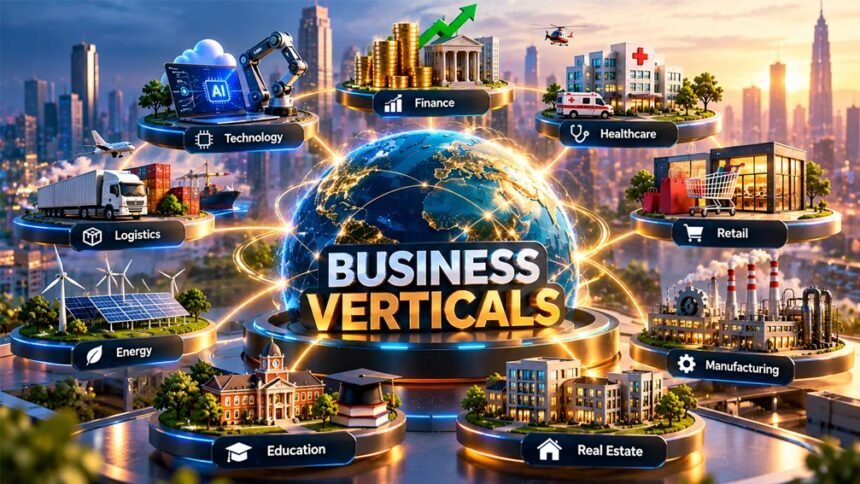
Business vertical classification categories help group companies based on what they do and the markets they serve.
For example, a company may belong to technology, healthcare, finance, retail, manufacturing, or education.
These categories are useful for sales, marketing, SEO, market research, investing, and business data. They make it easier to understand and compare different companies.
There is no single list of business verticals that everyone uses. The right category depends on the company and why it is being classified.
What Are Business Vertical Classification Categories?
Business vertical classification categories are groups used to organize businesses by their main work or market.
For example, healthcare is a broad category. It can include hospitals, clinics, pharmacies, medical device companies, and healthcare software businesses.
Technology is another broad category. It can include software, cloud services, cybersecurity, artificial intelligence, and IT services.
A more specific vertical gives a clearer idea of what a company does. Instead of simply calling a company a technology business, we could describe it as a cybersecurity software company.
There is no universal list of verticals. A government agency, investor, marketing company, or business database may classify the same company differently.
A business vertical is also different from a legal structure. Terms such as corporation, partnership, and sole proprietorship explain how a company is legally set up, not the market it serves.
Sector vs. Industry vs. Vertical vs. Niche
These terms are related, but they usually describe different levels of a market.
A sector is a broad business area, such as technology or healthcare.
An industry is more specific. Software, for example, can be part of the technology sector.
A vertical focuses on a smaller market. Cybersecurity software can be considered a vertical within software.
A sub-vertical is even more specific. Identity management can be part of cybersecurity.
A niche or micro-vertical is a very specific market.
For example:
Technology → Software → Cybersecurity → Identity Management → Identity tools for small banks
These terms are not used in exactly the same way everywhere. Some businesses may use “industry” and “vertical” to mean similar things.
The important point is to choose clear categories and use them in the same way across your data.
How Business Vertical Classification Works
Classification normally starts by looking at what a company actually does.
First, check its main products or services. For example, a company selling accounting software clearly belongs somewhere within the software market.
Next, look at its customers. Software made only for hospitals may also have a strong connection to healthcare.
Revenue can also help. If a company has several business activities, its main source of revenue may help identify its primary vertical.
Looking at close competitors can also be useful. Businesses that sell similar products and serve similar customers often belong to related verticals.
Classification usually moves from a broad category to a more specific one.
For example:
Technology → Software → Business Software → Accounting Software
The level of detail depends on the purpose. A simple marketing database may only need a broad category. Detailed research may need a much more specific one.
It is better to use a broad but correct category than to choose a very specific category without enough evidence.
Main Business Vertical Categories
There is no official list that includes every business vertical. However, some categories are commonly used.
Technology and Software
Technology includes companies that develop or provide technology products and services.
Examples include software, SaaS, cloud computing, cybersecurity, artificial intelligence, data analytics, IT services, hardware, and mobile applications.
Technology can also overlap with other industries. For example, financial software can belong to both technology and finance.
Healthcare and Life Sciences
Healthcare includes businesses related to medical care and health services.
Examples include hospitals, clinics, pharmacies, laboratories, pharmaceutical companies, biotechnology businesses, medical device companies, telemedicine services, and healthcare software.
More specific categories can include HealthTech, digital health, biotechnology, and medical technology.
Financial Services
Financial services include companies that deal with money, payments, lending, investing, insurance, and other financial activities.
Common examples include banks, insurance companies, payment services, lenders, investment companies, and wealth management businesses.
FinTech combines finance with technology. Digital payment platforms and financial applications are common examples.
Retail and E-Commerce
Retail businesses sell products to customers.
They may sell through physical stores, websites, apps, or online marketplaces.
Common areas include clothing, electronics, grocery, beauty, home products, and specialty retail.
E-commerce mainly focuses on online buying and selling. Many modern retailers now use both physical and online stores.
Manufacturing
Manufacturing businesses make products from materials, parts, or components.
Examples include automotive, electronics, machinery, chemicals, textiles, food products, packaging, and industrial equipment.
Using a more specific category is often helpful because a car-parts manufacturer is very different from a food manufacturer.
Professional and Business Services
These businesses provide professional knowledge or support.
Examples include accounting, legal services, consulting, marketing, advertising, recruitment, architecture, engineering, and outsourcing.
More specific categories make it easier to find and compare similar companies.
Real Estate and Construction
Real estate businesses work with property.
They can include property sales, rentals, property management, development, and investment.
Construction includes home building, commercial construction, infrastructure, contractors, and engineering work.
PropTech combines property services with technology. Property management software is one example.
Education
Education includes businesses and organizations that provide learning and training.
Examples include schools, colleges, universities, tutoring services, training companies, online courses, and certification providers.
EdTech combines education with technology. Examples include online learning platforms and learning management systems.
Transportation and Logistics
Transportation and logistics businesses help move people or goods.
Examples include trucking, shipping, freight, aviation, warehousing, courier services, fulfillment, and delivery.
A trucking company and logistics software company may both be connected to logistics, but they perform very different jobs.
Hospitality and Tourism
Hospitality and tourism include businesses related to travel, accommodation, food services, and tourism.
Examples include hotels, resorts, restaurants, vacation rentals, travel agencies, and tour companies.
Technology businesses can also serve this industry through booking systems, hotel software, and restaurant management tools.
Telecommunications
Telecommunications includes businesses that provide communication and connectivity services.
Examples include mobile networks, internet providers, broadband services, satellite communication, and network infrastructure.
Energy, Utilities, and Climate Technology
This category includes businesses related to energy production, distribution, and utility services.
Examples include electricity, oil and gas, solar energy, wind energy, energy storage, and renewable energy.
Climate technology can overlap with energy, manufacturing, agriculture, and transportation.
Media and Entertainment
Media and entertainment include businesses that create or distribute content.
Examples include publishing, television, movies, music, streaming, gaming, podcasts, and digital media.
Different businesses in this category may use very different ways to make money.
Agriculture and Food
Agriculture includes farming, crops, livestock, agricultural equipment, and related services.
The wider food industry includes food production, processing, distribution, and food services.
AgriTech uses technology to support agriculture. Examples include farm software, sensors, and precision farming tools.
Emerging and Hybrid Business Verticals
Some newer businesses do not fit into only one traditional industry.
This has created hybrid verticals.
FinTech combines finance and technology.
HealthTech combines healthcare and technology.
EdTech combines education and technology.
PropTech combines property and technology.
AgriTech combines agriculture and technology.
Other growing areas include artificial intelligence, cybersecurity, climate technology, digital health, and specialized data services.
A company can also fit into several of these areas. For example, an AI tool for medical diagnosis can relate to AI, software, healthcare, and medical technology.
Very specific markets are sometimes called micro-verticals.
For example, dental practice software is more specific than general healthcare software.
However, companies should not create a new category for every small product difference. Categories are most useful when they describe a clear market.
Formal Business Classification Systems
Formal classification systems are different from normal marketing or sales verticals.
They use official rules and codes to classify economic activities or companies.
Important systems include NAICS, SIC, and GICS.
NAICS
NAICS stands for North American Industry Classification System.
It was introduced in 1997 and replaced SIC as the main system used by U.S. federal statistical agencies for industry statistics.
It is used across the United States, Canada, and Mexico, with country-specific details where needed.
NAICS groups establishments based on their economic activities. It starts with broad sectors and moves into more detailed industries.
If a form asks for a NAICS code, businesses should use the correct NAICS classification rather than a normal marketing vertical.
SIC
SIC stands for Standard Industrial Classification.
It is an older classification system. It was widely used in the United States before NAICS.
NAICS replaced SIC for U.S. federal statistical purposes, but SIC codes are still found in some business databases, financial records, and regulatory uses.
Because of this, you may still see both SIC and NAICS codes when researching businesses.
GICS
GICS stands for Global Industry Classification Standard.
It was developed by MSCI and S&P Dow Jones Indices. It is mainly used for investment and financial market analysis.
Its main structure is:
Sector → Industry Group → Industry → Sub-Industry
GICS helps investors and analysts compare companies in related areas.
GICS and NAICS have different purposes. NAICS is mainly connected with economic statistics, while GICS is mainly designed for investment analysis.
Other National and Regional Systems
Countries may also have their own classification systems.
India, for example, uses the National Industrial Classification (NIC) to classify economic activities for statistical purposes.
This means international companies may have different classifications in different systems.
For official forms, government reporting, or statistics, always use the classification system requested by the organization.
Other Ways to Classify a Business
A vertical does not explain everything about a business.
Companies can also be grouped by customers, business model, size, location, and products.
Customer Type
Businesses are often described as B2B or B2C.
B2B means a company mainly sells to other businesses.
B2C means a company mainly sells directly to consumers.
Some companies serve both.
B2B and B2C describe customers. They are not business verticals by themselves.
Business Model
A business model explains how a company provides its product or service and makes money.
Examples include subscriptions, direct sales, licensing, commissions, marketplaces, advertising, and professional services.
SaaS is another common term. It usually describes software provided as an online service, often through a subscription or usage-based model.
A SaaS company can operate in healthcare, finance, education, retail, or many other verticals.
Company Size
Companies can also be grouped by size.
Common groups include small businesses, mid-sized companies, large enterprises, and multinational companies.
Size may be measured by employees, revenue, assets, locations, or other factors.
Company size is separate from its vertical.
Geography
Businesses may operate locally, regionally, nationally, or internationally.
They can also be grouped by country, state, city, or service area.
Geography should normally be stored separately from the business vertical.
Product and Customer Industry
What a company sells and who it sells to can be different.
For example, a company may sell appointment software to dental clinics.
Its product is software. Its customers are in healthcare. Its specific market could be described as dental practice software.
Using both pieces of information gives a clearer description of the company.
Can a Business Belong to More Than One Vertical?
Yes. A business can belong to several verticals.
For example, a medical software company can be connected with both technology and healthcare.
A payment software company can be connected with technology and financial services.
A useful approach is to choose one primary vertical and then add secondary verticals when needed.
The primary vertical may be based on the company’s main activity, product, customers, or main source of revenue.
Large companies can be harder to classify because they may operate in many industries. In these cases, different subsidiaries or business divisions can be classified separately.
The right approach depends on why the company is being classified.
Why Business Vertical Classification Matters
Business vertical classification helps companies organize and understand business information.
It can be useful for sales, marketing, SEO, research, business intelligence, and investing.
Sales and Lead Generation
Sales teams can use verticals to find more relevant potential customers.
For example, a company selling hospital software can focus on healthcare organizations instead of contacting businesses from every industry.
Verticals can also be combined with company size, location, and customer type for more focused targeting.
Marketing
Different industries have different needs and problems.
A software company may therefore use different marketing messages for healthcare companies and manufacturers.
It can create industry-specific landing pages, case studies, examples, and content.
SEO and Content Strategy
Business verticals can help companies plan SEO content.
A company can research the questions and search terms that matter to each market.
For example, a software company may create useful content about healthcare software, financial software, or construction software if it actually serves those industries.
Market and Competitor Research
Classification helps businesses find more relevant competitors.
Instead of comparing every company in a broad sector, researchers can focus on businesses with similar products and customers.
This can also help with market research, market sizing, and trend analysis.
CRM and Business Intelligence
CRM systems can become messy when people use different names for the same industry.
One person may enter “finance,” another may enter “banking,” and another may use “financial services.”
Using standard categories helps keep business data more consistent.
Companies can then analyze sales, customers, revenue, and other information by vertical.
Investment and Financial Analysis
Investors use classifications to compare similar companies.
They can also use them to understand which industries a company or investment portfolio is exposed to.
Formal systems such as GICS are commonly used for this type of financial analysis.
How to Choose the Right Business Vertical
Start by looking at what the company actually does.
Check its main products and services. Then look at who buys them and what problem the company solves.
If the company has several activities, its main source of revenue can help identify its primary vertical.
Looking at close competitors can also help. Businesses serving the same customers with similar products often belong to related markets.
Choose the amount of detail you actually need.
For example, “technology” may be enough for a simple database. A sales team may need a more specific category such as “cybersecurity software.”
If you are filling out an official form, use the classification system requested by that organization.
Do not choose a very specific category when there is not enough information to support it.
Common Business Classification Mistakes
One common mistake is using categories that are too broad.
For example, calling a company simply “technology” does not explain whether it provides software, hardware, cybersecurity, AI, or IT services.
Categories can also become too specific. Creating a new vertical for every small difference makes the system difficult to manage.
Another mistake is mixing different types of information.
B2B and B2C describe customers. Subscription describes a business model. Corporation and partnership describe legal structures. These are not the same as business verticals.
Companies should also use the same classification rules for everyone. If one company is classified by its product and another by its customers, the data can become confusing.
Categories should also be updated when companies change their products, customers, or markets.
AI and Automated Business Classification
AI can help classify large numbers of businesses.
It can study company websites, product descriptions, service pages, business directories, public documents, and other available information.
The system can then suggest a suitable category.
This can save time, but AI can also make mistakes.
A company may have an unclear website or operate in several industries. An AI system may also confuse what a company sells with the industry it serves.
Confidence scores can help show how certain an automated system is about a category.
Low-confidence results can be checked by a person before they are accepted.
Human review is still important when accurate classification matters for financial, legal, regulatory, or major business decisions.
Best Practices for Business Vertical Classification
Use clear and simple category names.
Each important category should have a clear definition. Examples can also help people understand what belongs in that category.
Use the same hierarchy throughout the system.
Keep customer type, geography, company size, and business model separate from the main vertical when possible.
Avoid creating too many categories.
When a business is difficult to classify, check reliable information instead of guessing.
Classification systems should also be reviewed regularly. Companies and markets change over time, so old categories may need to be updated, combined, or removed.
The goal is not to have the largest number of categories. The goal is to have categories that are useful and accurate.
Future of Business Vertical Classification
Business classification is becoming more flexible.
Companies increasingly operate across several industries, especially as technology becomes part of healthcare, finance, education, real estate, agriculture, and other markets.
AI may also make automatic classification faster and more common.
Instead of giving every company only one label, business databases can store several details. These may include the main industry, products, customers, business model, location, and secondary verticals.
Micro-verticals may also become more useful as companies target smaller markets.
However, classification systems should remain simple enough to understand and manage.
Bottom Line
Business vertical classification categories help explain what companies do and which markets they serve.
Common verticals include technology, healthcare, finance, retail, manufacturing, education, real estate, logistics, hospitality, telecommunications, energy, media, and agriculture.
There is no single universal list.
The best category depends on the company’s main activities and why the classification is needed.
It is also important to understand the difference between sectors, industries, verticals, niches, customer types, and business models.
Formal systems such as NAICS, SIC, and GICS may be needed for specific official, statistical, or financial purposes.
A useful classification system should be simple, clear, consistent, and updated when businesses and markets change.
Frequently Asked Questions
What are business vertical classification categories?
They are groups that organize businesses by what they do. Examples include technology, healthcare, finance, and retail.
What are the main types of business verticals?
Common types include technology, healthcare, finance, retail, education, real estate, manufacturing, and logistics.
What is the difference between a sector, industry, and vertical?
A sector is a broad business area. An industry and vertical are usually more specific groups within that area.
Can a business belong to multiple verticals?
Yes. For example, a healthcare software company can fit into both healthcare and technology.
What is a micro-vertical?
A micro-vertical is a very small and specific business market. Dental software is one example within healthcare technology.
What are NAICS, SIC, and GICS?
They are systems used to group businesses into industries. They are used for statistics, business records, and financial research.
How do I choose the right business vertical?
Look at what the company sells, who its customers are, and what its main business activity is.
Why are business verticals important for marketing and sales?
They help companies find the right customers. They also make marketing and sales more focused.
More To Explore:
Gamer Challenger: Complete Guide to Improving Your Gaming Skills