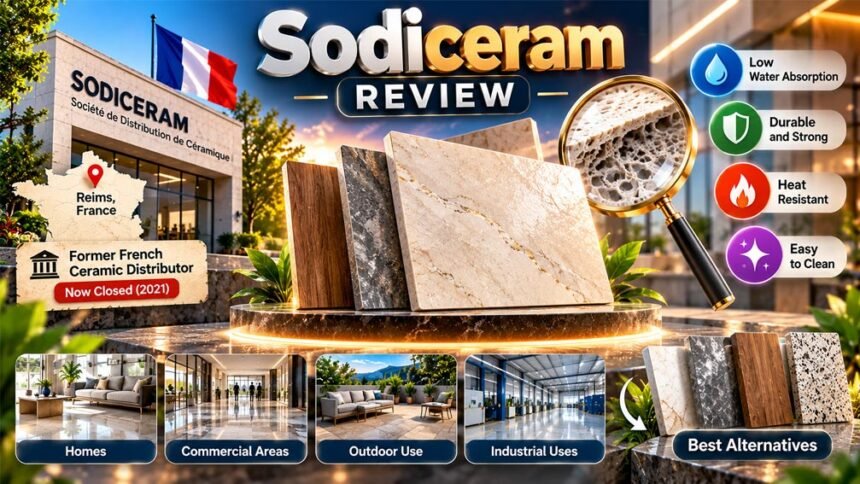
Sodiceram is a name linked with ceramics, but its meaning is not fully clear. It was the name of a former French ceramic company. Some newer websites also describe Sodiceram as a special ceramic material made with sodium compounds.
These two things may not be connected. The French company has some business records, but many claims about the newer ceramic material are not well proven.
This article explains what Sodiceram is, its company history, material claims, possible uses, benefits, drawbacks, and alternatives.
What Is Sodiceram?
Sodiceram has two different meanings online.
The first is a former French ceramic business. Its full name was Société de Distribution de Céramique. It worked as a distributor and seller of ceramic tiles and related building materials.
The second meaning is less clear. Some websites describe Sodiceram as a new ceramic material that contains sodium compounds. They say it may be dense, strong, durable, and resistant to water.
However, Sodiceram is not clearly recognized as a standard ceramic material. There is no single accepted formula or technical standard for it.
There is also no clear proof that the former French company created the newer material described online.
Sodiceram Company History
The documented company was called Société de Distribution de Céramique.
It reportedly operated from 9 Route de Witry in Reims, France. The company worked as a ceramic distributor and merchant.
A distributor does not necessarily make products. Instead, it supplies products made by manufacturers to builders, businesses, shops, and other customers.
Sodiceram was mainly connected with ceramic tiles and related building materials. These products can be used for floors, walls, kitchens, bathrooms, homes, shops, and renovation projects.
There is limited public information about the company’s early history. Its founding date, founders, early owners, major customers, and full product range are not clearly confirmed in the information reviewed.
What Happened to the French Sodiceram Company?
The collected information says the French Sodiceram company entered commercial liquidation proceedings in 2021.
Commercial liquidation is a legal process used when a business can no longer continue normally and its affairs need to be closed.
It is not clear why Sodiceram reached this point. There is not enough evidence to blame financial problems, competition, management, COVID-19, or any other specific reason.
As of 2026, the former company does not appear to operate as the same active ceramic business.
Some old business directories may still show its name, address, or contact information. This does not mean the company is still open.
Readers should check the date of old listings before using their information.
What Happened to Sodiceram.com?
The domain sodiceram.com was reportedly connected with the former French business.
It is no longer being used as the active official website of that ceramic distributor, according to the information collected.
The domain has also reportedly appeared on domain registration or sale services.
A domain name can remain available after a business closes. Someone else may later register and use it.
Because of this, a future website on sodiceram.com should not automatically be treated as the original company’s website.
Always check the current company name, owner, address, and contact details before making a purchase or sending money.
Is Sodiceram Really a New Ceramic Material?
Some newer websites describe Sodiceram as a sodium-based or sodium-enhanced ceramic material.
The name is sometimes explained as:
“Sodi” = sodium
“Ceram” = ceramic
According to these websites, sodium compounds are added to ceramic materials during production. They claim this can make the final ceramic denser and less porous.
Some of the basic science behind this idea is real. Sodium-containing materials can be used in ceramic production.
However, this does not prove that Sodiceram is an officially recognized ceramic material.
The information reviewed does not clearly identify a manufacturer, patent, research paper, technical standard, or official product specification for the newer Sodiceram material.
Some websites even describe Sodiceram differently. One may call it a material, while another may describe it as a manufacturer or design brand.
For this reason, claims about the newer Sodiceram material should be treated as unverified unless a real manufacturer provides reliable proof.
What Is Sodiceram Supposed to Be Made Of?
There is no single confirmed formula for Sodiceram.
Online descriptions say it may contain materials such as:
- Clay
- Silica
- Feldspar
- Sodium-containing compounds
- Other mineral additives
These materials can have different jobs.
Clay helps form the ceramic body. Silica is common in ceramics and helps create the final structure. Feldspar can help materials melt and bond during firing.
Other ingredients may change the ceramic’s color, texture, strength, or other properties.
The exact mixture is important. Two ceramics containing sodium can still have very different performance.
Buyers should therefore check the technical information for the actual product instead of trusting the Sodiceram name alone.
How Sodium Is Used in Ceramics
Sodium-containing materials can be useful in ceramic production.
Some work as fluxes. A flux helps parts of the ceramic mixture soften or form a liquid phase at a lower temperature during firing.
When ceramic material is heated in a kiln, moisture leaves it and the materials start changing. The particles begin to bond together.
Some ingredients can create a glass-like phase. This process can help make the ceramic denser and reduce open spaces inside it.
This is connected with vitrification, which is the formation of a glass-like structure during firing.
Good vitrification can help lower water absorption.
However, adding more sodium does not automatically create better ceramic.
The amount of each ingredient must be controlled. Too much flux can cause the ceramic to change shape or develop other problems.
The final result also depends on the other materials, firing temperature, firing time, particle size, and cooling process.
How Sodiceram Is Said to Be Made
Online descriptions suggest that Sodiceram is made in a way similar to other ceramic products.
First, materials such as clay, silica, minerals, and other ingredients are prepared and mixed.
Sodium-containing materials are then said to be added to the mixture.
Next, the ceramic is formed into the required shape. Tiles are often made by pressing material into a shape. Extrusion can also be used for some ceramic products.
The formed material is then dried. Proper drying is important because too much moisture or uneven drying can cause cracks or changes in shape.
The ceramic then goes into a kiln.
High temperatures help the particles bond together. This process is called sintering. Vitrification can also happen during firing.
After firing, the ceramic must cool carefully. Cooling too quickly can create stress and cracks.
Some online descriptions also mention quality testing.
However, there is no clearly verified Sodiceram manufacturer showing that every product follows this exact process.
Claimed Properties of Sodiceram
Websites describing Sodiceram often claim that it has several useful properties.
These include:
- High density
- Low porosity
- Low water absorption
- Hard surface
- Scratch resistance
- Wear resistance
- Heat resistance
- Chemical resistance
- Stain resistance
- Durability
- Easy cleaning
These properties are possible in ceramic products, but they should be tested.
For example, water resistance should have a tested water-absorption value. Strength should also have proper test results.
Floor tiles may need tests for wear and slip resistance.
There are no universal test results showing that every Sodiceram product has all these qualities.
For this reason, they should be treated as claimed properties, not guaranteed facts.
Is Sodiceram Waterproof and Heat Resistant?
Some websites say Sodiceram has low water absorption and good heat resistance.
However, low water absorption does not always mean a complete surface is waterproof.
A tiled surface also includes grout, joints, adhesive, waterproof membranes, and the material underneath. All these parts can affect water protection.
A reliable ceramic product should provide a tested water-absorption percentage.
Heat resistance is also different from thermal shock resistance.
A ceramic may handle high temperatures but still crack if its temperature changes very quickly.
Outdoor ceramic products may also face rain, sunlight, freezing weather, and large temperature changes.
Buyers should check the technical information for the exact product before using it in wet, hot, or outdoor areas.
Where Can Sodiceram Be Used?
Online sources describe several possible uses for Sodiceram. These are claimed uses and may not apply to every product.
Homes
Sodiceram is said to be useful for home surfaces.
Possible uses include floors, bathroom walls, showers, kitchens, backsplashes, countertops, and decorative walls.
The correct product depends on the location. A wall tile does not need the same strength as a floor tile.
Commercial Buildings
Some websites connect Sodiceram with hotels, restaurants, shops, and offices.
Commercial floors often have more foot traffic than home floors.
This means buyers should check strength, wear resistance, slip resistance, stain resistance, and cleaning needs.
Outdoor Areas
Sodiceram is also sometimes described as suitable for patios, exterior walls, and building facades.
Outdoor ceramic materials face rain, sunlight, moisture, heat, cold, and sometimes freezing weather.
Buyers should check whether the actual product is approved for outdoor use.
Industrial and Advanced Uses
Some websites make much bigger claims about Sodiceram.
They connect it with laboratories, industrial spaces, electronics, semiconductor equipment, and aerospace uses.
Advanced ceramics really are used in these industries. However, there is not enough evidence to prove that Sodiceram itself is used in them.
Ceramics used in aerospace or electronics may need very strict testing, high purity, and special technical properties.
These advanced Sodiceram uses should therefore be treated as unverified claims.
Benefits of Sodiceram
The possible benefits of Sodiceram are mainly based on claims about its dense ceramic structure.
One possible benefit is low water absorption. This may make a ceramic useful in kitchens, bathrooms, and other wet areas.
A hard surface may also help reduce scratches and normal wear.
Good wear resistance can be useful for floors with regular foot traffic.
Some ceramic materials also offer useful heat and chemical resistance.
Ceramic surfaces can be easy to clean. They can also be made in many sizes, colors, textures, patterns, and finishes.
However, these benefits are not guaranteed for every product called Sodiceram.
Buyers should check actual test results before making a decision.
Drawbacks and Limitations of Sodiceram
The biggest problem is that Sodiceram does not have a clear and widely accepted definition as a new material.
There is no confirmed formula that applies to every Sodiceram product.
A clearly verified manufacturer of the supposed newer material has also not been identified in the information reviewed.
This makes it difficult to compare products.
Another problem is the lack of independent technical information. Important details such as strength, water absorption, slip resistance, and heat performance need proper testing.
Ceramics can also be brittle. A hard ceramic can still crack or chip after a strong impact.
Installation is also important. Poor adhesive, an uneven base, structural movement, or bad installation can cause problems even with good-quality ceramic.
Buyers should therefore check the manufacturer, technical information, certifications, warranty, and installation instructions.
Cleaning and Maintaining Sodiceram
There is no confirmed cleaning guide that applies to every Sodiceram product.
The instructions from the actual manufacturer should always come first.
For normal ceramic surfaces, remove dust and dirt regularly. Small hard particles can scratch some surfaces when they are dragged across the floor.
Clean spills quickly, especially around grout.
A mild or pH-neutral cleaner may be suitable for many ceramic surfaces.
Avoid very rough cleaning pads unless the manufacturer says they are safe.
Strong acidic or alkaline cleaners may damage some finishes, grout, sealants, or nearby materials.
Good installation also helps with long-term maintenance. Cleaning cannot fix problems caused by poor installation.
Sustainability and Environmental Claims
Some websites say Sodiceram is environmentally friendly.
They may claim that it uses recycled materials, less energy, creates less waste, or lasts longer.
These claims are not clearly proven for Sodiceram as a whole.
Long-lasting ceramic products can reduce the need for frequent replacement. Some manufacturers also reuse production waste or recycled materials.
However, making ceramic products also uses resources.
Raw materials must be mined and processed. Ceramic kilns also use a lot of energy because they operate at high temperatures.
Buyers should look for real environmental information.
An Environmental Product Declaration (EPD) can provide useful details about a product’s environmental impact.
Without proper evidence, Sodiceram should not automatically be called more environmentally friendly than porcelain or traditional ceramic.
Sodiceram vs. Porcelain and Traditional Ceramic
Traditional ceramic tile is usually made from clay and other minerals. It is shaped, dried, and fired at high temperatures.
Porcelain is also a ceramic material. It is usually made to have a dense structure and low water absorption.
The biggest difference is that porcelain and traditional ceramic are well-known material categories.
Manufacturers can provide technical information about their products. This may include water absorption, strength, wear resistance, slip resistance, and chemical resistance.
Sodiceram does not currently have the same clear definition.
Some websites claim that Sodiceram is dense and absorbs little water. However, there is no universal standard proving that every Sodiceram product has these qualities.
This means it is not possible to say that Sodiceram is better than porcelain.
Buyers should compare the actual test results and specifications of each product.
Best Alternatives to Sodiceram
Several well-known materials may be good alternatives for people interested in the claimed benefits of Sodiceram.
Porcelain Tile
Porcelain is one of the closest alternatives.
It is a dense type of ceramic tile. Many porcelain products have low water absorption.
Porcelain can be used for floors, walls, bathrooms, kitchens, commercial areas, and some outdoor spaces.
It is available in many colors, sizes, textures, and designs. Some porcelain tiles look like wood, stone, or concrete.
Another advantage is that established manufacturers provide technical information, warranties, and installation instructions.
Porcelain may be a better choice for buyers who want a ceramic product with easier-to-check specifications.
Traditional Ceramic Tile
Traditional ceramic tile is another common choice.
It is widely used for walls, bathrooms, kitchens, and many other home surfaces. Some ceramic tiles are also designed for floors.
Ceramic tile comes in many designs and price ranges.
However, not every ceramic tile can be used everywhere. Buyers should check whether a tile is made for floors, wet areas, heavy traffic, or outdoor use.
Traditional ceramic tile is easier to research because it is a well-known material category.
Glazed Vitrified Tile
Glazed vitrified tile has a dense ceramic body with a decorative glazed surface.
It is used in homes and commercial spaces.
These tiles can come in many colors, patterns, and finishes. Some products also offer low water absorption and good resistance to normal wear.
They may be useful for buyers looking for density, easy cleaning, and many design choices.
Always check the specifications of the exact product before buying.
Engineered Stone
Engineered stone is different from ceramic tile.
It is commonly used for countertops, vanity tops, and other indoor surfaces.
People often choose it for its appearance and consistent finish.
However, it is not a direct replacement for ceramic tile in every situation. Its installation, maintenance, and heat performance can be different.
Some engineered stone products contain crystalline silica. Cutting these materials can create harmful dust, so professional workers must follow proper safety rules.
Engineered stone is mainly an alternative for people looking for countertops or decorative indoor surfaces.
How to Check Sodiceram Before Buying
Buyers should carefully check any product sold as Sodiceram.
First, ask for the manufacturer’s real company name and location.
Ask for a technical data sheet.
Useful information may include:
- Water absorption
- Strength
- Wear resistance
- Chemical resistance
- Slip resistance
- Size and thickness
- Surface finish
- Outdoor rating
- Freeze-thaw performance
Look for real test results instead of simple claims such as “very strong” or “waterproof.”
Check certifications and make sure they come from recognized organizations.
Also read the warranty and installation instructions.
For a large order, ask for a sample first. This can help you check the color, finish, texture, and quality.
It is also useful to search for information outside the seller’s website.
Look at independent retailers, industry directories, contractors, and customer reviews where available.
How to Verify a Sodiceram Company or Supplier
You should also check the company selling the product.
Start with its legal business name. Search the official business registry in the country where the company says it operates.
Check its physical address and contact details.
Look for the company in ceramic industry directories, trade associations, and trade shows.
Search for independent industry information about the company.
Certifications should also be checked. A certification logo on a website does not always prove that the company really has that certification.
A professional-looking website alone is not enough to prove that a company is trustworthy.
Be careful before sending large payments or giving personal or financial information to an unknown seller.
The Future of Sodiceram
It is not clear whether Sodiceram will become a recognized ceramic material name.
For this to happen, there would need to be clearer information about real products, manufacturers, formulas, testing, and certifications.
The wider ceramic industry continues to improve.
Better kiln technology can improve firing and reduce wasted energy. Digital systems can help manufacturers check temperature, size, materials, and product quality.
3D printing is also creating new ways to make complex ceramic shapes.
Advanced ceramics continue to be used in electronics, energy, medical equipment, industrial machines, transportation, and aerospace.
These developments are important for ceramic technology, but they do not prove the claims made about Sodiceram.
Until better evidence becomes available, the newer Sodiceram material should be treated as an unverified term.
Bottom Line
Sodiceram has two different meanings.
The first is Société de Distribution de Céramique, a former French distributor of ceramic tiles and related building materials in Reims. The collected information says the company entered commercial liquidation proceedings in 2021.
The second meaning comes from newer websites. They describe Sodiceram as a sodium-enhanced ceramic material that may offer low water absorption, high density, durability, heat resistance, and easy cleaning.
Some of the basic science behind these claims makes sense. Sodium-containing materials can be used in ceramic production.
However, there is not enough evidence to confirm Sodiceram as a standard new ceramic material with one formula, one verified manufacturer, and clear independent test results.
If you find a product sold as Sodiceram, check the manufacturer, technical data, testing, certification, warranty, and intended use before buying.
Established materials such as porcelain and traditional ceramic tile may be easier to compare because more verified technical information is available.
Frequently Asked Questions
What is Sodiceram?
Sodiceram was a French ceramic distributor. Some websites also use this name for a type of ceramic material.
Was Sodiceram a real French company?
Yes. Sodiceram was a ceramic distributor in Reims, France. It entered liquidation proceedings in 2021.
Is Sodiceram a real ceramic material?
Some websites say Sodiceram is a sodium-based ceramic material. However, there is not enough proof to confirm this.
What is Sodiceram supposed to be made of?
It may contain clay, silica, feldspar, sodium compounds, and other materials. There is no confirmed formula.
Is Sodiceram better than porcelain?
There is not enough proof to say Sodiceram is better than porcelain. Always compare real product test results.
Is Sodiceram waterproof?
Some websites say it absorbs little water. However, this does not mean every Sodiceram product is fully waterproof.
Where can Sodiceram be used?
It is said to be used for floors, walls, kitchens, bathrooms, and outdoor areas. The actual product should be checked before use.
What are the best alternatives to Sodiceram?
Porcelain, ceramic tile, and glazed vitrified tile are good alternatives. Engineered stone can also work for some indoor surfaces.
More To Explore:
Frehf: Meaning, Uses, Benefits, Challenges, and AI Applications