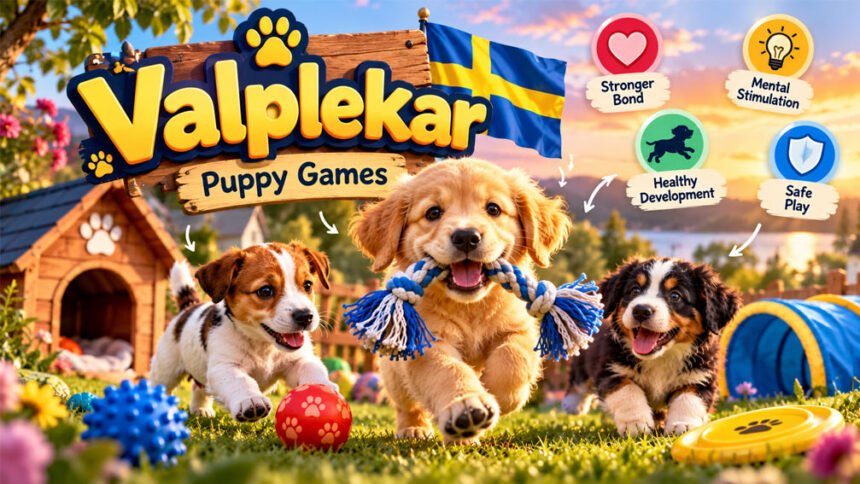
Valplekar is a Swedish term linked with puppies and play. In simple words, it means puppy games or puppy play.
People search for Valplekar because the word is not common outside Sweden. There are also different meanings for it online, which can cause confusion.
This guide explains what Valplekar means, why puppy play is useful, which games puppies can play, and how to keep play safe. It also explains some other claims about the word.
What Is Valplekar?
Valplekar is a Swedish term linked with puppy games and play. It can describe many simple activities for young dogs.
A puppy may chase a toy, carry an object, look for food, explore a safe place, or play with its owner. It may also play with another suitable dog.
Valplekar is not one special game. It can include many different types of puppy play.
Some games are guided by the owner. Other activities allow the puppy to explore and play more freely.
The right game depends on the puppy’s age, size, health, energy, confidence, and personality.
There is also no strong evidence that Valplekar is the official name of a special puppy training or development program. It is better understood simply as puppy play.
What Does Valplekar Mean in Swedish?
The Swedish meaning of Valplekar is quite simple.
Valp means puppy. Lek means play or game. Lekar means games or playful activities.
Together, these words connect Valplekar with puppy games or puppy play.
The word can look confusing to people who do not speak Swedish. “Valplekar” may look like the name of a person, company, product, or brand.
Writing it with a capital letter can make it look even more like a name. In Swedish use, however, the meaning is much simpler.
Why Puppy Play Is Important
Play is a normal part of a puppy’s life. Puppies learn about the world by moving, smelling, touching, watching, and exploring.
Safe games give puppies a good way to use these natural behaviors.
Simple physical games can help with movement, balance, and coordination. Puppies do not need hard exercise to get these benefits.
Games can also keep their minds active. Looking for hidden food or finding a toy makes a puppy use its senses and think about what to do.
Play can also give puppies a healthy way to use their energy. Without enough suitable activity, some puppies may become restless, chew things, bite hands or clothes, or keep asking for attention.
However, play is only one part of puppy care. Puppies also need enough sleep, good food, training, positive social experiences, a regular routine, and veterinary care.
Valplekar and the Owner-Puppy Bond
Playing together can help build a good relationship between a puppy and its owner.
A puppy can learn that spending time with its owner is safe and enjoyable. This can help build trust.
Owners should stay calm during games. They should also respect the puppy’s limits.
A nervous, scared, or tired puppy should not be forced to keep playing.
Shouting, punishment, or frightening movements can make play stressful. If the puppy makes a mistake, the owner can pause the game or make it easier.
Play can also help with basic training. A puppy that enjoys being around its owner may find it easier to pay attention, respond to its name, or come when called.
Still, every game does not need to become a training lesson. Puppies also need time to simply enjoy playing.
Easy Valplekar Games to Try
Puppy games do not need to be expensive or difficult.
A safe place, a suitable toy, and a little puppy food can be enough for several useful games.
Hide-and-Seek
Hide-and-seek is an easy indoor game.
One person can stay with the puppy while the owner hides behind a door or in another safe place. The owner can then call the puppy.
When the puppy finds the owner, it can receive praise or a small reward.
Start with an easy hiding place. Make the game a little harder when the puppy understands what to do.
Never make the puppy climb onto unsafe furniture or enter dangerous places.
This game can help the puppy use its smell, hearing, and memory. It may also help with learning to come when called.
Scent and Treat Games
Dogs naturally use their noses to explore.
A simple scent game is to place small pieces of the puppy’s normal food around a clean mat. Let the puppy find them.
Food can also be hidden under a safe cup or inside a loosely folded towel.
Keep the game easy at first. If the puppy cannot find the food, make the task simpler.
Food used in these games should be counted as part of the puppy’s normal daily food. Too many extra treats can add unnecessary calories or upset its stomach.
Always watch the puppy when using cups, towels, or puzzle items. Do not let it chew or swallow unsafe pieces.
Soft-Toy Games
Soft toys are useful for puppies that like chasing, carrying, retrieving, or chewing.
Choose a toy made for dogs and suitable for the puppy’s size. Avoid toys with small or loose parts.
You can move the toy slowly across the floor for the puppy to chase. You can also throw it a short distance.
Some puppies will bring the toy back. Others may simply carry or chew it. Both can be normal.
Gentle tug games can also be played. Avoid pulling too hard, twisting the puppy, or lifting it with the toy.
Check toys often for damage. Remove them if pieces are coming loose.
Simple Training Games
Basic training can be added to puppy play.
A puppy can practice its name, sitting, coming when called, or touching the owner’s hand with its nose.
For example, say the puppy’s name once. When it looks at you, give it a small reward or toy.
Another game is to hold out your hand. Reward the puppy when it touches your hand with its nose.
Keep these games short and simple. Stop while the puppy is still interested.
Safe Exploration
Exploring can also be part of Valplekar.
Let the puppy explore a safe room, garden, or other suitable place. New smells, sounds, surfaces, and objects can give it useful experiences.
Some puppies are confident and explore quickly. Others need more time.
Do not force a nervous puppy toward something new. Give it time to explore at its own speed.
Indoor and Outdoor Valplekar
Puppy games can happen indoors or outdoors. Each place offers different experiences.
Indoor Play
Indoor games are useful when the weather is bad or when the puppy needs a calmer activity.
Good options include scent games, gentle toy play, simple puzzles, retrieving, and exploring a safe room.
Avoid fast chasing around furniture or running on slippery floors.
Remove small objects that the puppy could swallow. Keep electrical cables, sharp items, chemicals, and other dangerous objects out of reach.
Indoor games do not always need lots of movement. A simple scent game can keep a puppy busy without making it run around.
Outdoor Play
Outdoor areas offer many new smells, sounds, surfaces, people, and animals.
A puppy can sniff, explore, watch its surroundings, or play a short toy game in a safe area.
Think about the weather, temperature, ground, traffic, and nearby animals.
Young puppies are still growing. They should not be pushed into hard exercise just because they have lots of energy.
Vaccination status can also affect where a young puppy can safely go. Local disease risks are different in different places. Ask a veterinarian if you are unsure where your puppy can safely explore.
Playing With Other Puppies and Dogs
Playing with another dog can give a puppy useful social experience.
Dogs communicate through body movements, facial expressions, sounds, and pauses during play.
However, not every dog is a good play partner.
Think about each dog’s size, age, health, personality, confidence, and energy level.
A large and very active puppy may be too much for a smaller or quieter puppy.
Owners should watch the dogs while they play.
Good play often includes relaxed movements, short breaks, and chances for both dogs to stop. Growling can sometimes happen during normal play, so owners should also look at the dog’s full body language.
Warning signs can include hiding, crying, stiff movement, trying to escape, defensive snapping, constant chasing, or cornering.
If one puppy keeps trying to leave, do not force it to continue.
Safe and comfortable social experiences are more useful than making a puppy meet as many dogs as possible.
Valplekar vs Puppy Training
Valplekar and puppy training can work together, but they are not the same.
Training normally has a clear goal. For example, an owner may teach a puppy to sit, come when called, respond to its name, or follow simple house rules.
Play is more flexible. A puppy may chase a toy simply because it enjoys doing it.
However, puppies can still learn during play.
Hide-and-seek may help with recall. Bringing a toy back can encourage the puppy to come toward its owner. Scent games can help with focus and problem-solving.
There is no strong evidence that Valplekar is a formal or official Swedish puppy-training method. There is no clearly established Valplekar program with special rules, qualifications, or a known developer.
It is better understood as puppy play that can also support simple learning.
Play, Exercise, and Rest
Play and exercise are similar, but they are not exactly the same.
Exercise mainly involves physical movement. Play can include movement, thinking, sniffing, exploring, and social interaction.
Chasing a toy may require more physical effort. Searching for hidden food may use less energy but still keep the puppy’s mind busy.
Young puppies are still growing. They should not be pushed into hard exercise, repeated jumping, or long periods of running.
Rest is also very important. Puppies need plenty of sleep and quiet time.
The goal of Valplekar is not to make a puppy completely tired. Try to balance active games, mental activities, calm time, and sleep.
How to Tell When a Puppy Needs a Break
A tired puppy does not always become calm. Some puppies actually become more active when they need rest.
They may bite harder, run around quickly, or find it difficult to listen.
Other signs that a puppy may need a break include:
- Yawning.
- Losing interest.
- Moving slowly.
- Trying to hide.
- Walking away from the game.
- Becoming distracted.
- Finding simple commands difficult.
- Becoming too excited or frustrated.
- Heavy panting during gentle activity.
One sign does not always mean the puppy is tired. Think about the weather, activity, health, and the puppy’s normal behavior.
When the puppy looks tired, stop the game calmly. Give it fresh water and a comfortable place to rest.
How to Make Valplekar Safe
Choose games that match your puppy’s age, size, health, confidence, and development.
Check the play area before starting. Remove electrical cables, sharp objects, chemicals, and small items that could be swallowed.
Try to use floors with good grip. Running or turning quickly on slippery floors can cause falls.
Choose toys that are the right size. Check them often and remove damaged toys if pieces could come off.
Growing puppies should not repeatedly jump from high places or do hard physical activities.
Watch your puppy when introducing a new toy, puzzle, place, or playmate.
Most importantly, allow the puppy to stop. Do not force it to continue when it is tired, scared, uncomfortable, or trying to leave.
For questions about injuries, exercise, vaccinations, growth, or health problems, speak with a veterinarian.
Common Valplekar Mistakes
Playing too hard is a common mistake. More play is not always better. Short games can often be enough.
Do not use your hands as toys. A puppy may learn that biting fingers is part of playing. Give it a suitable chew toy instead.
Be careful about chasing your puppy. It may learn that running away from you starts a fun game.
Do not use toys that are too small, broken, or easy to pull apart.
Remember that treats used in games are still food. Too many can add extra calories.
Do not force a puppy to play with another dog if it looks scared or uncomfortable.
Also remember that every puppy is different. One may enjoy chasing toys, while another prefers sniffing or exploring.
Not every game needs to teach a skill. Puppies also need simple, enjoyable play.
Building a Balanced Valplekar Routine
There is no perfect play schedule for every puppy.
Age, breed, health, energy, personality, and daily routine all matter.
Several short play times may be easier than one long session.
Try different activities. These can include toy games, scent work, safe exploration, simple training, chewing, and quiet time.
Watch how your puppy reacts. If a game regularly causes fear, frustration, too much excitement, or difficulty calming down, change or shorten it.
Everyone in the home should also follow similar rules.
For example, one person should not encourage rough biting while another person is trying to stop it. Clear and simple rules make things easier for the puppy.
Why Is There Confusion About Valplekar Online?
Valplekar can look strange to people who do not speak Swedish.
Because of this, some readers may think it is a person’s name, company, brand, place, or special idea.
Online articles can make the confusion bigger. One website may give the word a certain meaning. Other websites may then repeat the same information.
A claim does not become true just because many websites repeat it.
The Swedish language gives a simple explanation for Valplekar: it is connected with puppies and play.
Claims about a culture, place, digital platform, or special training system need their own reliable evidence.
Is Valplekar a Surname?
Valplekar has also appeared as a surname in some online discussions.
Some sources connect the surname with South Asia, especially western India. The ending “-kar” appears in many Marathi and Konkani surnames and can sometimes be linked with places.
However, there is not enough strong evidence to confirm the exact history of the Valplekar surname.
There is also no reliable evidence here to connect it with one specific village, caste, community, or family.
The surname and the Swedish word may have completely different origins even though they have the same spelling.
17. Is Valplekar a Place, Platform, or Cultural Tradition?
Some websites give Valplekar other meanings, but these claims are not strongly confirmed.
Some content describes Valplekar as a place or travel destination. However, the research collected for this article does not provide strong geographical evidence for a well-known place with this name.
A real town, village, or area would normally have supporting records such as official maps, government information, postal records, or reliable historical documents.
Valplekar has also been described as an old cultural tradition involving farming, festivals, music, crafts, storytelling, marriage, and spirituality.
These activities exist in many cultures. Strong historical or academic evidence would be needed to prove that they belong to a specific tradition called Valplekar. That evidence has not been clearly established in the information collected.
Some online content also describes Valplekar as a digital platform.
However, there is no clearly confirmed developer, official app, company, pricing plan, technical documentation, or established list of platform features in the collected research.
For now, these meanings are better treated as unconfirmed claims or separate uses of the word.
Bottom Line
Valplekar is best understood as a Swedish term for puppy games or puppy play.
It can include hide-and-seek, scent games, toy play, exploring, simple learning, and safe play with people or other dogs.
Games should match the puppy’s age, size, health, confidence, and development.
Owners should use safe toys, watch their puppies during play, and give them enough time to rest.
There is no strong evidence that Valplekar is an official puppy-training system. Other claims about a place, platform, surname, or cultural tradition should be considered separately unless reliable evidence supports them.
Frequently Asked Questions
What does Valplekar mean?
Valplekar is a Swedish term for puppy games or puppy play.
Is Valplekar a Swedish word?
Yes. Valp means puppy, and lekar means games or playful activities.
Is Valplekar a puppy-training method?
No strong evidence shows it is an official training method. It mainly means puppy play.
What are some good Valplekar games for puppies?
Hide-and-seek, scent games, toy play, retrieving, and safe exploring are good options.
How long should a puppy play?
There is no fixed time. Stop when your puppy becomes tired or loses interest.
Can puppies safely play with other dogs?
Yes, with suitable dogs and proper supervision. Stop if either puppy looks scared or uncomfortable.
How do I know when my puppy is tired?
A tired puppy may yawn, slow down, lose interest, hide, or become more restless.
Does Valplekar have other meanings?
Yes, some websites link it with a surname, place, culture, or platform. However, these meanings are not clearly confirmed.
More To Explore:
Masgonzola Complete Guide: What It Is, Taste, Uses, and Storage