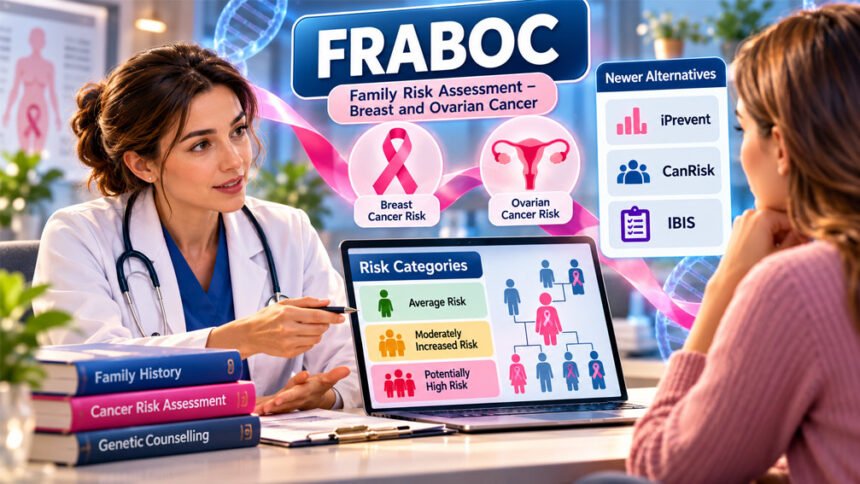
FRABOC, also written as FRA-BOC, stands for Familial Risk Assessment – Breast and Ovarian Cancer. It was an Australian tool used by health professionals to check breast and ovarian cancer risk based on family history.
People may still see FRABOC in old medical records, referral letters, GP documents, or cancer information online. However, the original FRABOC tool is no longer available through Cancer Australia.
FRABOC was not a cancer test or genetic test. It helped doctors understand family cancer patterns and decide if someone may need further assessment.
This guide explains what FRABOC was, how it worked, its old risk categories, and the newer tools used today.
What Is FRABOC?
FRABOC was an online health tool linked with Cancer Australia. Its full name was Familial Risk Assessment – Breast and Ovarian Cancer.
It was mainly made for doctors, nurses, and other health professionals.
FRABOC helped them look at a woman’s family cancer history. It could show whether her family history suggested an average, moderately increased, or potentially high risk of breast or ovarian cancer.
FRABOC did not check the body for cancer. It also did not test DNA. It simply helped health professionals understand family cancer patterns.
The tool is no longer available through Cancer Australia. However, FRABOC can still be found in older medical and health documents.
What Was FRABOC Used For?
FRABOC was used to make family cancer history easier to understand.
Having one relative with breast cancer does not always mean someone has a high cancer risk. Doctors also need to know how many relatives had cancer, what type of cancer they had, and how old they were when diagnosed.
FRABOC helped organize this information.
It could help a doctor decide whether someone needed a more detailed risk assessment, genetic counselling, or a referral to a family cancer service.
A higher FRABOC result did not mean a person had cancer. It also did not mean they would definitely develop cancer.
It only showed that their family history may suggest a higher risk.
How Did FRABOC Work?
FRABOC mainly used information about cancer in a person’s family.
A health professional collected details about close relatives on both the mother’s and father’s sides.
They looked at the type of cancer each relative had and the age when the cancer was diagnosed.
FRABOC then placed the person into one of three main risk groups:
- At or slightly above average risk
- Moderately increased risk
- Potentially high risk
These groups helped doctors decide what steps might be needed next.
Family history can also change. For example, another relative may later develop cancer. This is why family cancer information should be updated when possible.
What Family History Did FRABOC Consider?
FRABOC looked at both first-degree and second-degree relatives.
First-degree relatives include parents, brothers, sisters, and children.
Second-degree relatives include grandparents, aunts, uncles, nieces, and nephews.
Doctors looked at more than the number of relatives with cancer. The cancer type and age at diagnosis were also important.
Family patterns that could be important included:
- several relatives with breast or ovarian cancer
- breast cancer at a young age
- breast and ovarian cancer in the same family
- cancer in both breasts
- male breast cancer
- a known high-risk gene change in the family
Both sides of the family mattered.
Cancer-related gene changes can come from the mother or father. This means cancer history on the father’s side should not be ignored.
FRABOC Breast Cancer Risk Categories
FRABOC used three broad groups for breast cancer risk.
The figures below come from older Cancer Australia guidance. They explain how FRABOC worked in the past.
They should not be used to calculate someone’s cancer risk today.
At or Slightly Above Average Risk
This was the lowest FRABOC risk group.
More than 95% of women were estimated to be in this group under the old system.
Their estimated breast cancer risk up to age 75 was between about 1 in 11 and 1 in 8.
Examples included women with no confirmed family history of breast cancer, one first-degree relative diagnosed at age 50 or older, or one second-degree relative diagnosed at any age.
These are old FRABOC examples. Current risk assessments use newer tools.
Moderately Increased Risk
The second group was called moderately increased risk.
Under the old guidance, fewer than 4% of women were estimated to be in this group.
Their estimated breast cancer risk up to age 75 was about 1 in 8 to 1 in 4.
One example was having a first-degree relative who developed breast cancer before age 50, when stronger high-risk signs were not present.
Some families with two close relatives who had breast cancer could also fall into this group.
The full family history was important when deciding the risk level.
Potentially High Risk
The highest FRABOC group was called potentially high risk.
Under the old system, fewer than 1% of women were estimated to be in this group.
Their estimated breast cancer risk up to age 75 was about 1 in 4 to 1 in 2.
Possible signs of higher risk included several relatives with cancer on the same side of the family.
Other important signs included breast cancer before age 40, cancer in both breasts, breast and ovarian cancer in the same woman, male breast cancer, or a known high-risk gene change in the family.
Women in this group could be referred for a specialist family cancer assessment.
These are historical figures. They should not be used as a personal cancer risk estimate today.
How FRABOC Assessed Ovarian Cancer Risk
FRABOC also looked at ovarian cancer in the family.
Doctors considered how many close relatives had ovarian cancer and how those cases fitted with the rest of the family history.
Several cases of ovarian cancer could be important. A family with both ovarian cancer and early breast cancer could also need closer assessment.
A known high-risk gene change could also matter.
However, one relative with ovarian cancer did not automatically mean that an inherited cancer condition was present.
The full family history needed to be considered.
Older Cancer Australia guidance also discussed the limits of ovarian cancer screening with ultrasound and the CA125 blood test.
People looking for ovarian cancer screening advice today should follow current medical guidance rather than old FRABOC information.
FRABOC vs BRCA Genetic Testing
FRABOC and BRCA genetic testing were different.
FRABOC looked at family history. Genetic testing looks at DNA.
FRABOC could not tell someone whether they had a gene change in BRCA1, BRCA2, or another cancer-related gene.
It did not use blood, saliva, or laboratory testing.
Instead, FRABOC could help identify family patterns that may need a closer look.
A doctor could then decide whether genetic counselling or genetic testing might be useful.
Having breast cancer in the family does not always mean there is an inherited BRCA gene change.
Gene changes can also come from either parent. This is why the father’s family history can be just as important as the mother’s.
What Happened After a Higher-Risk Result?
A higher FRABOC result did not automatically mean someone needed treatment or genetic testing.
Instead, it helped doctors decide what to consider next.
A person might be sent for a more detailed cancer risk assessment or referred to a family cancer service.
A specialist could look more closely at the family history and explain the possible cancer risk.
They could also discuss genetic counselling, genetic testing, breast checks, or ways to reduce risk when appropriate.
The next step depended on each person’s situation.
Was FRABOC a Cancer Test?
No. FRABOC was a risk assessment tool.
It was not a blood test, genetic test, mammogram, ultrasound, or other medical scan.
It could not find or diagnose breast or ovarian cancer.
FRABOC simply used family history to help estimate a person’s possible cancer risk.
A higher risk also does not mean someone will definitely develop cancer.
In the same way, someone without a strong family history can still develop cancer.
Risk tools estimate chances. They cannot tell exactly what will happen to one person.
Is FRABOC Still Available?
No. FRABOC is no longer available through Cancer Australia.
Some old medical documents, websites, referral forms, and health resources may still mention it.
This can cause confusion for people who search for the FRABOC calculator today.
The old system is still useful for understanding how family cancer risk was assessed in the past. However, it should not be used for a new personal risk assessment.
Newer tools are now available.
What Replaced FRABOC?
Current breast cancer risk assessment uses newer tools and models. Important examples include iPrevent, CanRisk, and IBIS.
These tools are not exact copies of FRABOC. They can use more information to provide a more detailed risk estimate.
iPrevent
iPrevent is a breast cancer risk assessment and management tool developed by a team at Peter MacCallum Cancer Centre.
A person can enter information about their health and family history. The tool then creates a personal report that can be discussed with a doctor.
iPrevent can consider more than family history. It may include personal health information, reproductive factors, lifestyle information, previous breast disease, and family cancer history.
Family questions can include breast, ovarian, pancreatic, and prostate cancer.
Peter MacCallum Cancer Centre says the assessment takes about 30 minutes to complete.
It also says iPrevent should not be used by people who have already had invasive breast cancer or ductal carcinoma in situ, known as DCIS.
iPrevent uses established breast cancer risk models, including IBIS and BOADICEA through CanRisk.
CanRisk
CanRisk is an online cancer risk tool based on BOADICEA models.
It can provide a more detailed breast cancer risk estimate using family history and other information.
It can be useful when a family has a more complex cancer history or when genetic information needs to be considered.
Unlike old FRABOC categories, CanRisk can provide a more personal risk estimate.
However, the result is still an estimate. It cannot tell for certain whether someone will develop cancer.
IBIS
IBIS, also called the Tyrer-Cuzick model, is another breast cancer risk model.
It uses family history and other personal information to estimate breast cancer risk.
IBIS can provide a more detailed estimate than the old FRABOC categories.
It is also one of the models used by iPrevent.
FRABOC vs iPrevent
FRABOC and iPrevent both help with cancer risk assessment, but they work differently.
| Feature | FRABOC | iPrevent |
|---|---|---|
| Status | No longer available | Current tool |
| Main purpose | Family breast and ovarian cancer risk | Breast cancer risk and management |
| Main method | Broad risk groups | Personal risk estimate |
| Uses family history | Yes | Yes |
| Uses other personal factors | Limited | Yes |
| Result | Risk category | Personal risk estimate |
| Current use | Historical | Current assessment |
FRABOC mainly placed women into three broad groups.
iPrevent can use family history together with other risk factors. This allows it to provide a more personal assessment.
Why FRABOC Still Appears in Search Results
FRABOC was used and mentioned in Australian health information for many years.
Because of this, old GP documents, medical records, PDFs, referral forms, and cancer resources may still contain the name.
This does not mean FRABOC is still active.
If FRABOC appears in an old medical document, it usually means the historical Familial Risk Assessment – Breast and Ovarian Cancer tool.
For a new assessment, current tools and medical guidance should be used.
FRABOC and the Other Meaning of “FRA–BOC”
The term FRA–BOC can also have a completely different meaning in travel.
FRA is the airport code for Frankfurt Airport in Germany. BOC is the airport code for Bocas del Toro Isla Colón International Airport in Panama.
Travel websites may therefore show FRA–BOC or FRA to BOC for travel between these airports.
This meaning has no connection with the FRABOC cancer risk tool.
In Australian medical information, FRABOC usually means Familial Risk Assessment – Breast and Ovarian Cancer.
Should You Use Old FRABOC Risk Figures Today?
No. Old FRABOC figures should not be used to work out your current personal cancer risk.
They are useful for understanding how the old tool worked.
Cancer risk assessment has changed over time. Newer tools can consider more information and provide a more detailed estimate.
Current tools include iPrevent, CanRisk, and IBIS.
Anyone worried about their family cancer history should speak with a qualified health professional instead of trying to place themselves into an old FRABOC risk group.
Preparing for a Family Cancer Risk Assessment
Collecting family information before an assessment can be helpful.
Try to find out:
- which relatives had cancer
- how they are related to you
- what type of cancer they had
- their age when diagnosed
- whether anyone had cancer in both breasts
- whether anyone had more than one relevant cancer
- whether a man in the family had breast cancer
- whether any relatives had genetic testing
- whether a known cancer-related gene change was found
Check both the mother’s and father’s sides of the family.
If a relative has had genetic testing, bring a copy of the result if possible.
Do not worry if you cannot find every detail. Give your doctor the information you know and explain which details are uncertain.
Family history can also change. New cancer diagnoses or genetic test results in the family may be important for future assessments.
Bottom Line
FRABOC stood for Familial Risk Assessment – Breast and Ovarian Cancer. It was an Australian tool used by health professionals to understand breast and ovarian cancer risk from family history.
FRABOC was not a cancer test, genetic test, or diagnosis. It placed people into broad risk groups to help guide further assessment.
The FRABOC tool is no longer available through Cancer Australia. Its old risk groups are useful for understanding its history, but they should not be used for a new personal assessment.
Newer tools include iPrevent, CanRisk, and IBIS. Anyone worried about cancer in their family should discuss their personal history with a qualified health professional.
Frequently Asked Questions
What does FRABOC stand for?
FRABOC stands for Familial Risk Assessment – Breast and Ovarian Cancer. It was a cancer risk tool used in Australia.
What was FRABOC used for?
FRABOC helped health professionals check breast and ovarian cancer risk using family history.
Is FRABOC still available?
No. Cancer Australia no longer provides FRABOC, but it may still appear in old medical documents.
Was FRABOC a genetic test?
No. FRABOC checked family history. Genetic tests check a person’s DNA.
Could FRABOC diagnose breast or ovarian cancer?
No. FRABOC did not diagnose cancer. It only helped estimate a person’s family-related cancer risk.
What replaced FRABOC?
Newer tools include iPrevent, CanRisk, and IBIS. They provide more detailed breast cancer risk assessments.
What is the difference between FRABOC and iPrevent?
FRABOC used broad risk groups. iPrevent uses family history and other factors to give a more personal risk estimate.
Does having breast cancer in the family mean I am high risk?
Not always. Your risk depends on your full family history, age at diagnosis, cancer types, and other factors.
More To Explore:
Bddiabetes.com: What It Was and What Happened to the Website