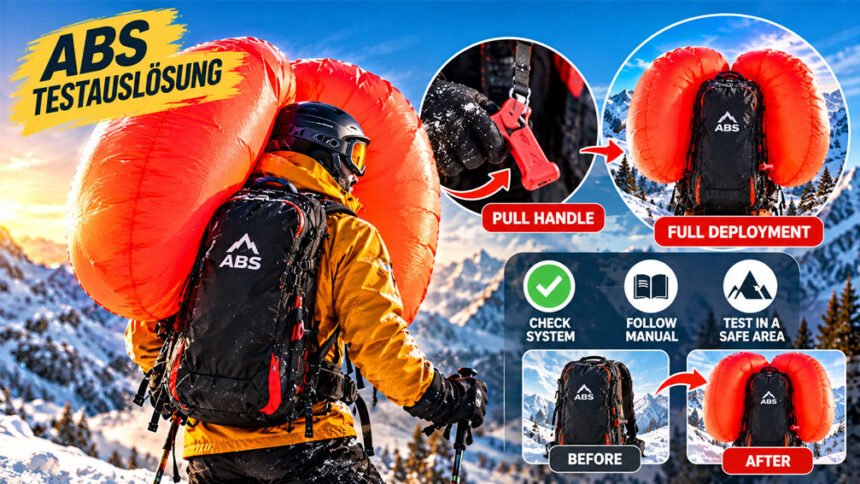
ABS Testauslösung means testing an ABS avalanche airbag in a safe and controlled place. The test helps users check the backpack and practise using the release handle.
People search for ABS Testauslösung because they want to know how to test their avalanche backpack, when to test it, and whether they can test it without using a cartridge.
This guide explains what ABS Testauslösung means, how an ABS avalanche airbag works, the different ABS systems, testing methods, safety checks, common problems, and what to do after a test.
What Is ABS Testauslösung?
The German word Testauslösung means a test release or test activation.
In this article, ABS means an avalanche airbag system. It does not refer to the anti-lock braking system in a car.
An ABS Testauslösung means activating the avalanche airbag in a safe place. It helps users check the equipment and practise pulling the release handle.
A full test also lets the user see how the airbag opens and inflates. Afterward, the airbag can be checked for visible damage, air leaks, or other problems.
Some ABS systems also allow a dry trigger test. This lets the user practise pulling the handle without inflating the airbag. However, this option is not available for every ABS system.
A dry test also does not show whether the airbag can inflate properly. Users should only use this method when the instructions for their exact system allow it.
How Does an ABS Avalanche Airbag Work?
An avalanche airbag is safety equipment used by skiers, snowboarders and other people who travel in avalanche areas.
When the user pulls the release handle, the system starts the inflation process. The airbag then comes out of its compartment and fills with gas.
A full test uses the correct cartridge or other approved inflation system. The exact method depends on the ABS model.
The supplied information says that some ABS twin-airbag systems can inflate in about three to four seconds.
During a test, there should be enough space around the backpack. Keep your face and hands away from the airbag while it is opening.
After the airbag opens, check its shape and look for visible damage or air leaks.
An avalanche airbag can provide another layer of protection during an avalanche. However, it cannot stop an avalanche or guarantee that someone will avoid injury. It also does not replace safe route planning or rescue equipment.
Different ABS Airbag Systems
ABS has made different avalanche airbag systems over the years. Because of this, users should first find out which system their backpack uses.
The systems mentioned in the supplied information include EASY.TECH, SOLID and p.RIDE. ABS has also produced electronic airbag systems and different backpack models.
The testing process can be different for each system.
EASY.TECH
Some EASY.TECH systems allow a dry trigger test without inflating the airbag.
The system can give different signs when the test is successful. These may include a click, physical feedback and a change in the status display.
The supplied information reports that the display can show green before the test and red after the trigger is activated.
This type of test is useful for practising the release handle. However, it does not test the full airbag inflation.
SOLID
The SOLID system uses a cartridge and a release handle.
Users should not assume that a SOLID system can be tested without a cartridge just because another ABS system allows a dry test.
Always use the instructions for the exact SOLID system.
p.RIDE
p.RIDE backpacks use their own activation and inflation system.
The correct testing and refill process can depend on the backpack and inflator version.
Users should follow the matching instructions instead of using general instructions from another ABS system.
Electronic ABS Airbag Systems
Some ABS airbag products use an electronic system instead of the same cartridge system used by other models.
These products need their own testing and deployment instructions.
Do not use a cartridge-based testing process for an electronic system unless the manufacturer specifically says to do so.
Full Deployment vs. Dry Trigger Testing
There are two main types of ABS airbag testing: full deployment and dry trigger testing.
They do not test the same things.
Full Deployment
A full deployment activates the airbag and makes it inflate.
It can help check several parts of the system. These include the release handle, activation system, inflation process and airbag itself.
After the airbag opens, check both sides. Look at the fabric and seams. Listen for unusual air loss.
If the airbag does not open fully, only one side opens, or the air escapes quickly, do not use the backpack in avalanche areas until it has been checked.
A full test also uses the cartridge or inflation component. Depending on the system, it may need to be refilled, replaced or exchanged afterward.
The airbag must also be deflated, folded correctly and returned to its ready condition.
Dry Trigger Testing
A dry trigger test activates the release handle without inflating the airbag.
This can be useful for practising the pulling movement. It can also help users learn where the handle is and how easy it is to reach while wearing winter clothing and gloves.
However, a dry test does not check the airbag itself.
It cannot confirm that the airbag will inflate, that the cartridge has the correct pressure, or that the airbag can hold air.
A click or status change does not mean that the complete system has been tested.
The most important rule is simple: only perform a cartridge-free test when the instructions for your exact ABS system say that it is allowed.
Preparing for an ABS Testauslösung
Before testing an ABS avalanche airbag, check the exact backpack and activation system.
Different ABS systems can have different testing instructions.
Check the Manual and Equipment
Start by finding the manual for your exact model.
Check the backpack name, activation system, cartridge type and other product information.
Do not use instructions for another backpack just because it looks similar.
Next, inspect the backpack. Look at the shoulder straps, waist belt, leg loop, buckles, seams, airbag compartment and release handle.
Look for cuts, damaged stitching, loose parts, corrosion or other visible damage.
The airbag compartment should be clean and empty. Nothing should block the airbag.
For a full test, use only the cartridge approved for your ABS system.
The supplied information says that ABS recommends checking the cartridge and its weight. The allowed weight is shown on the cartridge. A difference of more than five grams is reported as a reason not to use it.
Do not use another cartridge just because it looks similar or seems to fit. Cartridge compatibility must be confirmed for the exact system.
Choose a Safe Testing Area
A full airbag needs plenty of space to open.
Do not test it in a small room where the airbag could hit a wall, shelf, lamp or piece of furniture.
Choose a clean, dry and stable area.
Keep children, pets and other people away from the testing area. Remove sharp objects and anything that could damage the airbag.
If testing outdoors, make sure there are no nearby branches, rocks, vehicles or other objects.
The airbag can also make a sudden sound when it opens. Tell anyone nearby that you are testing the system.
Wear the Backpack Correctly
Wear the backpack as you normally would during a winter trip.
Use your normal winter jacket and gloves. This helps you see whether the release handle is easy to reach in real conditions.
Adjust the shoulder straps and fasten the waist belt and other required straps.
The supplied information also mentions the leg or crotch safety strap.
Make sure the release handle is in the correct position and easy to reach.
How to Perform a Full ABS Testauslösung
A full ABS Testauslösung should always follow the instructions for the exact backpack.
The general process is only a basic guide. It does not replace the manufacturer’s instructions.
First, check that the airbag is folded correctly and that nothing is blocking the airbag compartment.
Prepare or reset the release system as shown in the manual.
Install the correct filled cartridge or approved activation part. Do not force any connection or change the order of the steps.
Put on the backpack and secure the required straps.
Stand in the clear testing area and make sure other people are at a safe distance.
Find the release handle and pull it firmly in the required direction.
When the airbag starts to open, stay clear and let it inflate fully.
Some ABS twin-airbag systems are reported to inflate in about three to four seconds.
After inflation, check both sides of the airbag.
Make sure they have opened fully and have the expected shape.
If one airbag does not open, the inflation is incomplete, or the airbag loses air quickly, stop using the backpack in avalanche areas.
The problem could be caused by an activation issue, blockage, connection problem or incorrect packing. The backpack should be checked by an approved service provider.
How a Compatible EASY.TECH Dry Test Works
Some EASY.TECH systems allow users to test the release handle without inflating the airbag.
This is mainly useful for practising the release movement.
Before the test, prepare the system according to its instructions and check the ready status.
The supplied information says that a successful test may produce a clear click and physical feedback. The status display may also change from green to red.
After the test, reset the system according to the correct manual.
A dry test can be useful when practising with different gloves or winter clothing. It helps users become familiar with the location of the handle.
However, it does not inflate the airbag.
It therefore cannot show whether the airbag fabric, valves, inflation path or cartridge pressure are working correctly.
Do not use the EASY.TECH dry-test method on another ABS system unless its own instructions allow it.
How to Check the Airbag After Testing
After a full deployment, leave the airbag open while you check it.
Make sure all parts have opened properly. Check the shape and make sure no fabric is trapped inside the backpack.
Look at the fabric, seams, connections and valves.
Listen for unusual or fast air loss.
If the airbag loses air quickly or has damaged fabric, seams or valves, arrange a professional inspection.
If only one side opens or the airbag does not fully inflate, stop using the backpack in avalanche areas.
Do not try to repair internal parts yourself.
A successful test shows that the system worked during that test. It does not guarantee that it will always work in the future.
What to Do After an ABS Testauslösung
After a full deployment, release the gas using the correct valve shown in the manual.
Do not puncture the airbag. Do not force the fabric out of the compartment.
If the airbag becomes wet or damp, let it dry fully before packing it again.
Fold the airbag in the correct way shown by the manufacturer. Correct folding helps the airbag open properly during the next activation.
Keep the fabric away from zippers, buckles and sharp objects while packing it.
After a full test, the used cartridge or inflator may need to be refilled, exchanged or replaced. The exact process depends on the ABS system.
The supplied information reports different refill procedures for SOLID, EASY.TECH and p.RIDE systems. Check the correct instructions for your backpack.
Before using or storing the backpack, make sure the system has been reset, the airbag is packed correctly and the required ready status is shown.
ABS Airbag Maintenance and Storage
An ABS Testauslösung is only one part of airbag maintenance.
The supplied information reports that ABS recommends a training deployment with a filled cartridge before each season for applicable systems. It also reports a larger service every three years for current applicable products.
Older models may have different service rules. Always check the manual for your exact backpack.
Some release handles or other parts may also have their own replacement dates. Check the service or expiry information on the relevant part.
Professional inspection is especially important after an avalanche deployment, hard fall, serious impact or visible damage.
Keep the backpack clean and dry when storing it.
Keep it away from strong heat, direct sunlight, oil, sharp tools and other things that could damage the fabric or activation system.
Follow the manufacturer’s instructions about whether the cartridge should stay installed during storage.
Before every winter trip, check that the system is ready. Make sure the handle is easy to reach, the airbag opening is clear, the cartridge or power system is ready, and the backpack straps are in good condition.
Common ABS Testauslösung Problems
The Airbag Does Not Inflate
If the airbag does not inflate during a full test, do not use the backpack in avalanche areas.
Do not keep pulling the handle again and again.
Check the instructions for your exact system. If the cause is not clear, arrange a professional inspection.
Only One Airbag Inflates
If only one side opens, the deployment was not normal.
The problem could be related to a blockage, connection, activation system or packing.
Stop using the backpack and have it checked by ABS or an approved service provider.
The Airbag Does Not Fully Inflate
Partial inflation should not be treated as a successful test.
Check whether the airbag was packed correctly and whether the activation process followed the manual.
If you cannot find the problem, arrange a professional inspection.
The Airbag Loses Pressure Quickly
Fast air loss can point to a problem with the airbag, seams, valves or another part of the system.
Do not try to repair the internal parts yourself.
Have the backpack inspected before using it again.
The Release Handle Does Not Respond
If the handle does not work as expected, stop the test.
The cause could be incorrect preparation, a problem with the activation system or a damaged part.
Check the exact manual or contact an approved service provider.
The Status Indicator Is Unexpected
Some ABS systems use indicators to show whether the system is ready.
If the indicator does not show the expected status, stop and check the instructions for your exact model.
Do not assume that an unexpected indicator means the system is ready.
Common Mistakes to Avoid
One common mistake is thinking that every ABS backpack uses the same test method.
They do not. Always identify the exact model first.
Another mistake is trying a cartridge-free test on a system that does not support it.
Only perform a dry test when the manufacturer says it is allowed.
Testing in a small or crowded area is also a mistake. A full airbag needs enough space to open safely.
Do not test the backpack with loose straps. Wear it correctly and use normal winter clothing and gloves.
Do not use a cartridge that is damaged or not approved for your system.
Do not judge cartridge compatibility only by its size or appearance.
Correct repacking is also important. A backpack is not ready for use simply because the airbag opened successfully.
After a full test, remember that the cartridge or activation component may need to be replaced or refilled.
If the test gives an unexpected result, do not keep activating the system. Stop and find out what is wrong before testing again.
ABS Airbag Safety and Limitations
An ABS avalanche airbag can provide another layer of protection during an avalanche, but it does not guarantee safety.
A successful ABS Testauslösung only shows that the system worked during that test.
It cannot guarantee that the system will work after future damage, poor storage, normal wear or another deployment.
An airbag also cannot stop an avalanche.
It cannot remove every danger from trees, rocks, cliffs or injuries.
An airbag should never be a reason to enter terrain that is not safe for the current conditions.
Avalanche safety also requires other equipment and good planning.
The supplied information recommends carrying an avalanche transceiver, shovel and probe. Users should also practise companion rescue.
Checking the avalanche forecast and current snow conditions is important before entering avalanche terrain.
The airbag is one part of the safety system. It does not replace avalanche training, rescue skills or careful decisions.
Bottom Line
An ABS Testauslösung is a controlled way to test an avalanche airbag and practise using its release handle.
The first step is to identify the exact ABS system. Different models can use different testing methods.
A full deployment checks the actual airbag inflation. A dry trigger test can help practise the handle, but it does not test the complete airbag system.
After a full test, inspect the airbag, release the gas correctly, fold it properly and replace or refill the used cartridge or activation part when required.
Regular maintenance is also important.
Most importantly, an avalanche airbag is only one part of avalanche safety. Follow the avalanche forecast, understand the conditions, choose suitable terrain and carry the proper rescue equipment.
Frequently Asked Questions
What does ABS Testauslösung mean?
ABS Testauslösung means testing an ABS avalanche airbag. It helps check the system and practise using the release handle.
How often should you perform an ABS Testauslösung?
ABS recommends testing applicable systems with a filled cartridge before each season. Always check your backpack’s manual for its exact schedule.
Can you test an ABS avalanche airbag without a cartridge?
Some EASY.TECH systems allow a dry trigger test. Other systems may not, so check the manual first.
How long does an ABS avalanche airbag take to inflate?
Some ABS twin-airbag systems can inflate in about three to four seconds. The time may vary by system.
Do you need a new cartridge after an ABS Testauslösung?
Yes, a full test uses the cartridge or inflator. It must be refilled, exchanged, or replaced before use again.
What should you do if your ABS airbag does not inflate?
Do not use the backpack in avalanche areas. Check the manual and contact an approved service provider if needed.
Can you perform an ABS Testauslösung yourself?
Yes, if your system allows it and you follow the correct instructions. Use a safe place and wear the backpack properly.
Does a successful ABS Testauslösung mean the backpack is completely safe?
No. A successful test only shows that it worked at that time. Regular checks and service are still needed.
More To Explore: