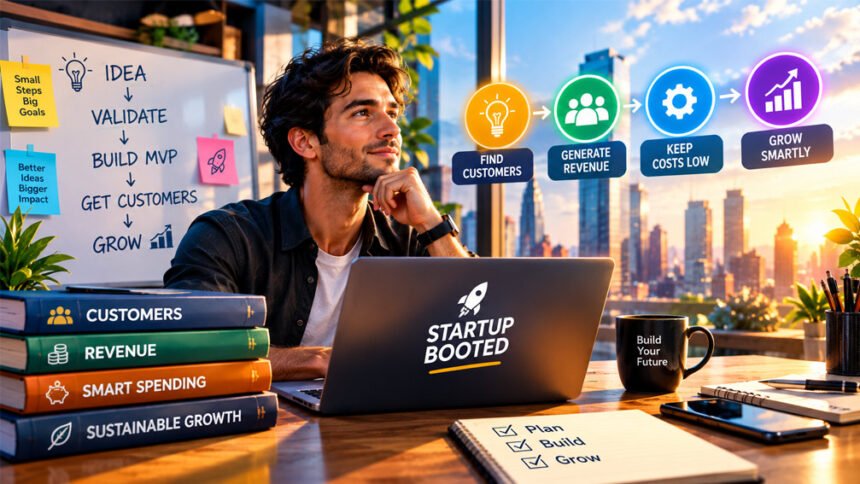
Startup Booted is a way of building a startup with a strong focus on customers, revenue, and careful spending. It is closely related to bootstrapping, where founders use their own money and business income instead of depending heavily on investors.
StartupBooted is also the name of a startup consulting service. Because the term can have different meanings, it is important to understand the context.
This guide explains what Startup Booted means, how it works, its benefits and risks, and when a startup may need outside funding.
What Is Startup Booted?
Startup Booted generally means building a startup mainly with the founder’s own resources and money earned from customers.
For example, a founder may use personal savings to create the first version of a product. The business can then find customers and use the money it earns to improve the product and grow.
The goal is not simply to spend as little as possible. The goal is to spend money carefully and only where it can help the business.
Customer demand is also very important. Founders try to find out whether people actually want the product before spending heavily on it.
A Startup Booted company can still raise money from investors later. Outside funding may be useful when the company needs to hire people, increase production, enter a new market, or grow faster.
So, Startup Booted is mainly about using money at the right time and for the right reason.
Startup Booted vs Traditional Bootstrapping
Startup Booted and traditional bootstrapping are very similar.
A bootstrapped business usually starts with the founder’s own money. It then uses money earned from customers to continue growing.
The Startup Booted approach follows the same basic idea. However, it can also include outside funding when that money has a clear purpose.
For example, a founder may build a product, find customers, and create steady revenue without investors. Later, the company may raise money to expand something that is already working.
| Area | Traditional Bootstrapping | Startup Booted Approach |
|---|---|---|
| Early funding | Founder money and revenue | Founder money and revenue |
| Customer revenue | Very important | Very important |
| Founder control | Usually high | Usually high |
| Outside funding | Often avoided or delayed | Can be used when needed |
| Growth | Careful and steady | Careful with selective funding |
| Equity dilution | Usually low or none | Kept limited where possible |
Startup Booted can therefore be seen as a flexible form of bootstrapped growth.
Startup Booted vs Venture Capital
Venture capital works differently.
A venture capital investor gives money to a startup in exchange for part ownership of the company. This money can help the startup hire employees, develop products, advertise, and enter new markets.
A Startup Booted business usually has less money available at the beginning. This can make growth slower.
However, founders may keep more ownership and control. They may have more freedom to make decisions about products, prices, hiring, and growth.
Neither option guarantees success.
A startup can raise a lot of money and still fail if the money is not used well. A bootstrapped startup can also fail if it cannot find enough customers or runs out of cash.
The best choice depends on the business. Some companies can start with very little money, while others need large amounts of funding before they can operate.
How the Startup Booted Strategy Works
Startup Booted usually starts with finding a real customer problem.
The founder first learns who has the problem and how people currently deal with it. They can also study competitors and existing products.
The next step is to test whether customers are willing to pay for a solution.
If there is real interest, the founder can create a simple Minimum Viable Product, or MVP. It should include enough features to test the main idea.
The business then tries to find its first paying customers.
These customers can show what works and what needs improvement. Their feedback can also help founders understand which features matter most.
Money earned from customers can then be used to improve the product, marketing, sales, customer support, or other important parts of the business.
As the company grows, founders can look for patterns. They can learn why customers buy, how much it costs to get a customer, and whether customers stay.
The company can scale when there is enough evidence that the business model is working.
Customer Validation Before Heavy Spending
Customer validation means checking whether people really want a product before spending a lot of money on it.
Founders can talk with potential customers, run surveys, or show them an early version of the product.
However, someone saying they like an idea is not the same as someone paying for it.
A purchase, paid trial, subscription, deposit, or signed agreement can give stronger proof that real demand exists.
Small tests can answer important questions. Will customers pay? Does the product solve their problem? Will they continue using it?
Testing early can save money. If an idea does not work, the founder can change it before making a much larger investment.
Building an MVP on a Limited Budget
MVP means Minimum Viable Product. It is a simple version of a product used to test an idea with real customers.
An MVP does not need every planned feature.
For example, a startup may first offer a service manually instead of building expensive software. A software company may launch one useful feature before creating a large platform.
Founders can also use existing software, cloud services, automation tools, contractors, and no-code or low-code platforms to reduce early costs.
Saving money should not mean ignoring quality. Security, privacy, reliability, legal requirements, and customer safety still matter.
If customers find the MVP useful, the company can invest more money in improving it.
Finding the First Paying Customers
The first paying customers are important because they show that people are willing to spend money on the product or service.
Founders often handle early sales themselves. This helps them speak directly with customers and understand their needs.
Customers may come from direct outreach, referrals, partnerships, professional groups, useful content, or product demonstrations.
A startup does not always need thousands of users at this stage. A small number of good customers can provide useful information.
Founders can learn why customers buy, what questions they ask, what problems they face, and why some customers leave.
This information can later help the company create a better and more reliable sales process.
Financial Planning and Budgeting
Good financial planning is very important for a Startup Booted business.
Founders should know how much money comes into the company and how much goes out.
Important costs can include salaries, software, equipment, marketing, rent, product development, and other business expenses.
Cash flow also matters. A company may make sales but still have trouble paying bills if customer payments arrive too late.
Founders should also understand burn rate and runway.
Burn rate shows how quickly the company is using its available cash.
Runway estimates how long the company can continue operating with the money it currently has.
A financial model can help founders see what may happen if sales rise, expenses increase, or the company hires more people.
A lean budget does not mean avoiding all spending. It means spending money where it can clearly help the business.
Important Metrics to Track
The right metrics depend on the type of business.
Revenue and cash flow are two basic measures. They help founders understand whether the company is making money and has enough cash to operate.
Customer Acquisition Cost (CAC) shows how much the business spends to gain a customer.
Customer Lifetime Value (LTV) estimates how much value a customer may bring to the business over time.
Retention shows how many customers stay. Churn shows how many customers leave.
Subscription businesses may also track:
- Monthly Recurring Revenue (MRR)
- Annual Recurring Revenue (ARR)
- Gross margin
- Net Revenue Retention (NRR)
- Burn rate
- Runway
The collected material also cites 2026 SaaS Capital research. For a specific group of bootstrapped private B2B SaaS companies with $3 million to $20 million in ARR, median annual growth was reported at 15%, median NRR at 103%, and median gross revenue retention at 91%.
These numbers should not be treated as goals for every startup. A small new company can have very different needs and results.
Metrics should mainly help founders understand whether customers are staying, revenue is becoming more stable, costs are under control, and the business has enough money to grow.
When Is a Startup Ready to Scale?
A startup may be ready to scale when there is clear evidence that the business model works.
Signs can include steady sales, repeat customers, good retention, improving profit margins, and reliable ways of finding new customers.
Product-market fit is also important. In simple words, it means there is good evidence that a clear group of customers wants the product.
Growing revenue alone is not enough.
For example, if revenue doubles but expenses triple, the business may actually become weaker.
Founders should first understand what is stopping growth. They can then spend money on solving that problem.
Scaling should strengthen a business that is already working.
Key Benefits of Startup Booted
One important benefit is greater founder control. Founders may have more freedom to make decisions about products, prices, hiring, and growth.
They may also keep more ownership because they are not giving large amounts of equity to investors early.
Startup Booted can also encourage careful spending. When money is limited, teams have a strong reason to focus on things that actually help the business.
Another benefit is the strong focus on customers. Raising investment does not prove that people want a product. Paying customers provide stronger evidence.
Founders also get time to test prices, improve products, understand customers, and learn how to sell before spending large amounts of money.
A company with real customers and revenue may also have a stronger position if it decides to raise investment later.
Challenges and Risks
Limited money is one of the biggest challenges of Startup Booted.
A company may find a good opportunity but not have enough money to hire people, improve technology, increase production, or reach more customers.
Growth may also be slower than at a well-funded competitor.
Founders can face greater personal financial risk if they use their own savings.
Small teams may also have heavy workloads. The same people may need to handle sales, marketing, customer service, product work, and administration.
Being too careful with money can also become a problem. Some investments are necessary for growth.
Startup Booted should mean spending carefully, not refusing to spend.
Common Startup Booted Mistakes
A common mistake is building too much before testing customer demand.
Hiring too early can also create high monthly costs before the company has enough revenue.
Other mistakes include paying for expensive offices, unused software, large advertising campaigns, or long contracts too early.
Underpricing can also cause problems. A very low price may attract customers but may not cover the real cost of running the business.
Founders should not look only at revenue. A company can increase sales and still lose money.
Another mistake is refusing all outside investment. Funding can sometimes help solve a clear problem or support a proven growth opportunity.
When Startup Booted May Not Be the Right Choice
Startup Booted does not work equally well for every company.
Some businesses need a lot of money before they can sell anything.
Hardware startups may need money for design, prototypes, manufacturing, inventory, and shipping.
Biotechnology and pharmaceutical companies can need years of research, testing, and regulatory work.
Deep-tech and manufacturing businesses may also require expensive equipment, facilities, materials, and skilled workers.
Some markets also move very quickly. Waiting too long to grow can allow competitors to take the opportunity.
In these situations, outside funding may simply be a practical business need.
When Should a Startup Seek Outside Funding?
A startup should have a clear reason before raising outside money.
For example, the business may have more customer demand than it can currently handle. Funding could help increase capacity.
Money may also help hire an important employee, enter a new market, improve technology, or build necessary infrastructure.
Founders should know exactly what they want the funding to achieve.
They should also understand its cost. Equity funding means giving investors some ownership. Debt normally needs to be repaid.
Funding is most useful when it solves a clear problem or helps the company use a proven opportunity.
Funding Options Beyond Venture Capital
Venture capital is not the only funding option.
Angel investors invest their own money in companies, usually in exchange for equity or another investment interest.
Business loans allow companies to borrow money without normally giving away ownership. However, the money must be repaid under the agreed terms.
Grants can provide funding for eligible businesses or projects. They often have rules about who can apply and how the money can be used.
Crowdfunding allows a company to raise money from many people. Different crowdfunding models may involve products, rewards, donations, loans, or investments.
Strategic investors may provide both money and useful business relationships or industry knowledge.
Revenue-based financing usually connects repayments to the company’s revenue.
Startups may also use a SAFE, or Simple Agreement for Future Equity. A SAFE can later convert into equity under certain conditions. It is not the same as a normal business loan.
Founders should understand the terms before accepting any type of funding.
What Is the StartupBooted Consulting Service?
StartupBooted can also refer to a startup consulting business.
The collected information describes three main services: investor pitch decks, financial modeling and budgeting, and fundraising strategy.
Investor Pitch Decks
A pitch deck helps founders explain their company to potential investors.
It may cover the problem, solution, customers, market, business model, competition, traction, financial plans, funding needs, and use of the money.
The collected material reported a starting price of about $5,000 for this service.
Financial Modeling and Budgeting
StartupBooted also offers financial modeling and budgeting support.
A financial model can cover revenue, costs, cash flow, burn rate, runway, future growth, and funding needs.
The collected material reported a starting price of about $10,000.
Fundraising Strategy
This service focuses on helping founders prepare for raising money and decide how funding may support their business.
The collected material reported a starting price of about $2,000.
These are reported starting prices, so the final cost may be different.
The collected information also says that the StartupBooted website offers guest posts and link insertions. These services are separate from its startup consulting work.
StartupBooted is presented as a consulting and fundraising-support service, not as a venture capital fund that guarantees investment.
What to Check Before Hiring StartupBooted
Before paying for StartupBooted or another startup consultant, founders should understand exactly what they are buying.
Ask who will work on the project and what experience that person has.
Check what is included in the price. This may include documents, meetings, research, revisions, and final files.
Financial models should use real information from the business, such as prices, expenses, customer numbers, hiring plans, and expected growth.
Founders should also ask whether they will receive editable files and who will own the finished work.
Any extra costs should be clear before the project begins.
Startup consulting cannot guarantee investment. Consultants can help founders prepare, but investors still make their own decisions.
Does “Startup Booted” Have Other Meanings?
Yes. Startup Booted can mean different things depending on the context.
If someone says a startup was “booted,” it may mean the company was removed, suspended, or excluded from an accelerator, marketplace, platform, partnership, or funding relationship.
A startup may be removed because of contract problems, policy violations, inactivity, compliance concerns, founder disputes, payment problems, or other issues.
Being removed from one program or platform does not always mean the startup has failed. The company may continue operating in other ways.
“Booted” also has a different meaning in computing. Booting means starting a computer or operating system.
For example, saying a system “booted successfully” simply means it started correctly.
The meaning of Startup Booted therefore depends on how the words are being used.
Bottom Line
Startup Booted is mainly used here to describe a simple, revenue-focused way of building a business.
The approach focuses on finding real customers, testing demand, controlling costs, and using revenue to support growth.
It does not mean a startup must avoid investors forever. Outside funding can be useful when there is a clear reason for it.
StartupBooted can also refer to a consulting service that offers pitch decks, financial modeling, budgeting, and fundraising support.
The right funding approach depends on the type of business, its costs, its market, and its growth needs.
Frequently Asked Questions
What does Startup Booted mean?
Startup Booted means building a startup mainly with your own money and customer income while keeping costs under control.
Is Startup Booted the same as bootstrapping?
They are very similar. Startup Booted may also use outside funding later when the business needs it.
Can a Startup Booted company raise money later?
Yes. A startup can use its own money first and raise money from investors later if needed.
What are the main benefits of Startup Booted?
It gives founders more control, helps them save money, and keeps the focus on real customers.
What are the biggest risks of Startup Booted?
Limited money can make growth and hiring slower. Founders may also have more financial pressure.
How much money does a bootstrapped startup need?
There is no fixed amount. It depends on the type of business, its costs, and how quickly it can earn money.
When should a bootstrapped startup seek investors?
A startup may seek investors when extra money can help solve a clear problem or support growth.
Is StartupBooted a funding company?
No. StartupBooted is presented as a consulting service that helps with business planning and fundraising, but it does not guarantee funding.
More To Explore: