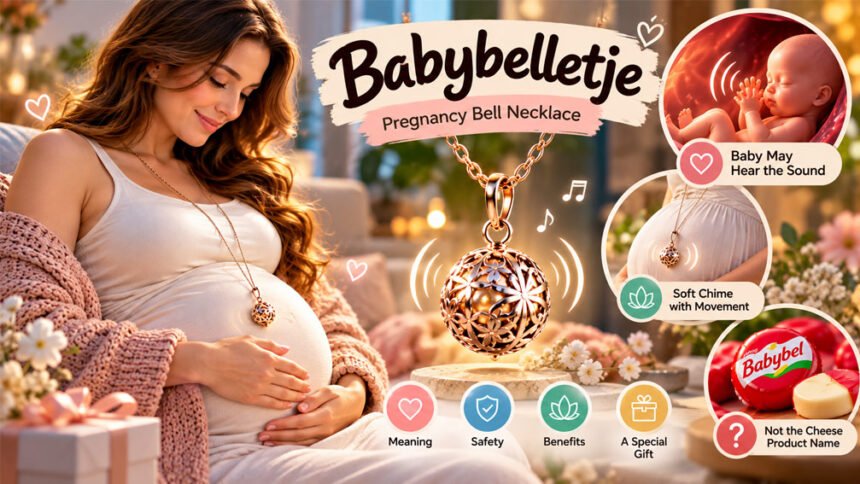
Babybelletje is a long pregnancy necklace with a small pendant that makes a soft sound. The pendant usually hangs over the baby bump and makes a gentle chime when the person moves.
It is also called a pregnancy bell, pregnancy bola, harmony ball, or baby bell. Some people wear it during pregnancy as jewelry, while others use it as a personal symbol or keepsake.
The word can be confusing because it also looks similar to Mini Babybel cheese. This guide explains what Babybelletje means, how it works, its possible benefits, and important safety facts.
What Is a Babybelletje?
A Babybelletje is a long necklace mainly worn during pregnancy. It has a small pendant that makes a soft ringing sound when it moves.
The necklace is usually long enough for the pendant to rest near the lower part of the baby bump.
A small moving part inside the pendant creates the sound. Walking and normal body movement are usually enough to make it chime.
Similar jewelry may be called a pregnancy bell, pregnancy bola, harmony ball, baby bell, or angel caller. In Dutch, zwangerschapsketting means pregnancy necklace.
Not every necklace is the same. The material, size, weight, sound, and design can be different.
What Does Babybelletje Mean?
The name has a Dutch connection.
The Dutch word bel means “bell.” Belletje is a smaller or friendlier form of the word and can mean “little bell.”
These smaller word forms are common in Dutch. They can describe something small or make a word sound friendly and familiar.
For example, huis means house, while huisje means little house. Boek means book, while boekje can mean a small book or booklet.
However, Babybelletje itself should not automatically be treated as an official Dutch dictionary word. Its meaning can change depending on where and how it is used.
Is Babybelletje Related to Babybel Cheese?
Babybelletje can easily be confused with Babybel cheese because the names look similar.
Babybel is a cheese brand. Mini Babybel is the official name used for its small, individually packed cheese snacks.
Babybelletje is not shown as an official Mini Babybel product name in the information we collected. However, some websites and people may use the word informally when talking about Mini Babybel.
Context is important. If the word appears in a discussion about pregnancy, jewelry, or a chiming pendant, it probably means pregnancy jewelry.
If it appears in a discussion about food or lunchboxes, it may be an informal reference to Mini Babybel cheese.
Babybelletje, Pregnancy Bola, and Harmony Ball
Several names are used for similar types of pregnancy jewelry.
A Babybelletje usually means a pregnancy necklace with a small chiming pendant.
A pregnancy bola is normally a long necklace with a ball-shaped pendant that makes a soft sound.
A harmony ball is a chiming pendant that may or may not be made specifically for pregnancy.
Zwangerschapsketting is the Dutch term for a pregnancy necklace. It does not always mean that the necklace has a bell inside.
Some sellers also use the name angel caller. This name can have spiritual or symbolic meanings. Claims that these necklaces give medical or physical protection are not proven.
When choosing one, look at the material, size, weight, sound, and quality instead of relying only on the product name.
How Does a Babybelletje Work?
A Babybelletje has a simple design.
There is a small moving part inside the pendant. When the person walks or moves, this part moves inside the pendant and creates a gentle ringing sound.
Some pendants contain a small ball inside a metal shell. Others have the chiming part inside a decorative outer case.
Normal movement is enough to make the sound. There is no need to shake the pendant against the stomach.
Some people also use the sound as a reminder to slow down, breathe, or pay attention to their pregnancy. This is a personal routine, not a medical treatment.
Can a Baby Hear a Babybelletje in the Womb?
A baby’s hearing develops slowly during pregnancy.
The information we collected says that the ears are developed by about 20 weeks. Babies may begin responding to sounds at around 24 weeks.
However, sounds outside the body do not reach the baby as clearly as they sound outside. They have to travel through the mother’s body and are softer and more muffled by the time they reach the womb.
How much of the Babybelletje sound reaches the baby may depend on its volume, pitch, position, clothing, body tissue, and stage of pregnancy.
Lower sounds usually travel through the body better than high sounds. This means a small, high-pitched chime may be harder for the baby to hear.
Research shows that unborn babies can respond to sounds. Some repeated sounds may also become familiar.
However, this does not prove that every baby can clearly hear or remember the sound of a Babybelletje.
There is also no strong proof that the pendant improves intelligence, hearing, sleep, or development.
When Can You Start Wearing a Babybelletje?
There is no medical rule about when to start wearing a Babybelletje.
Some people wear one early in pregnancy. Others start around 20 to 24 weeks, when the baby’s hearing is developing more.
The most important thing is comfort.
As the baby bump grows, the necklace can be adjusted so the pendant hangs comfortably without pulling on the neck.
Normal daily movement is enough to make it chime. Shaking the pendant against the stomach has no proven benefit.
Why Do People Wear a Babybelletje?
People wear a Babybelletje for different personal reasons.
Some use it as a small pregnancy routine. Hearing the chime may remind them to pause, touch their bump, or notice the baby’s movements.
Others simply like the necklace and its design. Pendants may include hearts, stars, moons, flowers, trees, wings, birthstones, or initials.
A Babybelletje can also become a keepsake. After pregnancy, it can be stored in a memory box or worn as normal jewelry.
It is also sometimes given as a maternity or baby-shower gift.
Babybelletje Benefits: What Is Actually Proven?
The possible benefits of a Babybelletje should not be confused with medical benefits.
Its main benefits are personal. It can be a pregnancy keepsake, a piece of jewelry, a personal symbol, or a reminder to slow down and enjoy quiet moments.
Research shows that unborn babies can respond to some sounds. However, this does not prove that a pregnancy bell gives health or development benefits.
Possible Personal Benefits
A Babybelletje may help create a simple pregnancy routine.
The sound can remind the wearer to pause or notice the baby’s movements. The necklace may also have personal meaning connected with love, family, or pregnancy.
After pregnancy, it can be kept as a memory.
What Has Not Been Proven
There is no strong evidence that a Babybelletje:
- makes a baby more intelligent;
- improves the baby’s development;
- improves hearing or sleep;
- always calms a newborn;
- guarantees that the baby remembers the bell;
- makes the baby move toward the sound; or
- controls the baby’s position in the womb.
These claims should not be treated as proven medical benefits.
Symbolism and Traditional Claims
Babybelletje pendants can have many designs. Common symbols include hearts, stars, moons, flowers, trees, wings, birthstones, and initials.
People may connect these designs with love, family, protection, or their unborn baby.
Some websites also connect pregnancy bells with Mayan, Indonesian, Balinese, Celtic, or other traditions.
However, many of these historical claims are not well documented. They should not be presented as confirmed history without reliable evidence.
The same is true for claims that certain metals or symbols physically protect the mother or baby. These ideas may have personal, cultural, or spiritual meaning, but they are not proven medical effects.
Is a Babybelletje Safe During Pregnancy?
For most adults, a well-made Babybelletje is usually a low-risk piece of jewelry.
Check the chain, cord, clasp, pendant, and connecting parts. They should be strong and secure.
A heavy pendant may become uncomfortable. Long necklaces can also catch on handles, clothing, exercise equipment, or other objects.
People with sensitive skin should check what metal the necklace contains. Nickel and some other metals can cause skin reactions.
Do not depend only on words such as “hypoallergenic.” Check the actual materials when possible.
A Babybelletje is jewelry, not a medical device. It should never replace pregnancy checkups, scans, advice about baby movement, or other medical care.
Can a Babybelletje Cause Breech Position?
There is no good evidence that a Babybelletje causes a baby to become breech.
Babies naturally change position during pregnancy for many reasons.
There is also no good evidence that a baby will follow the sound of the bell inside the womb. Moving the necklace higher or lower should not be used as a way to change the baby’s position.
If you are worried about your baby’s position, speak with a qualified maternity professional.
Aromatherapy Babybelletje: What to Know
Some Babybelletje necklaces also have a place for essential oils. They may contain a small pad, stone, or insert that holds the scent.
Extra care is needed during pregnancy.
An essential oil being “natural” does not automatically mean it is safe during pregnancy. Safety can depend on the type of oil, amount, strength, and how it is used.
Do not allow undiluted essential oil to leak from the pendant onto your skin.
Stop using the scented pendant if it causes nausea, headache, dizziness, breathing problems, or skin irritation.
If you are unsure whether an essential oil is safe during pregnancy, ask a doctor, midwife, or pharmacist before using it.
How to Choose a Good Babybelletje
Choose a necklace that is comfortable and well made.
Pregnancy necklaces are usually long. Some adjustable designs are around 100 to 120 cm. An adjustable necklace can be useful as the baby bump grows.
Check the pendant’s weight. It should be comfortable enough for regular use.
Look for smooth edges and secure connecting parts. Check the clasp, knots, rings, and pendant loop.
The seller should clearly state what materials are used. This is especially important if you have sensitive skin or a metal allergy.
It is also useful to check the necklace measurements, cleaning instructions, seller details, and return policy.
Common Babybelletje Materials
Babybelletje necklaces can be made from different materials.
Common examples include silver, stainless steel, brass, gold-plated metal, and textile cords.
Plated jewelry can lose its finish over time. Water, sweat, perfume, skin creams, and regular rubbing can damage the plating.
If you have a metal allergy, check the exact material before buying.
Textile cords can be soft and flexible. Metal chains may look different but should still have a strong clasp and secure connecting parts.
Choosing the Right Sound
The sound is an important part of a Babybelletje.
A louder sound is not always better. You may wear the necklace for several hours, so a very loud or sharp sound could become annoying.
If possible, listen to an audio or video sample before buying.
The real pendant may sound slightly different from a recording, but a sample can still help you decide whether you like the sound.
Choose a gentle sound that you find comfortable. There is no proof that a louder bell gives more benefits.
Using Babybelletje After Birth
You can continue wearing a Babybelletje after your baby is born.
Some parents wear it as normal adult jewelry. Others keep it as a memory of their pregnancy.
If you wear it while holding or feeding your baby, keep control of the necklace. Stop wearing it around the baby if the child starts grabbing, pulling, chewing, or becoming tangled in it.
You can also store the necklace in a memory box and keep it as a keepsake.
Can a Baby Wear a Babybelletje?
No. A Babybelletje should not be placed around a baby’s neck.
Long necklaces and cords can create a strangulation risk. Small pendant parts may also become choking hazards.
Do not attach the necklace to a baby’s sleepwear or leave it inside a cot. Keep it away from a sleeping or unsupervised baby.
A Babybelletje is adult jewelry. It should not be used as a baby toy or teething necklace.
How to Care for a Babybelletje
Good care can help the necklace last longer.
Remove it before showering or swimming. It is also a good idea to remove it before heavy exercise or sleep if it could become caught or tangled.
Keep it away from too much water, sweat, perfume, lotion, and cleaning chemicals.
Clean it gently with a soft, dry cloth. Follow the maker’s cleaning instructions if they are available.
Do not soak a sealed pendant unless the manufacturer says it is safe. Water could enter the pendant and damage the part that creates the sound.
Store the necklace in a dry place. Keeping it away from other jewelry can prevent scratches and tangled chains.
If the pendant becomes loose or suddenly sounds different, check it before wearing it again.
Common Babybelletje Myths
There are several claims about Babybelletje necklaces that are not supported by strong evidence.
One claim is that the necklace is scientifically proven to calm babies. Babies can respond to sounds before birth, but this does not prove that a Babybelletje will calm every newborn.
Another claim is that the bell makes the baby’s brain develop better or makes the child more intelligent. There is no good evidence for this.
There is also no proof that a baby follows the bell inside the womb or that the necklace can control the baby’s position.
Some sellers may say that certain symbols or metals provide physical protection during pregnancy. These ideas may have personal or spiritual meaning, but they are not proven medical benefits.
Babybelletje as a Pregnancy Gift
A Babybelletje can be given as a pregnancy or baby-shower gift.
The necklace is mainly for the pregnant person rather than the baby. It does not depend on the baby’s clothing size or the season.
Some necklaces can be personalized with initials, birthstones, hearts, stars, or other symbols.
If you give one as a gift, you can include a short note explaining its meaning and gentle sound. Avoid saying that it is guaranteed to calm the baby or provide health benefits.
Bottom Line
A Babybelletje is a long pregnancy necklace with a pendant that makes a gentle chiming sound. It may also be called a pregnancy bell, pregnancy bola, or harmony ball.
People mainly wear it as jewelry, a pregnancy symbol, a personal routine, or a keepsake.
Babies can respond to sounds during pregnancy, but this does not prove that a Babybelletje improves development, controls the baby’s position, or always calms a newborn.
If you want to wear one, choose a comfortable necklace made from clearly listed materials. Check that it is secure, not too heavy, and has a sound you like.
Babybelletje can also be confused with Mini Babybel cheese because the names look similar. Mini Babybel is the official name of the cheese snack. Babybelletje should not automatically be treated as another official Babybel cheese name.
Frequently Asked Questions
What is a Babybelletje?
A Babybelletje is a pregnancy necklace with a small pendant that makes a soft sound when you move.
What does Babybelletje mean in Dutch?
Belletje means “little bell” in Dutch. Babybelletje can have different meanings depending on the context.
From what week can a baby hear a Babybelletje?
A baby starts responding to sounds at around 24 weeks. However, it is not certain how clearly the baby can hear the pendant.
Does a Babybelletje really calm a newborn?
There is no strong proof that it calms newborns. Some babies may respond to familiar sounds.
Is a Babybelletje safe during pregnancy?
It is generally safe as adult jewelry. Make sure it is comfortable, secure, and made from suitable materials.
Can a Babybelletje cause a baby to become breech?
No evidence shows that a Babybelletje causes breech position or makes a baby follow its sound.
Can a baby wear a Babybelletje after birth?
No. Necklaces and small jewelry parts can cause choking or strangulation risks for babies.
Is Babybelletje another name for Mini Babybel cheese?
Not officially. Mini Babybel is a cheese product, while Babybelletje can refer to pregnancy jewelry.
More To Explore:
What Is Sruhl? Meaning, Pronunciation, Origin, and Family History