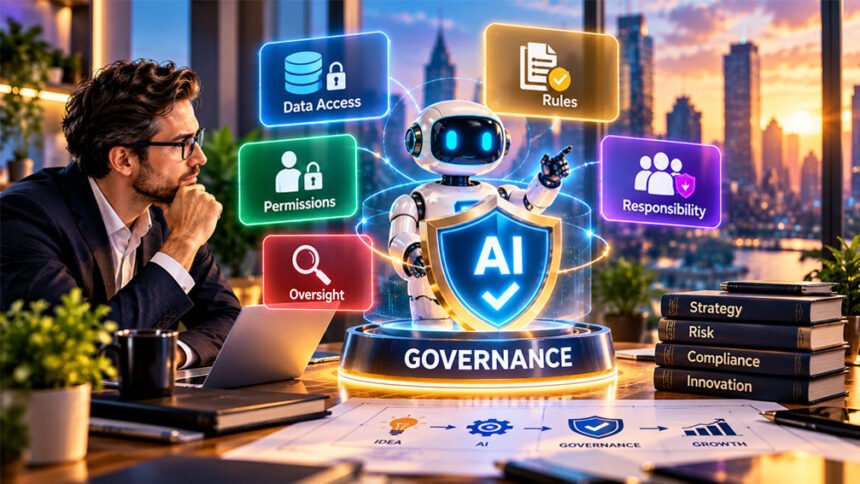
AI transformation is not only about choosing a better AI model or giving workers new AI tools. When a business starts using AI in daily work, it also needs clear rules.
Businesses need to decide what AI can access, what actions it can take, and who is responsible if something goes wrong.
This is why people say AI transformation is a problem of governance. AI can change how people work, how data is used, and how decisions are made. This guide explains AI governance, its main risks, and how businesses can manage AI safely and clearly.
What Does “AI Transformation Is a Problem of Governance” Mean?
The phrase means that using AI across a business creates management problems, not just technology problems.
Buying or using an AI model can be easy. The difficult questions often come when a company starts using it for real work.
Who can use the AI? What company data can it see? Can it contact customers? Can it make decisions? Can it take actions without asking a person first? Who is responsible if it makes a mistake?
These are all governance questions.
AI governance means the rules, responsibilities, and controls a business uses to manage AI.
Technology tells us what AI can do. Governance decides what AI is allowed to do.
The same AI model can also have very different uses. One worker may use AI to fix grammar in a presentation. Another business may connect AI to financial systems and use it to help find suspicious transactions.
The technology may be similar, but the risks are very different.
This means businesses should look at how AI is being used, what data it can access, what decisions it affects, and what could happen if it makes a mistake.
Governance is not the only part of AI transformation. AI projects can also fail because of poor data, weak planning, unsuitable technology, poor employee training, or bad business processes.
AI governance is one important part of successful AI transformation, but it does not solve every problem.
AI Adoption vs. AI Transformation
AI adoption and AI transformation are not exactly the same.
Using an AI chatbot to improve an email is simple AI adoption. Workers may also use AI to summarize documents, create ideas, translate text, study information, or help write code.
AI transformation goes further.
It happens when AI starts changing how a business works. AI may become part of customer service, research, sales, software development, administration, or financial work.
This can change employee roles, workflows, and how decisions are made.
The difference becomes more important when AI is connected to other business systems.
A simple chatbot may only see the information a worker gives it. A connected AI system may have access to company files, customer databases, emails, financial software, or other internal tools.
This can make AI more useful, but it also creates more risk.
A small AI test can usually be stopped quickly. An AI system used across important business processes may affect many workers, customers, records, and transactions.
This is why stronger AI use usually needs stronger controls.
Why Traditional IT Rules Are Not Enough
Traditional software usually follows fixed rules.
For example, payroll software processes payments using programmed instructions. A database stores and returns information. Accounting software performs calculations based on set rules.
Generative AI works differently.
Large language models do not always give exactly the same type of answer. Their responses can change based on the question, instructions, available information, context, or model version.
AI can give a useful answer in one situation and a wrong or unexpected answer in another.
AI systems can also change over time.
A provider may update its model. A company may connect the AI to new tools or information. Workers may start using it for tasks that were not planned at the beginning.
Because of this, approving an AI system once may not be enough.
Businesses need to keep checking how the AI is being used, what it can access, and whether its risks have changed.
Normal IT controls are still important. Businesses still need security checks, testing, access controls, and proper change management.
AI simply adds new risks that these existing systems also need to manage.
AI Agents Create New Governance Risks
AI agents create a bigger governance challenge because they can do more than give answers.
A normal AI assistant may write an email for you.
An AI agent may be able to find the right customer, collect information from a business system, write the email, send it, schedule a follow-up, and update the customer record.
The important difference is action.
An AI assistant may suggest giving a customer a refund. An AI agent connected to company systems may be able to issue that refund itself.
AI agents can have several important abilities.
Reasoning helps an agent decide what to do next.
Memory helps it remember useful information from earlier interactions.
Tools allow it to work with software, databases, files, APIs, browsers, and other systems.
Autonomy allows it to complete several steps without asking a person for approval every time.
These abilities can make AI agents very useful. They can also make mistakes more serious.
A business should decide what an AI agent can and cannot do.
Can it send emails? Can it delete records? Can it spend company money? Can it create accounts? Can it approve transactions? Can it publish information?
Businesses should also decide which actions always need human approval.
A wrong chatbot answer can often be corrected. A wrong action from an AI agent may affect customers, money, company data, or important business systems.
The more freedom an AI system has, the more important its rules and controls become.
Permissions May Matter More Than Prompts
People often focus on writing better prompts for AI.
Prompts are important, but permissions can become even more important when AI is able to take actions.
Businesses need to decide what an AI system is allowed to see, use, change, send, and decide.
For example, an AI agent may need access to a customer database. This does not mean it needs access to every customer record or every tool inside that database.
The same idea applies to money.
A company may allow an AI agent to make a small purchase but require human approval for a larger payment.
Businesses should decide:
- Which files and databases AI can access.
- Which tools and apps AI can use.
- Whether AI can contact people outside the company.
- Whether AI can change or delete information.
- Whether AI can make payments.
- Which decisions AI can make by itself.
- When AI must stop and ask a person for approval.
A useful rule is to give AI only the access it actually needs.
This also means a more intelligent AI model is not always more dangerous.
A powerful model with no access to important company systems may have limited ability to cause direct harm. A simpler AI agent with access to customer records, emails, money, and business software may create much bigger risks.
As AI agents become more independent, permissions will become an important part of AI governance.
Data Governance and Privacy
AI needs information to be useful.
For a business, this information may include emails, customer records, contracts, internal documents, product information, financial records, and company procedures.
Giving AI access to this information creates privacy and security risks.
Businesses need to know who owns the data, who can access it, and whether it is allowed to be used with AI.
They should also understand what happens when information is sent to an outside AI provider.
Is the information stored? How long is it kept? Can the provider use it to train AI models?
The answers can be different depending on the AI provider, product, account, settings, and contract.
Businesses should therefore check the actual privacy rules of the AI services they use.
Another important question is how much access an AI agent should receive.
A worker may have access to several company systems because their job requires it. Giving an AI agent all of those permissions at once may create extra risk.
AI can also bring together information from different systems. This can create privacy, security, legal, and intellectual property concerns.
AI transformation can also expose old data problems.
Poor access controls become more serious when AI can search thousands of files quickly. Poorly managed private information becomes more risky when workers connect it to new AI tools.
AI may not have created these problems. It can simply make them easier to see.
For this reason, businesses need clear rules about which AI tools are approved, what data they can use, how information is stored, and what information should never be shared with AI.
Shadow AI and AI Sprawl
Shadow AI happens when workers use AI tools without clear approval from their company.
This can happen easily. Many AI tools are cheap and simple to use. A worker can create an account or connect an AI tool to company files without telling IT, security, or legal teams.
When many teams do this, a business can develop AI sprawl.
This means AI models, accounts, agents, and integrations become spread across the company without one clear view of them.
The business may then lose track of what data is being shared, how much AI costs, what permissions have been given, and what security risks exist.
An AI inventory can help.
For each important AI system, the business can record its purpose, owner, provider, data access, permissions, risk level, and review date.
The goal is not to create unnecessary paperwork. The goal is simply to know where important AI systems are being used.
Who Is Responsible for AI Decisions?
Responsibility can become confusing when many people are involved in one AI system.
An AI company may provide the model. A cloud company may host it. IT may control access. A data team may connect company information. A business team may decide how the AI is used.
Legal and security teams may also create rules.
If something goes wrong, responsibility can become unclear.
This is why every important AI system should have a clear owner.
The owner does not need to build the AI personally. They should simply be responsible for its business purpose, risks, controls, monitoring, and continued use.
Using an outside AI provider does not remove a company’s own responsibility.
The provider does not control every way a business uses its AI. The business decides what information the system can access and what work it can perform.
Businesses therefore need to understand which risks they control and which responsibilities belong to their AI providers.
Saying “the AI did it” is not enough when something goes wrong. A business should know who approved the system, who gave it permission, and who is responsible for its use.
Guardrails Are Not the Same as Governance
AI guardrails are controls that limit what an AI system can do.
They can block certain actions, protect sensitive information, limit access to tools, set spending limits, or require human approval.
Guardrails are useful, but they are only one part of AI governance.
For example, a business may allow an AI purchasing agent to approve small purchases.
A technical guardrail can stop the AI from spending above the set amount.
Governance answers the wider questions.
Who decided the spending limit? Why was that amount chosen? Who checks it? What happens if the AI behaves strangely?
Good AI governance includes several parts.
Policies explain how AI may be used. Permissions decide what AI can access. Guardrails limit certain actions. Monitoring shows what AI actually does.
Businesses also need testing, clear steps for dealing with problems, and someone who is responsible when something goes wrong.
Guardrails enforce limits. Governance decides what those limits should be.
Human Oversight Must Be Meaningful
Many businesses keep a human “in the loop” to reduce AI risks.
This means a person checks or approves an AI decision.
However, simply adding an approval button is not enough.
A worker may be able to carefully check 20 AI recommendations. Checking 20,000 recommendations is very different.
If people become used to the AI being correct, they may start approving its decisions without checking them properly.
There are different ways humans can control AI.
A human in the loop approves actions before they happen.
A human on the loop watches automated actions and steps in when needed.
A human over the loop creates rules and limits while AI works inside those limits.
The right approach depends on how serious the possible risks are.
The person reviewing AI also needs enough time, information, knowledge, and authority to question its decision.
Human oversight only works when a person can actually stop or change the result.
Traceability, Logging, and AI Audits
Businesses should be able to understand how important AI decisions were made.
For example, imagine an AI agent rejects a customer’s request.
The business may need to know what information the AI received, which model was used, what instructions it had, which tools it accessed, what answer it produced, and whether a person reviewed it.
Without records, finding this information may be difficult.
AI logs can record important details such as the model version, instructions, inputs, tool use, outputs, human approvals, and final actions.
This becomes especially important with AI agents because one action may involve several systems.
For example, an AI process could move from a user to an AI agent, then to a model, database, outside service, human reviewer, and finally a business action.
Not every simple AI task needs detailed records.
Higher-risk systems usually need better records because mistakes can have bigger effects.
Good records can help businesses investigate mistakes, customer complaints, security problems, and other failures.
Managing AI Based on Risk
Not every AI system needs the same rules.
Using AI to fix grammar in an internal email is very different from using AI to screen job applicants or help make financial decisions.
Businesses can therefore group AI systems by risk.
A low-risk AI tool may only need simple usage and data rules.
A medium-risk system may need an owner, logs, testing, and stronger access controls.
A high-risk system may need detailed testing, legal review, strict monitoring, human approval, and a clear way to challenge or change decisions.
The exact system can be different for every business.
The important point is to use stronger controls when a mistake could cause more harm.
Businesses can ask:
- How important is the decision?
- Who could be affected?
- What information does the AI use?
- What decisions can it make?
- How independently can it work?
- How many people could it affect?
- Can a mistake easily be fixed?
This approach keeps simple AI tasks simple while giving more attention to important or risky uses.
AI Governance Laws, Standards, and Frameworks
Businesses can use existing AI frameworks to help create their own rules.
The NIST AI Risk Management Framework (AI RMF) organizes AI risk management around four main areas: Govern, Map, Measure, and Manage.
It treats AI risk management as an ongoing process rather than something businesses only do before launching a system.
The OECD AI Principles also cover areas such as accountability, transparency, safety, human-centered values, and risk management.
The EU AI Act uses a risk-based approach. Different requirements apply to different types and uses of AI. Some higher-risk AI systems face stronger requirements.
AI laws are not the same in every country.
Rules around privacy, safety, transparency, and responsibility can differ depending on where a company operates and how AI is being used.
Businesses should therefore check the rules that apply to their country, industry, and AI use case.
General AI governance guidance can help businesses organize their work, but it does not replace professional legal advice when specific laws apply.
Does AI Governance Slow Innovation?
Bad governance can slow AI adoption.
If workers need a long approval process for every small AI experiment, they may stop trying useful ideas.
But having no clear rules can also create delays.
A company may start an AI project quickly and later discover privacy, security, or legal problems. The project may then need to be stopped or changed.
Good governance tries to avoid both problems.
Simple and low-risk AI uses can have simple rules. More serious uses can have stronger checks.
Clear rules can also help workers because they know what they are allowed to do.
The goal should be useful control, not unnecessary paperwork.
How Businesses Can Build an AI Governance Framework
Businesses do not need to prepare for every possible future AI development before creating useful rules.
They can start with a few practical steps.
Create an AI inventory. Keep a record of important AI models, agents, apps, providers, and integrations being used.
Classify AI by risk. Separate simple AI tools from systems that can affect customers, money, jobs, health, safety, or important decisions.
Assign an owner. Make one person or business team responsible for each important AI system.
Set data rules. Decide what information can and cannot be used with AI.
Limit permissions. Give AI only the data, tools, and authority it needs.
Set decision rights. Make it clear which decisions need approval from business, security, legal, compliance, or leadership teams.
Keep human control. Important decisions should have human oversight when the risk is high.
Keep useful logs. Record important AI actions so problems can be investigated later.
Test AI before use. Check its performance, privacy, security, and possible failures.
Monitor AI after launch. Watch for errors, unusual behavior, rising costs, complaints, and changes in performance.
Check AI providers. Review outside AI services for privacy, security, legal, and business risks.
Prepare for problems. Have a clear way to stop an AI system and investigate serious failures.
Review regularly. Check AI again when models, data, permissions, providers, uses, or laws change.
These steps make AI governance part of normal business work instead of only a written policy.
Why AI Governance Is an Ongoing Process
AI systems can change after a business starts using them.
Providers update their models. New features are added. Businesses connect new tools and data. Workers find new ways to use AI.
An AI agent may also receive more permissions over time.
This means a system that was low risk when it started may become more important later.
Businesses should therefore review AI systems regularly.
They should check whether the model, purpose, data, permissions, users, or risks have changed.
AI governance is similar to cybersecurity in this way.
A company does not check cybersecurity once and forget about it. Security controls need to be checked and updated as systems and risks change.
AI governance also needs regular attention.
The Role of Leaders and Boards
AI governance should not be handled only by IT teams.
AI can affect hiring, customer service, financial decisions, privacy, cybersecurity, contracts, company information, and daily operations.
Different teams understand different risks.
Technical teams understand how the system works. Security teams understand access and cybersecurity risks. Legal and compliance teams understand rules and legal duties.
Business teams understand how the work is actually done. Employees can also notice problems during everyday use.
Leadership needs to bring these groups together and make sure responsibilities are clear.
Business leaders do not need to understand every technical detail about how an AI model works.
They do need to understand what the AI can do, how independently it can work, what information it can access, what decisions it can make, and how many people it may affect.
Leaders should also know who owns the AI system, whether mistakes can be fixed, what controls exist, and what happens when something goes wrong.
This allows leaders to manage AI as a business issue, not only a technology issue.
Bottom Line
The idea that AI transformation is a problem of governance does not mean technology is unimportant.
Businesses still need good AI models, useful data, suitable systems, trained workers, and clear goals.
But better technology alone cannot answer questions about control and responsibility.
As AI becomes connected to company data, business tools, customers, money, and important decisions, businesses need clear rules.
They need to know who owns each system, what AI can access, what decisions it can make, when humans need to step in, and who is responsible if something goes wrong.
This becomes even more important with AI agents because they can take actions instead of only giving answers.
AI technology decides what a system can do. AI governance decides what it is allowed to do and who is responsible for the results.
Frequently Asked Questions
What does “AI transformation is a problem of governance” mean?
It means businesses need clear rules about what AI can do, what it can access, and who is responsible for it.
What is AI governance?
AI governance means the rules and controls for using AI safely and responsibly in a business.
Why is AI governance important for businesses?
It helps businesses protect data, control AI actions, reduce risks, and make responsibilities clear.
What is the difference between AI governance and AI guardrails?
AI guardrails limit specific AI actions. AI governance covers the wider rules, permissions, monitoring, and responsibility.
Do small businesses need AI governance?
Yes. Even small businesses should have simple rules for which AI tools and company data workers can use.
Who should be responsible for an AI system?
Each important AI system should have a clear owner who is responsible for how it is used and managed.
Can AI governance slow innovation?
Too many rules can slow AI use, but simple and clear rules can help businesses use AI safely and with fewer problems.
How often should businesses review AI systems?
Businesses should review AI regularly, especially when its model, data, permissions, tools, or purpose changes.
More To Explore:
Eractoll Guide: How to Check, Dispute, and Avoid Toll Charges