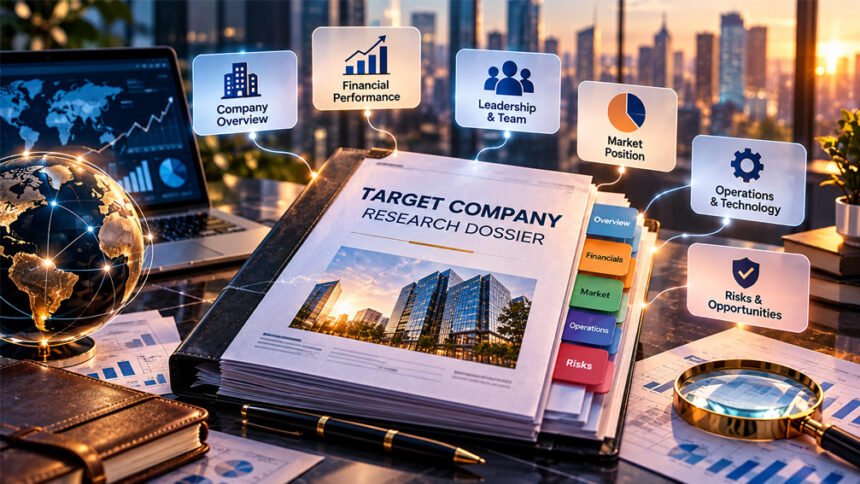
A research dossier for target company is a detailed report about a business. It collects important information about the company in one place.
People may create this report before investing in a company, buying a business, choosing a supplier, starting a partnership, or researching a competitor. It can also help job seekers learn more about a company before joining it.
This guide explains what a research dossier is, what information it should include, and how to create one using reliable sources.
What Is a Research Dossier for Target Company?
A research dossier for target company is an organized report about a business. It collects important facts and explains what those facts mean.
Here, target company simply means the company being researched. It does not always mean Target Corporation.
The report may include information about the company’s ownership, products, customers, leaders, finances, competitors, technology, operations, and legal matters.
A good dossier does more than collect facts. It helps the reader understand the full picture.
For example, a company may have growing sales. This may look positive. But if its debt is also growing or most of its sales come from one customer, there may be more risk.
The report should also show when information cannot be confirmed. This helps the reader know what still needs to be checked.
Research Dossier vs. Company Profile vs. Due Diligence
A company profile gives basic information about a business. It may cover its history, products, locations, and leadership.
A research dossier goes deeper. It looks at finances, competitors, customers, risks, and other important areas. It also explains what the information may mean for a business decision.
Due diligence is usually a deeper check. It is often done before an investment, acquisition, or major business deal.
Due diligence may include private financial records, contracts, tax information, legal documents, and technical checks.
A research dossier based only on public information has limits. It cannot confirm private information that the researcher cannot access.
Why Create a Research Dossier?
The main purpose of a research dossier is to help people make better decisions.
An investor may use one to check a company’s financial health and growth potential.
A buyer may use it before buying a company. They may want to check ownership, debt, contracts, customers, legal issues, and operating costs.
A supplier may want to know whether the company is financially stable and able to pay its bills.
A business may also research a competitor. It can study the competitor’s products, prices, customers, market reach, strengths, and weaknesses.
Job seekers can use company research too. They may check the company’s financial position, leadership, recent changes, and future plans before accepting a job.
A research dossier also shows what is still unknown.
For example, a private company may not publish its profits. This does not mean the company is making or losing money. It simply means there is not enough confirmed information.
Start With a Clear Research Goal
Before starting your research, decide what you want to learn.
A report for an investor may focus on revenue, profit, debt, market growth, and company value.
A supplier may care more about payment risk, demand, operations, and financial stability.
It can help to write one main question before starting. For example:
“Should we consider this company for a long-term supply agreement?”
This question helps you focus on useful information.
You should also decide who will read the report, which market or country it covers, and when the research will end.
Add a research cutoff date. This tells readers how current the information is.
It is also useful to write down the main questions you want to answer. This keeps the research focused and avoids collecting information that does not help with the final decision.
Company Identity, Ownership, and History
Start by confirming which company you are researching.
Find the company’s legal name. A brand name may be different from the official registered company name.
Large businesses may also have several companies or subsidiaries under one group.
Where available, check the registration number, country or state of registration, headquarters, official website, trading names, parent company, and subsidiaries.
Ownership is also important. Look for founders, parent companies, major shareholders, investors, or other important owners.
Do not rely only on the company name. Two businesses can have similar names, while one brand may operate through several legal companies.
Company history can also provide useful information.
Look at important events such as when the company started, major funding rounds, new products, acquisitions, business changes, expansion into new countries, and leadership changes.
There is no need to include every small event. Focus on events that help explain the company today.
Business Model, Products, and Customers
A research dossier should clearly explain what the company does and how it makes money.
Start with its main products and services. Explain what the company sells, who buys it, and what problem it solves.
Next, look at how the company earns money.
It may earn money from product sales, subscriptions, advertising, licensing, transaction fees, service charges, marketplace fees, or several sources.
Also check whether the income is recurring or comes from one-time purchases.
Pricing can provide useful information too. Customers may pay monthly, yearly, per transaction, per project, or through long-term contracts.
The report should also explain who the company’s main customers are and where they are located.
Customer concentration is important. If most of the company’s money comes from only one or two customers, losing one of them could cause problems.
Also look at why customers choose the company. Price, quality, technology, service, convenience, and contract terms may all matter.
The goal is not to list every product feature. It is more useful to understand what customers buy, why they buy it, and whether they are likely to keep buying it.
Leadership, Employees, and Governance
Leadership can have a major effect on a company.
Check the founders, CEO, senior executives, and important board members.
Look at their current jobs, useful experience, and how long they have been with the company.
Always check the date of the information. An old article may name someone as CEO even though that person has already left.
Major leadership changes can also be important. Several senior leaders leaving in a short period may be worth checking further.
Governance looks at how the company is managed and controlled. This may include board oversight, succession plans, and how much the company depends on one founder or leader.
Employee information can also help show the size of the business.
You may check employee numbers, departments, hiring activity, and staff turnover when reliable information is available.
Be careful with employee estimates. Some sources may include contractors, while others count only full-time employees.
Employee review websites can provide useful clues, but a few reviews do not prove what working conditions are like across the whole company.
Financial Performance and Financial Health
Financial information helps show how well a company is performing.
When possible, look at several years or reporting periods instead of checking only one number.
Useful financial information may include revenue, gross profit, profit margins, operating costs, net profit or loss, cash flow, cash reserves, and debt.
Revenue growth shows whether sales are increasing. But higher sales do not always mean the company is financially healthy.
Costs may be rising faster than revenue. Debt may also be growing, or the company may have limited cash.
Profit margins can help show how much money remains after costs.
Cash flow is also important. A company can report a profit but still have problems if it does not have enough cash available to pay its bills.
Other useful information may include customer acquisition cost (CAC), customer lifetime value (CLV), customer retention, and how much revenue comes from the company’s largest customers.
These figures are not available for every company.
Funding is especially important when researching startups. A company may announce that it raised millions of dollars, but this does not tell you how much money it still has.
Always check where financial numbers come from.
An audited financial statement is different from a number estimated by a third-party website. Estimates should always be clearly described as estimates.
Market Position and Competitor Analysis
A company should also be studied within its market.
Start by understanding the market it actually serves. A company may be strong in one small area without being a major company across the whole industry.
Useful information may include market size, customer demand, industry trends, and the areas or countries where the company operates.
Next, identify the main competitors.
Compare useful areas such as products, prices, services, delivery times, customer groups, and market reach.
Indirect competitors can matter too. Customers may use another type of product, do the work themselves, or decide they do not need the product at all.
Also look at what may give the company an advantage.
This could include better technology, a strong brand, loyal customers, important partnerships, lower costs, useful patents, or better service.
Some companies describe these strengths as a competitive moat. This means the business has an advantage that may be difficult for competitors to copy.
Do not assume that a company has a strong advantage simply because it says so.
Claims such as “market leader,” “number one,” or “fastest growing” should be checked. If there is no independent evidence, describe them as company claims.
Operations, Technology, and Intellectual Property
A research dossier should explain how the company runs its business.
This may include production, suppliers, supply chains, vendors, distribution, and other daily operations.
Check whether the company depends heavily on one supplier, manufacturer, technology platform, or distribution partner.
This can create risk. If that provider has a problem, the company may also face problems.
Scalability is another useful area to check. This means whether the business can handle more customers or orders as it grows.
For technology companies, look at software, digital systems, automation, research and development, cybersecurity, and data protection.
Intellectual property may include patents, trademarks, copyrighted work, software, and other technology.
Check who owns important technology when possible.
A company may use software created by another company or contractor. Using technology does not always mean the company owns it.
Business continuity plans may also be important. These explain how the company may continue operating after a cyberattack, system failure, supplier problem, or other disruption.
Legal and Regulatory Checks
Legal checks can help find problems that may affect the company.
Start by confirming the company’s official registration.
Some businesses also need special licenses or government approvals. The requirements depend on the industry and country.
Other useful checks may include lawsuits, regulations, trademarks, patents, contracts, and other legal duties.
Deeper due diligence may also include employment contracts, customer agreements, supplier agreements, and ownership documents.
Be careful when describing legal findings.
If you cannot find a lawsuit in one database, this does not prove that the company has never faced legal action.
It is better to explain which records were checked and when they were checked.
Laws can also be complicated and different in each country. Important legal questions may need help from a qualified lawyer or another professional.
Risks, Weaknesses, and Growth Opportunities
Every company has some risks.
Financial risks may include high debt, low cash, falling sales, weak profit margins, or continued losses.
Operational risks may include supplier problems, staff shortages, production problems, or technology failures.
Market risks may include new competitors, falling demand, or changes in what customers want.
Other risks may include lawsuits, new regulations, cybersecurity problems, old technology, or dependence on one important customer or leader.
Do not present a possible risk as a confirmed problem.
For example, a company that depends on one large customer has customer concentration risk. This does not mean that customer will leave.
A research dossier can also look at possible growth opportunities.
These may include entering new countries, finding new customers, launching products, improving technology, or creating new partnerships.
However, an opportunity is not a guaranteed result.
If a company announces plans to enter a new country, this is still a plan until the expansion actually happens.
Where to Find Reliable Company Information
Good sources are important when creating a research dossier.
Start with official records when possible.
Useful sources may include government business registers, financial statements, annual reports, regulatory filings, court records, and patent or trademark databases.
Public companies often provide more information than private companies.
In the United States, public company filings are available through the Securities and Exchange Commission’s EDGAR system.
In the UK, Companies House provides information about registered companies, directors, accounts, filing history, and other company details.
A company’s official website can also provide information about products, leaders, locations, and company announcements.
However, remember that the company controls the information on its own website. Important claims may need to be checked with other sources.
Reliable news reports, industry publications, and market research can provide more information.
Always check the date of the source. Even accurate information can become outdated.
How to Research a Private Company
Private companies can be harder to research because they may not publish detailed financial information.
Start with information you can confirm.
This may include company registration, directors, official websites, products, trademarks, patents, and public announcements.
Reliable news reports and industry sources may provide more details.
Business databases and professional profiles can also help, but their numbers may be estimates.
If possible, ask the company for important documents. These may include financial statements, debt information, major contracts, and customer information.
Interviews can also help.
Ask clear and specific questions. Record who answered the questions, their job, the date of the interview, and whether they provided documents to support their answers.
If you cannot confirm the company’s revenue or profit, say so.
Website traffic, hiring activity, and estimated employee numbers may provide clues about the business, but they do not prove how much money the company makes.
How to Verify Information and Handle Conflicting Sources
Keep confirmed facts, company claims, third-party reports, and estimates separate.
An evidence register can help with this.
For every important claim, record the source, date, period covered, and company involved.
Also note what type of information it is.
Sometimes two sources give different numbers.
For example, one source may say a company earned $8 million in revenue while another says $11 million.
First, check whether both numbers cover the same year, currency, company, and financial measure.
One number may cover the full company group, while another may cover only one part of the business. One may also be an estimate.
Do not simply average the two numbers.
Use the number supported by stronger evidence. If you cannot find the correct figure, explain that the information conflicts.
How to Analyze the Information
After collecting the information, look at what it actually means.
Do not study numbers alone. Look for patterns and changes.
If revenue is growing, ask why. The company may have gained more customers, increased prices, bought another company, or entered a new market.
Look at profit margins too.
Sales may rise while profit margins fall. This can show that growth is becoming more expensive, but you still need evidence to understand the reason.
Customer concentration can also change the picture. Strong sales may carry more risk if most of the money comes from one customer.
Compare similar financial periods. This is especially important for seasonal businesses.
A SWOT analysis can sometimes help. It groups findings into strengths, weaknesses, opportunities, and threats.
For investment or acquisition research, company valuation may also be useful.
Valuation can use revenue, earnings, or comparisons with similar companies. These methods depend on assumptions, so an estimated value should not be treated as an exact number.
Create a Risk and Unanswered-Questions List
Keep missing information separate from confirmed problems.
For example, if you cannot confirm whether a private company is profitable, this does not mean it is losing money. Profitability is simply unknown.
Create a list of important questions that still need answers.
These questions may include how much debt the company has, whether it owns its main technology, how much revenue comes from its biggest customer, or whether an important contract will be renewed.
Focus on questions that could change the final decision.
For each major risk, explain what evidence supports it, what effect it could have, and what should be checked next.
This makes missing information easier to manage.
How to Create the Final Research Dossier
Once the research is complete, organize the information clearly.
Start with an executive summary. It should briefly explain why the company was researched, what it does, the main findings, important risks, and major unanswered questions.
Next, explain the scope of the research. Include the cutoff date and any important limits.
The main report can then cover company identity, ownership, business model, leadership, finances, operations, technology, competitors, market position, and legal issues.
Keep risks and unanswered questions easy to find.
The final assessment should answer the main question that started the research.
For example, the result may be to continue with an investment, ask for more information, wait for new evidence, or stop the process.
Keep important sources, calculations, and documents with the report.
It is often better to write the executive summary last. This allows you to base it on the most important findings from the completed research.
Common Mistakes to Avoid
One common mistake is using weak sources for important information.
Use official records when they are available. Do not use a third-party estimate instead of an official financial figure without a good reason.
Another mistake is treating company marketing claims as confirmed facts.
Claims about growth, market position, products, or technology should be checked when possible.
Do not focus only on revenue. Profit, cash flow, debt, costs, and customer concentration can also be important.
Make sure you are researching the correct legal company. Information about a parent company may not apply to one of its subsidiaries.
Also check dates. Leadership, ownership, products, finances, and regulations can change.
Do not ignore competitors, customer dependence, supplier dependence, legal problems, or missing information.
AI tools can help organize research, but their answers should still be checked against the original sources.
Keeping a Research Dossier Up to Date
A research dossier does not stay current forever.
Always include a research cutoff date.
Review important information before using the report for a major decision.
Update it after important changes such as new financial results, funding, acquisitions, leadership changes, major contracts, lawsuits, or new regulations.
How often you update it depends on the company and industry.
A fast-changing technology company may need more regular updates than a company in a stable industry.
Focus on changes that could affect the final decision.
Bottom Line
A research dossier for target company helps people understand a business before making an important decision.
It can cover ownership, products, customers, leadership, finances, competitors, operations, technology, legal issues, and risks.
A good dossier also explains what is not known.
Keep confirmed facts separate from company claims and estimates. Use reliable sources and clearly explain information that cannot be verified.
The goal is not to collect as much information as possible. The goal is to collect the right information and use it to make a better decision.
Frequently Asked Questions
What is a research dossier for target company?
It is a report with important information about a company. It helps people understand the business before making a decision.
What should a target company research dossier include?
It may include the company’s ownership, products, leaders, finances, competitors, risks, and other important details.
What is the difference between a company profile and a research dossier?
A company profile gives basic details. A research dossier gives deeper information about the company, its performance, and possible risks.
Is a research dossier the same as due diligence?
No. Due diligence is usually a deeper check that may include private financial, legal, and business records.
Where can you find reliable information about a company?
You can check official company records, government databases, financial reports, regulatory filings, and trusted news sources.
Can you create a research dossier for a private company?
Yes. However, some financial and business information about private companies may not be publicly available.
How long should a company research dossier be?
There is no fixed length. It should be long enough to cover the important information without adding unnecessary details.
How often should a company research dossier be updated?
Update it when important company information changes or before using it to make a major decision.
More To Explore:
785 Area Code Guide: Coverage, History, Dialing, and Kansas Cities